Riverbank Protection and Irrigation Stability Using Ocean Non Woven Geobag (PP) 300 GSM in Howrah, West Bengal
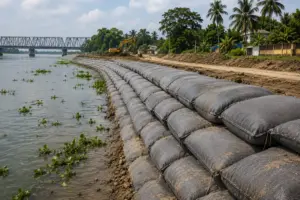
Riverbank erosion has become one of the most serious environmental and infrastructure-related challenges across eastern India. At the Irrigation Project in Howrah, West Bengal, Ocean Non Wovens supplied 27,000 Nos. of Ocean Non Woven Geobag (PP) 300 GSM for erosion control and embankment stabilization applications.
Regions exposed to heavy rainfall, fluctuating river discharge, tidal influence, and soft alluvial soil conditions often experience progressive embankment failure and land loss. In states like West Bengal, where irrigation infrastructure plays a critical role in agriculture and regional water management, maintaining stable embankments is essential for both environmental protection and agricultural sustainability.
Traditional erosion protection methods such as stone pitching and concrete structures are still widely used, but they often involve high transportation costs, difficult installation processes, and long construction timelines. In many locations, rigid protection systems also struggle to adapt to changing hydraulic conditions and natural ground movement.
To improve erosion resistance and irrigation infrastructure stability, modern hydraulic engineering projects increasingly rely on geosynthetic solutions such as geobags and geotextiles.
The project highlighted the growing importance of geosynthetics in river engineering and demonstrated how flexible protection systems can improve both structural durability and environmental adaptability.
Project Overview
- Project Type: Irrigation and Riverbank Protection Project
- Location: Howrah, West Bengal
- Product Used: Ocean Non Woven Geobag (PP) 300 GSM
- Quantity: 27,000 Nos.
- Application Area: Erosion control and embankment stabilization
The project required a durable erosion protection system capable of performing under fluctuating hydraulic conditions and continuous environmental exposure.
Importance of Riverbank Protection in Irrigation Infrastructure
Riverbank erosion affects more than just soil stability. In irrigation infrastructure, embankment failure can disrupt water flow management, damage nearby agricultural land, increase sediment movement, and weaken surrounding infrastructure.
According to studies published by water resource engineering organizations, erosion-related damage in river systems leads to significant maintenance expenditure every year, especially in regions exposed to monsoon-driven hydraulic fluctuations.
West Bengal’s river systems are particularly vulnerable because of:
- Soft alluvial soil conditions
- Heavy seasonal rainfall
- High sediment movement
- Continuous moisture exposure
- Fluctuating river velocities
In irrigation projects, uncontrolled erosion gradually weakens embankments and creates instability in surrounding areas. The use of geobags provides a flexible and adaptable erosion control solution that performs effectively under changing environmental conditions.
Why Geobags Were Selected for the Project
Ocean Non Woven Geobag (PP) 300 GSM was selected because of its durability, flexibility, and ability to conform to irregular surfaces. Compared to rigid protection systems, geobags provide several engineering advantages.
Flexibility Under Hydraulic Pressure
One major advantage of geobags is their ability to adapt to ground movement and hydraulic forces without immediate structural cracking. Concrete systems often fail when differential settlement occurs beneath the structure. Geobags are more flexible and can adjust better to localized movement.
Improved Hydraulic Stability
Properly installed geobags help reduce scouring effects caused by moving water. They absorb hydraulic energy more effectively and reduce soil erosion along vulnerable slopes.
Ease of Installation
Geobags are easier to transport and install compared to large concrete structures or stone pitching systems. This becomes particularly important in difficult access zones.
Environmental Compatibility
Flexible geosynthetic systems generally integrate better with natural terrain conditions and reduce large-scale disturbance during construction.
Site Challenges That Most Companies Rarely Discuss
River engineering projects involve several hidden field challenges that are often ignored in promotional project summaries.
Fluctuating Water Levels
One of the biggest operational challenges in Howrah was managing changing water levels during installation. Rapid fluctuations in river discharge can interrupt placement operations and increase instability risks.
Soft Soil Conditions
The alluvial soil conditions common in eastern India create difficulties during embankment preparation. Soft subgrades may experience localized settlement beneath protection systems if compaction and preparation are not handled carefully.
Underwater Placement Complexity
In several riverbank applications, accurate geobag placement becomes difficult because visibility and positioning control are limited. Improper alignment can reduce long-term stability.
Filling Ratio Management
One aspect rarely discussed publicly is the importance of proper filling density inside geobags. Overfilled bags can create stress concentration and stitching failure, while underfilled bags may lose stability during hydraulic exposure.
Maintaining consistent filling ratios was therefore essential.
Stitching Quality
The durability of geobag systems depends heavily on stitching integrity. Weak stitching may fail under continuous water movement and hydraulic stress. Quality control during fabrication and filling operations was therefore critical.
Installation Methodology
The project required systematic installation procedures to maintain alignment accuracy and long-term embankment performance. The installation process included:
- Surface preparation and grading
- Slope alignment inspection
- Geobag filling operations
- Controlled placement sequencing
- Layered arrangement for stability
- Hydraulic exposure assessment
One important issue often ignored in river engineering is improper placement sequencing. Random placement patterns can reduce interlocking efficiency and increase displacement risks during high-flow conditions.
The project therefore required careful engineering supervision throughout installation.
Long-Term Performance Considerations
Erosion protection systems are expected to function effectively for many years under difficult environmental conditions. Long-term performance depends on:
- Hydraulic exposure intensity
- Soil stability
- Installation quality
- Material durability
- Maintenance practices
- Drainage conditions
Research from hydraulic engineering studies indicates that flexible erosion protection systems generally perform better than rigid structures in areas experiencing settlement or fluctuating hydraulic forces.
However, periodic inspection remains important to identify localized displacement or scouring zones.
Environmental and Sustainability Benefits
Geobag systems contribute to more sustainable river engineering because they:
- Reduce dependence on concrete structures
- Lower transportation requirements
- Improve adaptability to natural terrain
- Reduce construction time
- Minimize large-scale excavation
As environmental regulations become stricter and sustainable construction gains importance, flexible geosynthetic systems are increasingly preferred for water infrastructure applications.
Role of Geosynthetics in Water Infrastructure Projects
The Howrah project demonstrates the broader importance of geosynthetics in modern irrigation and hydraulic engineering. Geosynthetics are now widely used for:
- Canal lining
- Embankment stabilization
- Riverbank erosion control
- Drainage improvement
- Soil reinforcement
- Flood protection
- Reservoir containment
Their ability to improve engineering performance while reducing lifecycle costs has significantly increased adoption across infrastructure sectors.
Maintenance and Lifecycle Benefits
One of the major advantages of geobag systems is reduced maintenance frequency compared to traditional rigid protection structures. Concrete systems often require crack repair and structural rehabilitation after settlement movement.
Flexible geobag systems are generally more tolerant of localized movement and hydraulic variation. This helps reduce:
- Repair frequency
- Maintenance costs
- Operational interruptions
- Structural replacement requirements
Long-term lifecycle efficiency has become one of the primary reasons for increasing geosynthetic adoption in water infrastructure projects.
Conclusion
The Irrigation Project in Howrah, West Bengal demonstrates how advanced geosynthetic systems are transforming river engineering and erosion protection infrastructure across India. Through the supply of 27,000 Nos. of Ocean Non Woven Geobag (PP) 300 GSM, Ocean Non Wovens contributed toward improving embankment stability, hydraulic protection, and long-term infrastructure durability.
The project highlights the growing importance of flexible geosynthetic systems in sustainable water management and environmental engineering. Beyond basic erosion control, geobags now play a critical role in improving infrastructure resilience, reducing maintenance costs, and supporting environmentally adaptive construction practices.
Ocean Non Wovens continues to provide technically advanced geosynthetic products for irrigation, river engineering, landfill, infrastructure, aquaculture, and environmental projects across India. With expertise in manufacturing, supply, and project execution support, Ocean Non Wovens remains committed to delivering durable and reliable geosynthetic solutions engineered for demanding field conditions and long-term engineering performance.

source on Google
 Riverbank Protection and Irrigation Stability Using Ocean Non Woven Geobag (PP) 300 GSM in Howrah, West Bengal
 What are Gabion Walls? – Application, Advantages & Disadvantages
 How to build a Gabion fence?