Industrial Park Ground Stabilization Using Geocell in Hosur, Tamil Nadu
Introduction
Industrial parks require robust ground stabilization systems capable of supporting heavy vehicle traffic, industrial equipment, and infrastructure loads. Weak or unstable soils can lead to settlement, pavement cracking, and costly repairs if not addressed during the construction phase.
To overcome these challenges, engineers increasingly rely on geosynthetic solutions such as geocells, which provide efficient soil confinement and load distribution.
This case study examines the use of Ocean HDPE Geocell 356×100 MM in an Industrial Park Project in Hosur, Tamil Nadu, where geocell reinforcement was deployed to enhance soil stability and improve pavement performance.
Table of Contents
Project Overview
Project Name: Industrial Park Project
Location: Hosur, Tamil Nadu
Product Supplied: Ocean HDPE Geocell 356×100 MM
Quantity Used: 5,006 SQM
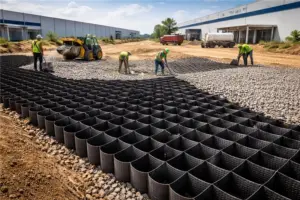
The geocell system was installed to reinforce the subgrade and create a stable base capable of supporting heavy industrial traffic.
Role of Geocells in Infrastructure Projects
Geocells are three-dimensional honeycomb structures made from HDPE strips that confine soil or aggregate materials. When filled with soil or stone, the system distributes loads over a wider area, reducing stress on the underlying soil.
Geocells are commonly used for:
- Road construction
- Industrial yards
- Slope stabilization
- Railway embankments
- Channel protection
Research by the Federal Highway Administration (FHWA) shows that geocell reinforcement can increase soil bearing capacity by up to 40–50 percent, making it particularly effective for infrastructure built on weak subgrades.
Geosynthetics in Modern Infrastructure
Geosynthetics improve infrastructure performance in several ways:
- Pavement reinforcement- Reducing rutting and settlement.
- Soil stabilization- Enhancing load distribution in weak soils.
- Erosion control- Protecting slopes and embankments.
- Drainage management- Facilitating water flow through engineered layers.
- Environmental protection- Preventing contamination and soil erosion.
The use of geocells has expanded significantly in industrial infrastructure projects due to their efficiency and ease of installation.
Installation Challenges and Quality Control
Installing geocells requires careful planning and execution.
Key steps include:
- Subgrade preparation and compaction
- Expansion and anchoring of the geocell panels
- Filling with aggregate or soil material
Quality control measures include verifying cell expansion, ensuring uniform filling, and maintaining proper compaction levels.
Failure to properly anchor the system can lead to displacement during loading.
Long-Term Performance
HDPE geocells offer several long-term advantages:
- High tensile strength
- Resistance to environmental degradation
- Long service life
Geocell systems maintain structural integrity even under repeated traffic loading.
Maintenance and Lifecycle Benefits
Compared with traditional soil reinforcement methods, geocells provide significant lifecycle advantages:
- Reduced pavement thickness requirements
- Lower maintenance costs
- Improved structural performance
These benefits contribute to the economic efficiency of industrial infrastructure projects.
Conclusion
The Hosur Industrial Park project highlights the effectiveness of geocell reinforcement in stabilizing weak soils and supporting heavy infrastructure loads. Ocean Non Wovens continues to provide advanced geosynthetic products that enhance infrastructure durability across India. With a strong manufacturing base and deep industry expertise, the company delivers reliable solutions for large-scale industrial and infrastructure developments.
 Industrial Park Ground Stabilization Using Geocell in Hosur, Tamil Nadu
 Case Study: Innovative Waterproofing Project in Bhubaneswar, Odisha
 Case Study: Chemical Project in West Bengal – Ensuring Safe Containment with Ocean HDPE Liner