Case Study: Landscaping Drainage Upgrade in Khorda, Odisha
Product used: Ocean Drain Cell, 30 mm
Quantity installed: 1,030 sqm
Location: Khorda (Khurda district), Odisha
Why drainage is the “make or break” layer in landscaping
Beautiful landscapes fail quietly. Not because the plants were wrong or the paving looked dated, but because water had nowhere to go. When water gets trapped under planters, lawns, walkways, or podium landscapes, you typically see the same chain reaction
- waterlogging and root stress
- algae and slippery surfaces on pavers
- foul odour in planters due to anaerobic conditions
- soil fines migrating into drains and choking outlets
- waterproofing membranes getting stressed by hydrostatic pressure
Khorda’s climate makes this risk very real. The normal annual rainfall for Khurda district is around 1,449 mm, with heavy monsoon concentration. When rainfall arrives in intense spells, landscapes need a drainage layer that can collect water quickly and move it laterally to discharge points, instead of letting it pond and pressurize the system.
Project context and site challenge (Khorda, Odisha)
This landscaping project required a dependable sub-surface drainage layer that could handle monsoon-driven inflows while protecting the integrity of the landscaped buildup.
Key on-ground challenges that commonly show up in similar Odisha projects
- High inflow during monsoon months (June to September) which increases short-duration saturation and waterlogging risk.
- Fine soils and silt movement which can clog aggregate-only drainage layers over time if filtration isn’t addressed properly.
- Limited depth availability in many landscaped sections (planters, podiums, walkways) where thick aggregate layers are not practical.
- Long-term maintenance reality: if outlets are not accessible, even a good drainage system can fail because no one can flush or inspect it later.
The solution selected: Ocean Drain Cell 30 mm
For this project, Ocean Drain Cell 30 mm was supplied and installed across 1,030 sqm as the primary drainage and protection layer beneath landscaped zones.
In landscaping, a drain cell (also called a drainage cell, drainage board, or geocomposite drainage layer depending on configuration) is used to
- create a void space for rapid water collection
- enable in-plane flow (water movement within the plane of the drainage layer) toward outlets
- reduce dependence on thick gravel layers
- improve durability by providing a consistent, engineered drainage path
What most companies don’t talk about (but decides performance)
1. “Compressive strength” numbers can be misleading if you don’t define the condition
Many product datasheets quote compressive strength, but the test method often referenced in the industry is ASTM D1621, which was originally written for plastics. It can be modified in different ways, so comparing two datasheets without matching test conditions can lead to wrong decisions.
What matters in real landscaping
- the drainage layer must retain enough voids under load after installation, wetting, and over time
- strength at a single point is less useful than retained thickness and retained flow capacity under expected loads
In this project, selection focus was kept on practical, field-relevant performance: consistent drainage pathways and careful protection of the system from clogging and outlet failure.
2. Drainage capacity is about transmissivity, not just “it drains”
Engineered drainage layers are evaluated by transmissivity, which measures how much water can flow within the plane of the product under a given load and hydraulic gradient. The commonly used test method is ASTM D4716.
In simple terms: two drainage products may look similar, but the one with better retained transmissivity under load will handle monsoon surges more reliably.
3. Filtration and clogging are the silent killers
A drainage layer is only as good as its filtration strategy. In landscaping, fines migrate. When they enter void spaces, the drainage layer slowly turns into a “storage layer” that doesn’t discharge. Common real-world causes
- no filter geotextile where soil is present
- poor overlap detailing at joints
- outlets without silt traps
- soil entering from planter edges during rain splash or irrigation
The project execution emphasized clean interfaces, proper wrapping/termination where required, and ensuring discharge points remained functional and inspectable.
4. Root behaviour and maintenance access are rarely planned upfront
Roots will search for moisture. If outlets leak or clog, roots can concentrate near discharge zones. Also, many landscapes are designed with hidden outlets that become inaccessible after finishing. The outcome is predictable: nobody maintains what nobody can reach.
So, the project approach kept practical maintenance in mind
- locate discharge points logically
- ensure clean-outs or inspection access (wherever feasible)
- avoid creating “sealed systems” that cannot be flushed
Installation methodology used on site (high-level workflow)
While each site has its own detailing, the project followed a disciplined installation sequence that reduces long-term risk.
- Subgrade preparation
- slope checks toward discharge direction
- removal of sharp protrusions and debris to prevent puncture risks
- Placement of Ocean Drain Cell 30 mm
- installed across the planned landscaping zones totaling 1,030 sqm
- alignment maintained so in-plane flow direction remains efficient toward outlets
- Joint and edge detailing
- joints kept tight and consistent
- terminations detailed to prevent soil entry from edges (this is where many drainage systems fail first)
- Outlet integration and discharge continuity
- outlets checked for uninterrupted flow path
- discharge points kept clear during construction to avoid cement slurry or soil blocking them
- Cover layer and landscape buildup
- subsequent layers installed carefully to avoid crushing, displacement, or contamination of drainage voids during construction traffic
Why a 30 mm drain cell works well for landscaping
In many landscaping builds, you need a drainage layer that provides meaningful void space without consuming too much depth. A 30 mm profile is commonly adopted in applications like podium landscaping, planters, and roof gardens because it balances
- drainage void volume
- constructability
- depth efficiency
- protection to adjacent layers
(Exact final performance depends on the complete system: filtration, outlet design, slopes, and long-term maintenance planning.)
Outcomes and practical impact
For the Khorda landscaping site, the Ocean Drain Cell layer was intended to deliver clear, measurable improvements in real conditions
- faster removal of excess water during heavy rainfall periods common to Khurda district
- reduced waterlogging risk that typically damages plants and finishes
- reduced hydrostatic pressure build-up near sensitive layers (especially where waterproofing or structural interfaces exist)
- more consistent landscape performance during monsoon cycles
Lessons learned that help future projects (quick checklist)
If you’re planning landscaping drainage in high-rainfall regions, these checks save money later
- Don’t accept “compressive strength” at face value unless test conditions and retained performance are clear
- Ask for transmissivity testing references (ASTM D4716 is the common benchmark)
- Design filtration intentionally to prevent fines intrusion
- Keep outlets accessible and protect them during construction
- Treat drainage as a system, not a single product
Promotional (Ocean Non Wovens)
If you’re building podium landscapes, commercial planters, walkways, or any high-rainfall landscaping project, Ocean Non Wovens can support you with the right geosynthetics selection, supply, and site-ready guidance. Our Ocean Drain Cell 30 mm is designed for dependable sub-surface drainage, and our team helps ensure the detailing, discharge planning, and execution match real site conditions, not just drawings. Reach out to Ocean Non Wovens to plan a drainage layer that performs through monsoons, not just on day one.
 Sanitation Water Filtration Project in Zuarinagar, Goa: A Case Study
 NHAI Infrastructure Development with Ocean Geocomposite in Patna, Bihar
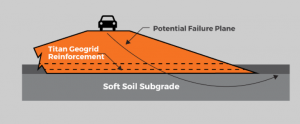 Why Engineers use Geomembranes for Earth Reinforcement