Multi-Geosynthetic Highway Project
Doboka, Assam
Project Overview
Project Name: Highway Infrastructure Project
Location: Doboka, Assam
Products Used:
- Ocean Geocomposite 5.5 MM – 500 SQM
- Ocean Geostrap (30–85 kN) – 43,500 Mtr
- Ocean Geotextile 150 GSM – 400 SQM
Table of Contents
Introduction
Highway development in Northeast India, particularly in Assam, presents a unique set of geotechnical and environmental challenges. The combination of high annual rainfall, weak alluvial soils, fluctuating groundwater levels, and continuous traffic loading often leads to premature pavement distress such as rutting, cracking, and subgrade failure.
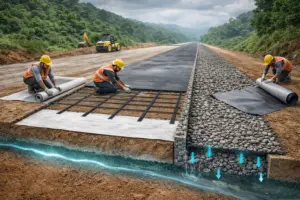
In the Doboka Highway Project, a multi-layered geosynthetic system was implemented to address these issues holistically. Instead of relying on traditional construction methods, the project integrated geocomposites, geostrips (soil reinforcement elements), and geotextiles to create a structurally stable, well-drained, and long-lasting pavement foundation.
This approach reflects a shift toward engineered geosynthetic solutions in road construction, where each layer performs a specific function within the overall pavement system.
Functional Role of Each Geosynthetic Component
1. Geocomposite (5.5 MM) – Drainage and Pressure Relief
Geocomposites are engineered combinations of geotextiles and drainage cores designed to allow efficient subsurface water flow.
Key Contributions:
- Rapid lateral drainage of infiltrated water
- Reduction of hydrostatic pressure beneath pavement layers
- Prevention of water accumulation in subgrade
In high rainfall zones like Assam, inadequate drainage is one of the primary causes of pavement failure. The geocomposite layer ensures that water does not remain trapped within the structural layers, thereby maintaining soil strength.
2. Geostrap (30–85 kN) – Soil Reinforcement and Load Distribution
Geostrips act as reinforcement elements within soil structures, improving mechanical stability.
Key Contributions:
- Enhancement of tensile strength of soil mass
- Improved load transfer from pavement to subgrade
- Reduction in differential settlement
By reinforcing the soil, geostrips help transform weak subgrades into mechanically stabilized layers, capable of supporting heavy vehicular loads.
3. Geotextile (150 GSM) – Separation and Filtration
Geotextiles are critical in maintaining the integrity of layered systems.
Key Contributions:
- Acts as a separator between aggregate and subgrade soil
- Prevents intermixing and contamination of layers
- Allows water to pass while retaining soil particles (filtration function)
Without proper separation, fine soil particles can migrate into aggregate layers, leading to loss of structural capacity and pavement deformation.
Geosynthetics in Modern Highway Engineering
The integration of multiple geosynthetic products reflects a systems-based approach to road construction.
Key Applications in Highways
1. Pavement Reinforcement
Geosynthetics reduce stress concentrations and improve fatigue resistance, delaying crack propagation.
2. Soil Stabilization
Weak subgrades are strengthened through reinforcement, reducing the need for excessive granular material.
3. Drainage Enhancement
Geocomposites and geotextiles ensure efficient removal of water, maintaining subgrade strength.
4. Erosion Control
Geosynthetics protect embankments and slopes from runoff-induced damage.
5. Sustainability Benefits
Reduced material usage and extended pavement life contribute to more sustainable infrastructure development.
According to the Indian Roads Congress (IRC SP:59), the use of geosynthetics in road construction can increase pavement life by 30–50%, particularly in weak soil conditions.
Site-Specific Challenges in Doboka, Assam
1. High Rainfall Intensity
The region receives 2000–3000 mm of rainfall annually, leading to:
- Water infiltration into pavement layers
- Subgrade softening
- Reduced load-bearing capacity
2. Weak Clayey Subgrade
The soil profile is dominated by soft, compressible clay, which exhibits:
- Low shear strength
- High plasticity
- Susceptibility to deformation under load
3. Elevated Groundwater Table
A high water table contributes to:
- Continuous moisture presence in subgrade
- Increased pore water pressure
- Risk of long-term settlement
Without geosynthetic intervention, these factors can significantly reduce pavement lifespan.
Installation Methodology and Execution Challenges
The success of a multi-geosynthetic system depends on proper sequencing, alignment, and integration of layers.
Layer Sequencing
- Placement of geotextile as the base separation layer
- Installation of geostrips for reinforcement
- Integration of geocomposite for drainage
Incorrect sequencing can compromise the entire system’s performance.
Anchorage and Reinforcement
- Geostrips must be properly tensioned and anchored
- Uniform spacing is essential for consistent load distribution
Drainage Alignment
- Geocomposite layers must be aligned with drainage outlets
- Any blockage or misalignment can reduce effectiveness
Construction Control
- Avoiding damage during aggregate placement
- Maintaining layer continuity across the entire stretch
Field execution requires careful coordination to ensure that each geosynthetic component performs its intended function.
Long-Term Performance and Structural Benefits
The combined use of geocomposites, geostrips, and geotextiles creates a synergistic system that enhances overall pavement performance.
Key Outcomes
- Improved Load-Bearing Capacity: Reinforced subgrade supports higher traffic loads
- Reduced Settlement: Controlled deformation over time
- Enhanced Drainage Efficiency: Lower moisture retention in structural layers
- Extended Pavement Life: Reduced frequency of repairs and overlays
Studies in geotechnical engineering indicate that reinforced pavement systems can reduce maintenance interventions by up to 40% over their lifecycle.
Maintenance and Lifecycle Efficiency
Geosynthetic-based highway systems offer significant long-term advantages over conventional designs.
Benefits
- Lower maintenance costs due to reduced distress
- Improved ride quality and safety
- Reduced need for frequent rehabilitation
- Optimized use of construction materials
These advantages make geosynthetics a preferred solution in challenging terrains like Northeast India.
Conclusion
The Doboka Highway Project highlights how a multi-layered geosynthetic approach can effectively address complex geotechnical challenges. By combining drainage, reinforcement, and separation functions, the system ensures structural stability even under adverse environmental conditions. This project demonstrates the importance of moving beyond traditional methods toward integrated geosynthetic engineering solutions for sustainable infrastructure development.
Final Note
Ocean Non Wovens continues to lead the way in delivering advanced geosynthetic solutions for infrastructure projects across India. With expertise in geocomposites, geostrips, geotextiles, and engineered systems, the company ensures precise execution tailored to site-specific challenges. From highways in high-rainfall regions to large-scale infrastructure developments, Ocean Non Wovens remains a dependable partner for building durable, efficient, and future-ready geosynthetic solutions.

source on Google
 Multi-Geosynthetic Highway Project
 How Thick is a Geotextile?
 Football Project: How Ocean Non Wovens’ 120 GSM Nonwoven Geotextile Delivered a Durable, Drainage-Ready Field in Mumbai