Erosion Control Mats & Blankets
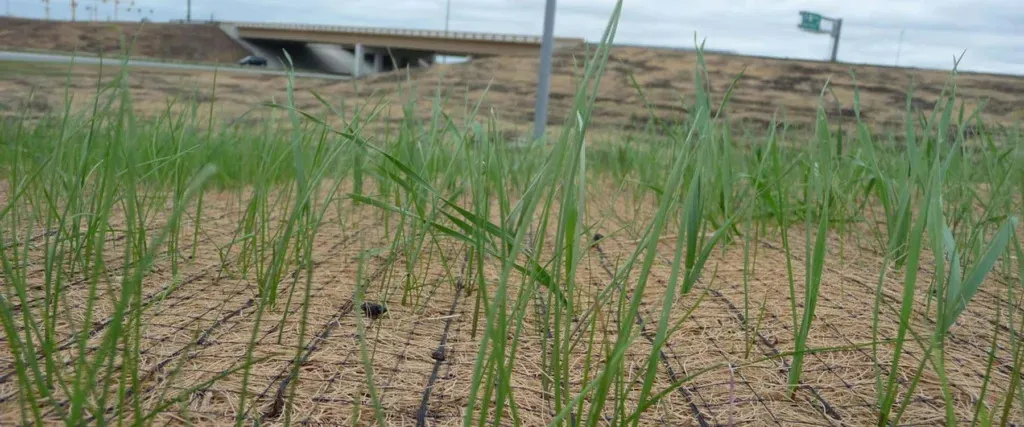
Erosion control mats
Ocean Geosynthetics manufactures and supplies erosion control mats and blankets made from coir and jute geotextiles. They are laid on bare slopes, embankments, channel banks and reclaimed ground to hold topsoil and seed in place until vegetation takes over the job. The range covers coir nonwoven mats (with a PP net or a green shade net), woven coir mats in 400, 700 and 900 GSM, and open-weave jute mats in three grades. Full specifications are in the tables below.
Table of Contents
What are erosion control mats?
Erosion control mats, also called erosion control blankets, belong to a product group the industry calls rolled erosion control products (RECPs). They arrive rolled like carpet, are unrolled over prepared soil and pinned down. RECPs are made from natural fibres, synthetic fibres or a mix: coconut coir, jute, wood excelsior, wheat straw and polypropylene are the common ones. Ocean’s mats are made from coir and jute, so they biodegrade once vegetation has established.
They are used wherever soil is left bare and exposed to rain, runoff or wind: new road and rail embankments, cut slopes in hill areas, canal and river banks, pond and lake edges, trenches, and mine dumps under reclamation. The right mat depends on the slope angle, how much water flows over it, how long protection is needed before plants take hold, and the soil type. Fibre type, mat weight, weave or netting and fibre density decide how strong and how long-lasting a mat is. (For when a synthetic landscape fabric is or isn’t a substitute, see can landscape fabric be used for erosion control.)
How erosion control blankets work
Soil erosion starts when raindrops or flowing water detach soil particles and carry them downslope. On a bare embankment this moves from thin sheet erosion to rills and then gullies within a single monsoon. Stream banks and channel beds lose soil to flowing water; dry, exposed ground loses it to wind.
A blanket interrupts this in four ways:
- Raindrop impact: the fibre layer absorbs the energy of falling rain so particles are not dislodged.
- Runoff velocity: the fibres and mesh slow sheet flow across the surface, so it carries less soil.
- Moisture and temperature: the mat works as a mulch, cutting evaporation and keeping the seedbed cooler, which helps germination on sun-exposed slopes.
- Seed retention: seed and topsoil stay where they were placed instead of washing to the toe of the slope.
Roots grow through the open structure. By the time a natural-fibre mat has decomposed, the vegetation should be protecting the slope on its own, and the decomposed fibre adds organic matter to the soil.
Types of erosion control blankets
1. Photodegradable erosion control blankets
These use plastic netting, usually polypropylene, with UV stabilisers designed to stop working after a set period. Netting exposed to sunlight then breaks down, but netting buried under soil or shaded by grass can last much longer. On sites with wildlife or regular mowing, leftover plastic netting can be a problem.
2. Biodegradable erosion control blankets
These are made from natural fibres such as coir and jute, which decompose in the soil. They suit projects where leaving no residue matters: riverbanks, wetlands, forest and eco-sensitive sites. Depending on the fibre and construction, a biodegradable blanket can last from a few months to a few years. Jute breaks down fastest; coir, which has a high lignin content, lasts considerably longer. Read more on biodegradable erosion control matting.
Mats in the Ocean range
Coir nonwoven erosion mats
Loose coir fibre needled into a mat and held between netting. Ocean supplies two versions: with a 9 x 9 mm PP net in 400 and 700 GSM, and with a green shade net in 450 and 650 GSM. The dense fibre layer gives good ground cover and moisture retention, which makes these mats a good fit for seeded or hydroseeded embankment slopes and topsoil retention. Note that the PP or shade net is a synthetic component and will not biodegrade at the same rate as the coir.
Woven coir mats
Coir yarn woven into an open mesh, also known as coir bhoovastra or coir geotextile. Made from 100% coir, in 400, 700 and 900 GSM. The twisted yarns give much higher tensile strength than nonwoven mats (10 to 16.5 kN/m dry in the machine direction, per the table below), so woven coir is the usual choice for steeper slopes, stream banks, and channels with flowing water. The open mesh lets plants grow through readily.
Jute erosion mats
Open-weave jute geotextile in three types: 730, 500 and 292 GSM. Jute fibre absorbs a large amount of water and swells when wet, so the mat holds moisture against the soil and conforms closely to the ground. It decomposes faster than coir, which makes it a good fit for gentler slopes and sites where vegetation establishes within one or two growing seasons.
Soil Saver
Soil Saver is a lightweight open-weave mat used on slopes, embankments and loose soil to stop surface erosion and keep moisture in the seedbed. It is quick to lay and is often used on landscaping and garden beds as well as roadside slopes. Ask our team for the current construction and grade.
Technical Specifications
Ocean Coir Nonwoven Mats with PP Net
| Property | 400 GSM | 700 GSM | Test Method |
|---|---|---|---|
| Material | 100% Coir | 100% Coir | – |
| PP Net (mm) | 9 x 9 | 9 x 9 | – |
| Mass Per Unit Area (GSM) | 400 – 410 | 690 – 720 | ASTM D 5261 |
| Thickness (mm) | 6 – 7 | 7 – 9 | ASTM D 5199 |
| Width (m) | up to 2.4 | up to 2.4 | – |
| Length (m) | up to 50 | up to 50 | – |
| Tensile Strength MD (kN/m) | 1.95 | 2.95 | ASTM D 4595 |
| Tensile Strength Cross (kN/m) | 1.42 | 2.62 | ASTM D 4595 |
Ocean Coir Nonwoven Mats with Green Shade Net
| Property | 450 GSM | 650 GSM | Test Method |
|---|---|---|---|
| Material | 100% Coir | 100% Coir | – |
| Mass Per Unit Area (GSM) | 450 | 650 | – |
| Thickness (mm) | 8 | 10 | ASTM D 5199 |
| Width (m) | 2.8 | 2.8 | – |
| UV Resistance @500 Hrs | 80% min | 80% min | ASTM D 4355 |
| Dry Tensile Strength MD (kN/m) | 7.35 | 9 | ASTM D 4595 |
| Wet Tensile Strength MD (kN/m) | 6.65 | 7 | ASTM D 4595 |
Ocean Coir Woven Mats
| Property | 400 GSM | 700 GSM | 900 GSM | Test Method |
|---|---|---|---|---|
| Material | 100% Coir | 100% Coir | 100% Coir | – |
| Mass Per Unit Area (GSM) | 400 | 700 | 900 | IS 15686 |
| Thickness (mm) | 6.5 – 7 | 6.5 – 7 | 6.5 – 7 | IS 15868 |
| Width (m) | 2 | 2 | 2 | IS 12503 |
| Break Load, Dry MD (kN/m) | 10 | 14 | 16.5 | IS 16635 |
| Break Load, Dry CMD (kN/m) | 8 | 10 | 12 | IS 16635 |
Ocean Jute Geotextile Mats
| Property | Type 1 | Type 2 | Type 3 | Test Method |
|---|---|---|---|---|
| Material | 100% Natural Jute Fibre | 100% Natural Jute Fibre | 100% Natural Jute Fibre | – |
| Weight @20% MR (GSM) | 730 | 500 | 292 | IS 2387:1969 |
| Width (cm) | 122 | 122 | 122 | IS 1954:1990 |
| Thickness (mm) | 7 | 5 | 3 | IS 7702:1975 |
| Aperture Size (mm) | 12 x 12 | 13 x 20 | 8 x 7 | IS 2405:1980 |
| Breaking Load, Warp (N/10cm) | 1200 | 1040 | 1000 | IS 1969:1985 |
Key Applications
- Fill slopes, road and rail embankments, berms and detention basin side slopes
- Grassed swales, roadside ditches, canal shoulders and low-energy streambanks
- Hydroseeded or broadcast-seeded slopes and native restoration
- Slopes draining to water bodies, wetland creation and bioswales
- Topsoil retention over coarse subgrade
- Riparian buffers and eco-sensitive sites
Key Features
- Moisture retention for faster germination
- Filtration and separation that retains fines while allowing infiltration
- Seedbed protection that reduces raindrop impact and shallow flow
- Conformability that drapes over irregular ground for uniform soil contact
- Rapid installation with standard staples or biodegradable stakes
- Biodegradable, plastic-free construction that enriches the soil
- High tensile strength from twisted coir yarns
- UV and weather tolerance from natural fibres
Reading the specifications
The tables above give mass per unit area, thickness, roll width and length, tensile strength and the test method for each property. Mass per unit area (GSM) is weight, not thickness: a 700 GSM woven coir mat and a 400 GSM one are the same 6.5–7 mm thick, but the heavier mat has more and thicker yarn and is roughly 40% stronger. Request a test certificate for the specific lot when ordering for a tendered project.
How to choose a mat
- Gentle slopes (flatter than about 1V:3H), short-term cover: jute mats (292 or 500 GSM) or a lighter coir nonwoven mat.
- Moderate to steep slopes, seeded embankments: 400–700 GSM coir nonwoven or 400–700 GSM woven coir.
- Steep slopes, cut faces in hill roads, stream banks and channels with flow: 700–900 GSM woven coir, with closer staple spacing. Where flow velocities are high or protection must be permanent, a synthetic turf reinforcement mat, geocells or gabions may be needed instead.
- Time to vegetation: if grass will take more than a season or two to establish (dry climate, poor soil), choose coir over jute because it lasts longer.
- No-plastic requirement: choose woven coir or jute; the nonwoven coir mats carry a PP or shade net.
Applications
Sectors: roads and highways, railways, civic works and landscaping, slopes and retaining structures, irrigation and canal works, mining and restoration projects. Main function: erosion protection, with surface stabilisation and short-term reinforcement of the topsoil.
- Road and rail embankment slopes and cut slopes
- Slope stabilisation and re-vegetation in hill areas
- Stream bank and riverbank restoration, riparian corridors
- Canal banks, drains and channels with moderate flow
- Wetland construction and restoration, pond and lake edges
- Mine dump and quarry rehabilitation
- Landfill cover slopes after capping
- Gardens, re-vegetating beds and roadside landscaping
- Coastal dunes and high-wind sites (above the wave zone)
Installation basics
Follow the project specification and the drawings. A typical slope installation runs like this:
- Trim and grade the slope, remove stones, roots and clods so the mat touches the soil everywhere. Fill rills.
- Spread topsoil, fertiliser and seed (or hydroseed) before laying the mat, unless the design calls for seeding through it.
- Dig an anchor trench along the crest, commonly about 150 mm wide and 150 mm deep. Lay the end of the roll in it, staple, backfill and compact.
- Unroll the mat downslope, loosely and without stretching. Do not lay it across the slope.
- Overlap adjacent rolls by about 100–150 mm at the sides; at roll ends, lay the upslope roll over the downslope one, shingle style, by about 150 mm.
- Pin with U-shaped steel staples or wooden or bamboo pegs. Staple density depends on slope and mat; steeper slopes and channels need more.
- In channels, lay the mat parallel to the flow and add check slots across the channel at intervals so water cannot get under the mat.
- Water the slope during dry spells until the grass is established.
Relevant standards
- IS 15869: open weave coir bhoovastra (woven coir geotextile), covering 400, 700 and 900 g/m² grades. A Ministry of Textiles quality control order makes BIS certification to this standard compulsory for open weave coir bhoovastra sold in India.
- IS 14986: guidelines for jute geotextile for rainwater erosion control on road and railway embankments and hill slopes. It covers the 730, 500 and 292 GSM types.
- IS 15868: methods of test for natural fibre geotextiles (jute and coir).
- IRC:56-2011: Indian Roads Congress recommended practice for treatment of embankment and roadside slopes for erosion control.
- ASTM D6459 and ASTM D6460: large-scale performance tests for RECPs on slopes (rainfall) and in channels (shear stress), used in international specifications.
Related products
- Coir geotextile and jute geotextile
- GCCM (geosynthetic cementitious composite mat) for hard-armoured drains and channels
- Geocells for steep slope confinement
- Synthetic geotextiles for filtration under riprap and gabions
Frequently asked questions
What is the difference between an erosion control mat and an erosion control blanket?
In India the terms are used interchangeably. Internationally, “blanket” usually means a temporary, degradable RECP, while “mat” can also mean a heavier, permanent turf reinforcement mat.
Coir or jute: which should I use?
Coir is stronger and lasts longer, so it suits steeper slopes, banks and channels. Jute absorbs more water and decomposes faster, so it suits gentler slopes where grass establishes quickly.
How long does a coir erosion mat last?
It depends on mat weight, climate and soil moisture. Woven coir generally lasts several years, longer than jute, which is enough for most vegetation to establish. Heavier grades last longer.
Do I seed before or after laying the mat?
Usually before, so the seed is held under the mat. With open-weave woven coir you can also hydroseed over the mat after laying.
What roll sizes are available?
Coir nonwoven mats with PP net come up to 2.4 m wide and 50 m long; mats with green shade net are 2.8 m wide; woven coir is 2 m wide; jute mats are 122 cm wide. Contact us for roll lengths for your order.
Can erosion control mats be used in flowing water?
Heavier woven coir mats can protect channel banks and low-energy streams with moderate flow if they are well anchored with check slots. For high-velocity channels, use a hard or permanent solution such as GCCM, gabions or riprap over a geotextile filter.


Related Case Studies