Badarpur NTPC ECO Park
The National Thermal Power Corporation (NTPC) Eco Park at Badarpur, New Delhi covers 884 acres of the former ash disposal area of the Badarpur thermal power station, and is described as one of the largest man-made parks in the country.
Its planned facilities include jogging tracks, public recreation zones, fountains, yoga centres, green public squares, man-made lakes and open gyms.
A park of this size has to be managed as well as built. The man-made lakes, ponds, fountains and other water bodies needed the most attention: they had to hold water without seepage or leakage into the surrounding ground, and stay clean enough to limit algae.
To line them, HDPE liners 0.5 mm (500 micron) thick were used across the park’s water bodies. Besides being close to impermeable, HDPE liners resist chemicals, so they keep the pond water separate from the soil below. A detailed write-up of the lining work is in our NTPC Eco Park case study.
Product – Ocean HDPE Liner-0.5 mm Thickness
Quantity – 5000 Sqm
Location – NTPC Badarpur Eco-park
Problem
Water bodies are central to an eco park, both for the landscape and for the natural setting.
The NTPC Eco Park is also planned to host herbivorous animals, so some water bodies had to be built to give them clean drinking water.
Adding water bodies brought its own risks: polluted water, contamination of the soil, and the need to keep conditions right for aquatic life.
Delhi’s climate swings from summers well above 40°C to cold winters, so the lining had to last for years in direct sun and changing temperatures while protecting the aquatic life and animal habitats in the park.
For a separate NTPC project at Badarpur, Ocean Non Wovens supplied Ocean HDPE Liner in two grades: 20,000 sq m at 1.8 mm and 5,000 sq m at 2 mm. Read about the 1.8 mm and 2 mm HDPE liner at Badarpur.
Solution
The answer was to line the water bodies with HDPE (high-density polyethylene) liners.
HDPE is a tough thermoplastic polymer, and it is used as a flexible pond liner sheet laid over a prepared bed.
It is affordable, which is why it is so widely used. It resists a wide range of chemicals, and the carbon black in geomembrane-grade HDPE protects it from UV. Its main advantage is a long service life.
HDPE liners 0.5 mm thick were used in several water bodies at the NTPC Eco Park to prevent water seepage, leakage and contamination of the ground. HDPE stays serviceable across the temperature range of Delhi’s seasons, which made it a good fit for all the water bodies in the park.
The liner also acts as a barrier between the pond water and the underlying soil, so impurities in the ground do not reach the water and pond water does not leak into the ground.

source on Google
 Shoreline Protection and Stabilisation Techniques
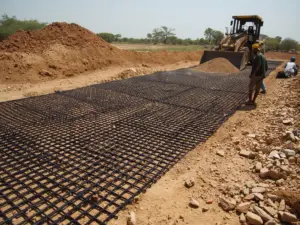 Case Study: CPWD Project in Bhuj, Gujarat – Strengthening Infrastructure with Ocean Geogrid 60 Kn
 Geotextiles for Slope Stabilization