Case Study: Advancing Waterproofing Infrastructure with Geotextile 120 GSM in Baghpat, Uttar Pradesh
Project overview
Ocean Non Wovens supplied 8,000 square metres of Geotextile 120 GSM for sub-surface waterproofing on a municipal development in Baghpat, Uttar Pradesh. The geotextile went under walkways, green spaces and stormwater channels, where it protects the waterproofing membrane and keeps the soil beneath it in place.
- Location: Baghpat, Uttar Pradesh
- Product supplied: Geotextile 120 GSM
- Quantity: 8,000 SQM
- Application: Sub-surface waterproofing for municipal development (walkways, green spaces and stormwater channels)
- Duration: 3 weeks (planning to execution)
The problem
The main concerns on the Baghpat site were groundwater coming up during the monsoon and unstable soil in some reclaimed patches. Waterproofing membranes and coatings laid straight onto soil tend to fail at the contact with the ground:
- Stones and sharp aggregate in the subgrade puncture or abrade the membrane
- Soil movement and settlement crack rigid coatings
- Fine soil washes into drainage paths and clogs them, so water sits against the barrier
A geotextile between the soil and the barrier handles separation, filtration and protection, which is why it was specified here.
What the 120 GSM geotextile does
Ocean’s Geotextile 120 GSM is a non-woven, needle-punched synthetic fabric. It is permeable: water passes through it, soil does not. It is a light grade, suited to separation and filtration under pedestrian and landscaping loads rather than heavy traffic. On this project it had three roles.
1. Separation
Laid between the subsoil and the waterproofing membrane, it stops soil particles migrating up against the membrane, where over time they can puncture or weaken it.
2. Filtration and drainage
Water passes through the fabric while the soil stays behind, so the layers beneath walkways and green areas drain instead of waterlogging. A light non-woven like this works mainly as a filter across its thickness; where water has to travel sideways for any distance, a drainage geocomposite is the usual choice.
3. Cushioning
The fabric sits between sharp soil aggregate and the membrane, reducing mechanical damage during installation and backfilling.
Installation
- Grading was uneven over more than 45% of the plot, so it was mechanically re-levelled before the geotextile went down.
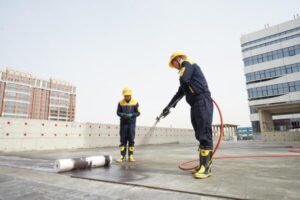
- Rolls were laid with 200 mm overlaps, spot thermally bonded and, in some zones, held with galvanised steel pins so wind could not lift the fabric during laying.
- Crews worked alternating shifts to avoid daytime temperatures that reached 42°C, which could affect membrane adhesion after laying.
On delivery, it is good practice to check roll labels for grade and GSM, keep rolls wrapped and off the ground, and cover the geotextile within a few days, since polypropylene and polyester fabrics lose strength under prolonged sunlight.
Result
Local contractors reported no seepage in the first rainy season after installation, an improvement over adjacent areas built without a geotextile layer. By keeping the membrane clear of sharp stones and the drainage layer clear of fines, the geotextile helps the waterproofing last longer and cuts down on maintenance.
Work with Ocean Non Wovens
Ocean Non Wovens manufactures non-woven geosynthetics for walkways, industrial waterproofing, green roof drainage layers and other infrastructure work. Contact us for material samples, technical support on site or a quote, or browse more case studies.

source on Google
 Geotubes, the Effective Solution for Sludge Dewatering
 Mountain Engineering in Srinagar: A Case Study on Slope Stability Using Ocean Hexagonal Woven Double Twisted Gabion Boxes
 Case Study: Advancing Waterproofing Infrastructure with Geotextile 120 GSM in Baghpat, Uttar Pradesh