Geotextile and Geogrid for a Railway Project in Maharashtra
Ocean Geosynthetics supplied 32,000 sqm of geotextile and 28,834 sqm of geogrid for a railway project in Maharashtra. The aim was to make the track formation more stable and longer-lasting, with less maintenance over its life.
Project snapshot
- Sector: Railways
- Location: Maharashtra
- Products: Geotextiles (32,000 sqm) and geogrids (28,834 sqm)
- Functions: Separation, erosion control, embankment reinforcement
The problem
The track formation faced soil erosion and stability problems. The client also wanted the tracks to last longer and need less maintenance.
Both problems usually start in the formation, not the rails. Under repeated train loading, wet fine-grained subgrade soil is pumped upwards into the blanket and ballast. The ballast fouls, drainage slows, the track loses its geometry and has to be packed and re-levelled more often. On embankments, rain washes soil off the slopes and soft fill settles unevenly.
The solution
Ocean Geosynthetics worked with the project engineers on a two-product design.
Geotextile (32,000 sqm) beneath the tracks. Laid under the track structure, the geotextile keeps the subgrade soil and the granular layers above it apart, so the two do not mix, and protects the formation against erosion. A geotextile in this position also acts as a filter: water passes through it, while the soil particles stay behind.
Geogrid (28,834 sqm) in the embankments. The geogrids reinforce the railway embankments. Granular fill locks into the open apertures of the grid, which restrains the fill laterally and spreads train loads over a wider area. This reduces the risk of settlement.
Implementation
- Site assessment: Ocean Geosynthetics’ engineering team assessed the site to set the requirements for each product.
- Product supply: Geotextiles and geogrids were supplied to the project’s specifications and site conditions.
- Installation support: Ocean Geosynthetics worked with the construction team on correct installation of the geosynthetics.
On formation work of this kind, the usual checks are a graded and compacted subgrade free of sharp debris before the geotextile goes down, correct overlaps between rolls, geogrid laid flat and pulled taut so it engages the fill, and no tracked plant driving directly on the exposed geosynthetics.
Outcomes
- Stability: The geotextiles and geogrids improved the stability of the railway tracks and reduced the risk of soil erosion and settlement.
- Lifespan: With a separating layer under the tracks and reinforcement in the embankments, the formation is expected to last longer and need less maintenance.
- Schedule: Timely supply and joint work on installation helped the project keep to its construction timeline.
For railway formation, embankment or track-bed work, see more Ocean case studies or contact the team for geotextile and geogrid grades suited to your site.

source on Google
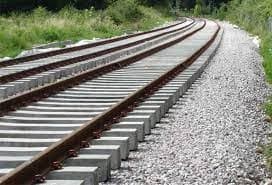 Geosynthetics for Railway ballast stabilization
 Landslide Protection and Slope Protection With Gabion Retaining Wall
 Advanced Leachate Drainage Infrastructure with Ocean Drainage Geocomposite 5.5 MM in Odisha Landfill Project