Geomembrane vs Geotextile: Key Differences Every Engineer Should Know
Geomembranes and geotextiles are both geosynthetics, both made from synthetic polymers, and both used in civil and environmental engineering. Beyond that they have little in common.
They are easy to confuse because the names are similar and the two often turn up on the same site. Specifying the wrong one costs anywhere from wasted money to a failed structure. A geotextile where you needed a geomembrane lets contaminated liquid reach groundwater. A geomembrane where you needed a geotextile traps water, builds up hydrostatic pressure, and can eventually cause structural failure.
The difference comes down to one property: a geotextile lets water through and a geomembrane does not. Material, manufacturing, installation and cost all follow from that.
Table of Contents
The core difference: permeability
One question tells you which material you are dealing with: does it let water pass through?
Geotextiles are permeable. They are engineered fabrics with a porous structure that work with both water and soil at the same time. Water moves through them while soil particles stay in place, which is what lets them filter and drain.
Geomembranes are impermeable. They are continuous polymer sheets that block the movement of liquids and gases. They do not filter or drain; their job is containment.
| Feature | Geomembrane | Geotextile |
|---|---|---|
| Primary Function | Creates an impermeable barrier to contain liquids and gases | Allows water to pass while filtering, separating, reinforcing, and draining soil |
| Water Permeability | Impermeable | Permeable |
| Main Purpose | Containment | Soil stabilization and water management |
| Material Structure | Continuous polymer sheet | Woven or non-woven synthetic fabric |
| Common Materials | HDPE, LLDPE, LDPE, PVC, PP, EPDM | Polypropylene (PP), Polyester (PET) |
| Manufacturing Process | Extrusion or calendering into sheets | Woven, needle-punched, or heat-bonded fibers |
| Water Flow | Blocks virtually all water movement | Allows controlled water flow |
| Soil Filtration | No | Yes |
| Drainage | No | Yes |
| Soil Separation | No | Yes |
| Reinforcement | Limited | Good (woven and high-strength grades) |
| Waterproofing | Excellent | Not suitable |
| Chemical Resistance | Excellent | Good |
| UV Resistance | Excellent | Moderate (best when buried) |
| Puncture Resistance | Moderate (often protected by geotextiles) | Good |
| Installation | Requires welding and seam testing | Simple overlap and anchoring |
| Maintenance | Seam testing at installation; periodic inspection of exposed areas | Minimal once installed |
| Installation Complexity | High | Low |
| Typical Lifespan | Exposed: decades (often 30 years or more for HDPE); covered: estimated at over 100 years | Buried: often 25 to 100+ years; exposed: much shorter unless UV-stabilised |
| Relative Cost | Higher | Lower |
| Best Used For | Liquid and gas containment | Drainage, filtration, reinforcement, separation |
What geotextiles actually do
Geotextiles perform four main functions, and most installations rely on at least two of them at once.
Filtration. Water carrying fine soil particles flows towards the fabric; the water passes through and the soil stays behind. This keeps drains from clogging and stops soil washing out from behind retaining walls. If the fabric’s opening size is wrong for the soil, the filter either clogs or lets soil through, and the drain fails.
Separation. A geotextile between two different layers, such as a soft subgrade and a granular road base, stops them mixing. Without it, aggregate is pushed down into the soft soil, the base loses strength, and the road needs rebuilding years early.
Drainage. Thick non-woven geotextiles can also carry water within their own plane, a property called transmissivity. Behind retaining walls and beneath pavements, this relieves water pressure that would otherwise load the structure.
Reinforcement. High-strength geotextiles add tensile strength that soil lacks and spread loads over a wider area, improving stability on weak ground, much as steel bars do in concrete.
Under a geomembrane, a heavy non-woven geotextile also works as a protection cushion against puncture. These functions make geotextiles standard in road construction, embankments, French drains, slope protection and erosion control. If the job is to manage water moving through soil rather than stop it, a geotextile is probably the right material.
What geomembranes actually do
Every geomembrane application comes down to containment: keeping a liquid or gas on one side of a barrier. The applications vary:
- Landfill lining: Stopping leachate from seeping into groundwater. A failure here means environmental contamination that is very expensive to clean up.
- Water conservation: Lining reservoirs, canals and irrigation ponds to cut seepage losses, which matters most in dry regions where every litre stored counts.
- Mining containment: Heap leach pads and tailings dams use geomembranes to hold process solutions and tailings water that would harm the environment if released.
- Aquaculture: Pond liners for fish and shrimp farming, where water level and quality have to be controlled.
- Secondary containment: Beneath chemical storage tanks and industrial facilities as a back-up against spills.
No geomembrane is perfectly leak-proof in service. Chemical attack, extreme temperatures and mechanical damage can all compromise it over time, which is why careful installation, seam testing and, for exposed liners, periodic inspection matter.
Material composition and manufacturing
The functional difference between the two materials comes from how they are made.
Geotextiles: fibers into fabric
Geotextiles start as synthetic polymer fibres, most commonly polypropylene (PP) or polyester (PET), which are made into fabric in one of two ways:
Woven geotextiles are made by interlacing yarns or tapes on a loom, giving a regular grid-like structure. They have high tensile strength and low elongation, so they are the better choice for reinforcement and stabilisation.
Non-woven geotextiles are made by bonding a mass of fibres together, either by needle-punching (mechanically entangling the fibres) or by heat bonding. The result is a felt-like mat. Non-wovens are far more common for drainage and filtration, because their random fibre structure forms a pore network that passes water while retaining soil.
For geomembrane protection and other long-term functions, use a geotextile made entirely of synthetic fibres. Natural fibres rot, and the protection goes with them; recycled fibre blends can contain cotton or wool. (Natural coir and jute geotextiles are made to biodegrade and are used for short-term erosion control, not protection.) In strongly alkaline ground, such as next to lime- or cement-treated soil, PP is usually preferred to PET, which can lose strength by hydrolysis at high pH.
| Feature | Woven Geotextile | Non-Woven Geotextile |
|---|---|---|
| Manufacturing | Interwoven fibers | Needle-punched or heat-bonded fibers |
| Strength | Very High | Moderate |
| Water Permeability | Moderate | High |
| Filtration | Good | Excellent |
| Drainage | Moderate | Excellent |
| Reinforcement | Excellent | Good |
| Best Applications | Roads, embankments, stabilization | Drainage, filtration, erosion control |
Geomembranes: polymer sheets
Geomembranes are made as continuous polymer sheets rather than from fibres. There are more material options than many people expect:
- Thermoplastics: High-density polyethylene (HDPE), low-density polyethylene (LDPE), very flexible polyethylene (VFPE), linear low-density polyethylene (LLDPE), polypropylene (PP), and flexible polyvinyl chloride (PVC)
- Elastomers: EPDM (ethylene-propylene-diene terpolymer) and chlorosulfonated polyethylene
- Modified bitumens: Bitumen modified with styrene-butadiene or ethylene-vinyl acetate copolymers
HDPE is the most widely used for environmental containment because of its chemical resistance and durability. Roll sizes vary widely, from about 1 m by 10 m for bituminous products up to 7.5 m by 200 m for polyethylene geomembranes. Larger rolls mean fewer seams, and seams are where most leaks start.
Installation differences
Geomembrane installation needs precision. Trained technicians weld the panels together on site into one continuous, watertight barrier, using hot-wedge or extrusion welders, and every seam is tested (air pressure, vacuum box or destructive samples). A badly made seam leaks, so the job needs specialised equipment, trained welders and construction quality assurance.
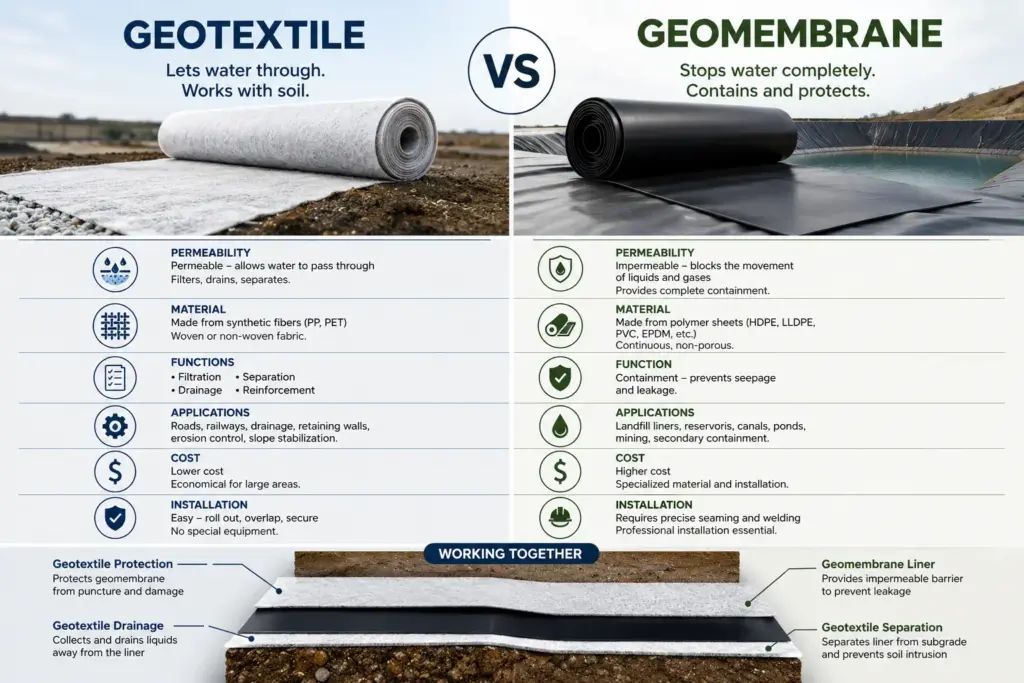
Geotextile installation is simpler. Crews roll out the material, overlap adjacent sheets (or sew them where overlaps would not hold), and pin or anchor them in place, with no welding or seam testing. Placement still matters: wrinkles, short overlaps and the wrong roll orientation can all reduce performance.
| Application | Geomembrane | Geotextile |
|---|---|---|
| Landfill Liners | Excellent | Used as protective layer |
| Reservoirs & Water Ponds | Excellent | Used below/above liner |
| Canal Lining | Excellent | Protection & drainage |
| Mining Tailings | Excellent | Protection & filtration |
| Chemical Containment | Excellent | Protective cushion only |
| Road Construction | Rare | Excellent |
| Railway Construction | Rare | Excellent |
| Embankments | Limited | Excellent |
| Retaining Walls | Rare | Excellent |
| French Drains | No | Excellent |
| Erosion Control | Limited | Excellent |
| Slope Stabilization | Limited | Excellent |
| Agriculture Pond Liners | Excellent | Protection layer |
| Aquaculture Ponds | Excellent | Cushion layer |
Durability and environmental resistance
Geomembranes cope better with direct exposure. Carbon-black stabilised HDPE resists UV, chemical attack and temperature extremes, so it can be used exposed, for example on pond slopes and uncovered containment areas.
Geotextiles degrade much faster when left in the sun, so most geotextile designs assume the fabric will be buried or covered soon after placement. Buried in soil or beneath other materials, they last a long time. Both materials resist the acids found naturally in soil, and when properly specified their service life can exceed that of the structure they serve.
Cost considerations
Geomembranes cost more up front: the polymer sheet, the welding equipment and the skilled installation all add up. For containment, where a leak means contamination or lost water, that cost is part of doing the job at all.
Geotextiles cost less per square metre, which makes them practical over large areas such as slopes, road subgrades and drainage systems covering thousands of square metres.
Comparing the two on price alone is of limited use, because they are rarely alternatives for the same function. Using a cheaper geotextile where containment is needed simply means the containment fails.
When they work together
Geomembranes and geotextiles often appear on the same project as parts of one system rather than as alternatives.
Landfills are the usual example. The geomembrane is the main barrier. Geotextiles sit above and below it as cushion layers that protect it from stones and debris, as filters over the leachate drainage layer, and as separators within the cover system.
Geocomposites go a step further by laminating geotextiles to geomembranes in the factory. The product combines the impermeability of the geomembrane with the protection, drainage or friction of the geotextile in one sheet. Where both functions are needed at the same interface, this saves installation time and removes the risk of the two layers being misaligned.
Choosing the right material
Start with the function you need:
If the primary need is blocking fluid movement: geomembrane. Landfill liners, pond liners, canal liners, secondary containment, reservoir waterproofing.
If the primary need is managing fluid movement through soil: geotextile. Drainage systems, filtration behind retaining walls, road subgrade separation, erosion control.
If you need both functions at the same location: use both materials in a layered system, or specify a geocomposite.
That choice then sets the next decisions: polymer type, thickness or weight (GSM), woven or non-woven for geotextiles, and installation method.
| Project Requirement | Recommended Material |
|---|---|
| Waterproof barrier | Geomembrane |
| Prevent groundwater contamination | Geomembrane |
| Pond or reservoir lining | Geomembrane |
| Canal lining | Geomembrane |
| Chemical storage containment | Geomembrane |
| Road base stabilization | Geotextile |
| Soil separation | Geotextile |
| Drainage system | Geotextile |
| Retaining wall drainage | Geotextile |
| Erosion control | Geotextile |
| Weak soil reinforcement | Geotextile |
| Need containment and drainage | Geomembrane + Geotextile (or Geocomposite) |
Common questions
Can a geotextile be used as a waterproof liner?
No. Geotextiles are permeable by design and let water pass through. Using one where you need waterproofing means the containment fails. For waterproofing, use a geomembrane.
Can geomembranes and geotextiles be used together?
Yes, and they often are. In landfill construction, reservoir lining and mining containment, geotextiles usually serve as protection and drainage layers above and below the geomembrane. Geocomposite products combine both in a single factory-made sheet where the pairing is standard.
Which is more expensive?
Geomembranes cost more per square metre, because of the material and the installation, including seam welding and testing. Geotextiles are cheaper to make and simpler to install. Because the two do different jobs, a direct price comparison only applies in the rare cases where either could work.
What is the lifespan of each material?
Both, properly specified and installed, can outlast the structures they serve. Geomembranes tolerate direct exposure better; geotextiles last longest when buried or shielded from UV and chemical attack.
Quick Decision Guide
| If Your Goal Is… | Use |
|---|---|
| Stop water or chemicals from escaping | Geomembrane |
| Allow water to pass while holding soil | Geotextile |
| Reinforce weak ground | Geotextile |
| Protect groundwater | Geomembrane |
| Build a landfill liner | Both (Geomembrane + Geotextile) |
| Line a fish pond or irrigation pond | Geomembrane |
| Build roads on weak subgrade | Geotextile |
| Prevent erosion on slopes | Geotextile |
| Protect a geomembrane from punctures | Geotextile |
| Need waterproofing and protection together | Geomembrane + Geotextile or Geocomposite |

source on Google
 How to Choose the Right Pond Liner Material?
 Ocean Hexagonal Woven Double Twisted Gabion Boxes at a Mining Project in Odisha
 Geosynthetics in India’s Tunnel Construction Boom: Zojila, Bullet Train and Beyond