Reservoir Project Success: Using HDPE Liner and Geotextiles by Ocean Non Wovens

For a water reservoir in West Bengal, Ocean Non Wovens supplied two products that work as a pair: Ocean HDPE Liner 1000 micron to seal the reservoir against seepage, and Ocean Non Woven Geotextile 200 gsm for cushioning, filtration and separation. Each covered 5000 square meters.
Project overview
- Location: West Bengal
- Project Type: Water reservoir lining
- Products: Ocean HDPE Liner 1000 micron (5000 sqm), Ocean Non Woven Geotextile 200 gsm (5000 sqm)
Ocean HDPE Liner 1000 micron: the seepage barrier
The reservoir needed a geomembrane that would keep stored water from seeping into the ground. The Ocean HDPE Liner has a thickness of 1000 microns (1.0 mm). Across 5000 square meters it forms a continuous, welded barrier over the reservoir bed and slopes. HDPE is chosen for water storage because it is effectively impermeable, resists UV and weathering when carbon-black stabilised, and does not react with water or soil. A 1 mm sheet suits a reservoir of moderate depth on a well-prepared, cushioned subgrade; deeper reservoirs or rougher ground usually call for 1.5 mm.
Ocean Non Woven Geotextile 200 gsm: cushion and drainage
Under the liner and on the embankments, 5000 square meters of Ocean Non Woven geotextile 200 gsm provided filtration and separation. It prevented soil erosion, allowed subsoil drainage and improved the stability of the reservoir structure. Beneath an HDPE liner, a needle-punched non-woven also acts as a protection layer: it spreads the point loads from stones and clods in the subgrade, which is the commonest cause of liner punctures once the reservoir is filled. The 200 gsm grade (200 grams per square metre) is a typical cushion weight under a 1 mm liner on soil subgrades.
How the two layers go in
In a typical sequence, the reservoir bed and slopes are trimmed, compacted and cleared of roots and sharp stones. The geotextile goes down first with overlapped joints. The HDPE panels are then unrolled over it, fusion-welded with double-track wedge welders, and the seams tested by air pressure and, at patches and details, vacuum box. The top edges of both layers are buried in an anchor trench at the crest.
Frequently asked questions
Can Ocean HDPE Liner 1000 micron withstand outdoor exposure?
Yes. HDPE geomembranes are stabilised with carbon black to resist UV, and they tolerate the temperature swings of an exposed reservoir slope. HDPE expands and contracts with temperature, so the liner is laid with some slack and anchored in trenches at the crest. A covered liner ages more slowly than an exposed one.
Does Ocean Non Woven Geotextile 200 gsm need special installation?
No special equipment is needed. The geotextile is unrolled over the prepared subgrade with overlaps (typically 300 mm or more), held down with sandbags or pins against wind, and covered by the liner soon after. It can be cut on site to fit the reservoir shape.
Why put a geotextile under an HDPE liner?
The geotextile is a cushion. Stones and roots in the subgrade can puncture a 1 mm liner once water pressure pushes it down; a needle-punched non-woven spreads those point loads. It also lets water and gas beneath the liner escape sideways instead of lifting the sheet.
Ocean Non Wovens Pvt. Ltd
Manufacturer, supplier and exporter of geomembranes and geosynthetics. See also pond liners and our case studies.
RR-24, 2nd floor, Rohtak Rd, Mianwali Nagar, New Delhi, 110087
Tel: +91 8447226007 | Email: sales@oceangeosynthetics.com

source on Google
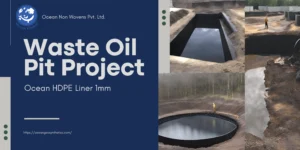 Ocean HDPE Liner 1mm in the Waste Oil Pit Project, Durgapur, West Bengal
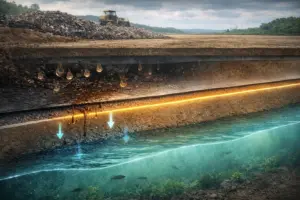 Landfill Protection Using GCL
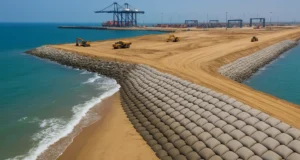 Tuna Tekra Container Development with Ocean Non Woven Geobags