Saving Every Litre in Saurashtra: How Ocean HDPE Liner Sealed the Water Storage Project at Amreli
Project snapshot
Ocean Geosynthetics supplied 3,600 square metres of Ocean HDPE Liner for a water storage structure at Amreli, Gujarat. The structure had to hold its stored volume through a hot, water-scarce climate without losing it to the ground below, so the design team chose an engineered geomembrane over a traditional earthen or masonry lining. In a district where one weak monsoon can decide a farming season, every litre kept in the pond is a litre that reaches a field.
Why line a pond in Saurashtra
Amreli sits in Saurashtra, a semi-arid region with erratic rainfall and heavily drawn-down groundwater. Ponds here have traditionally been lined with compacted earth or masonry. Both seep: an earth-lined pond can lose a large share of what it stores into the subgrade, and masonry cracks at joints as the ground moves and temperatures swing.
A polymeric geomembrane gives a continuous, effectively impermeable barrier with known, tested properties, and it can be laid quickly over a prepared surface. That is why geosynthetics have become the default for lined farm ponds and storage tanks across water-stressed parts of India.
What Ocean HDPE Liner is and how it works
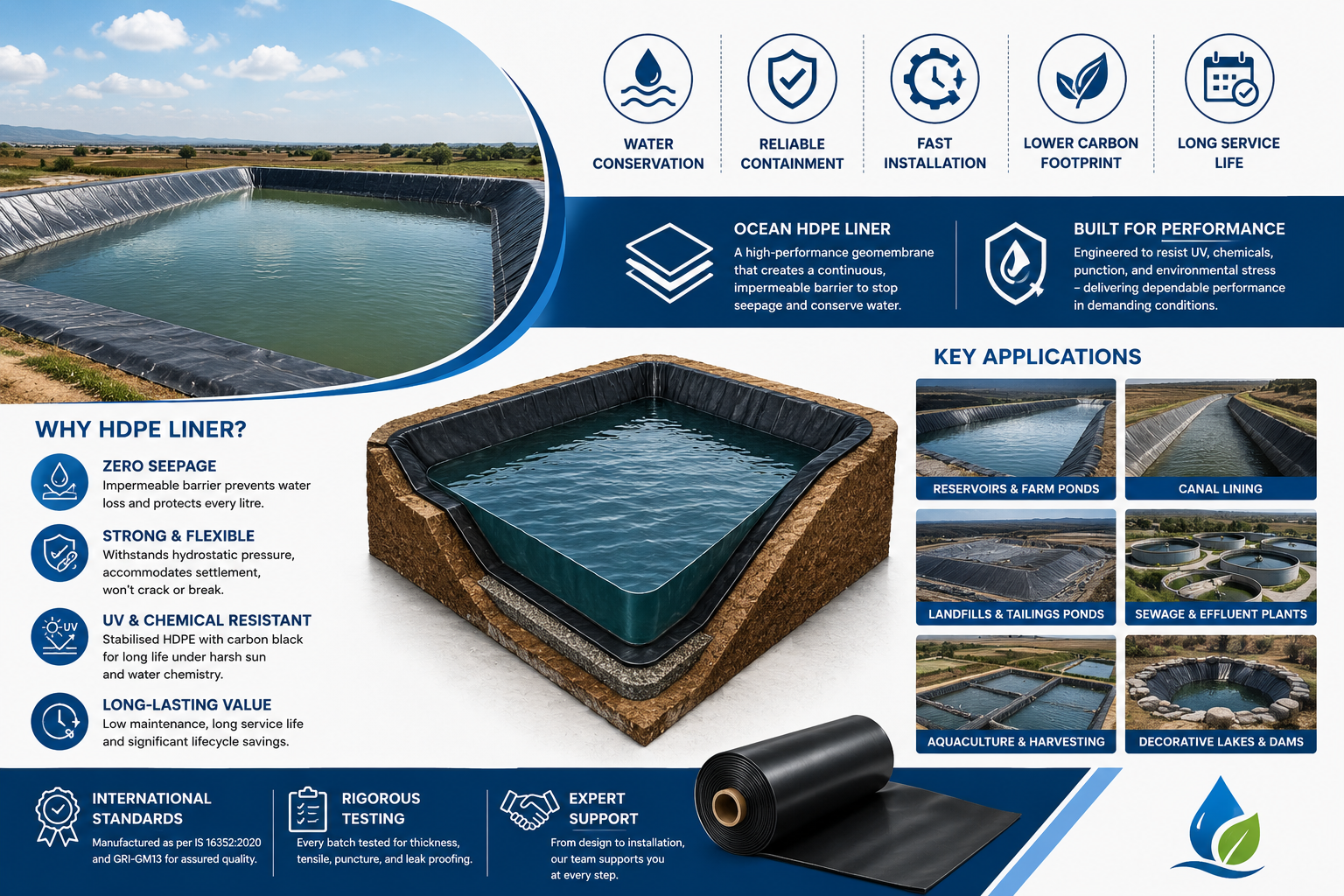
An HDPE liner is a continuous sheet of high-density polyethylene made to a controlled thickness. It does not carry load or confine soil. Its job is to stop water passing through, and the dense, semi-crystalline polymer gives an intact sheet a permeability so low that seepage through it is negligible.
On site, rolls are joined by thermal fusion, usually hot-wedge welding, so a properly made seam is as watertight as the sheet itself. The result is one monolithic membrane across the floor and slopes. Internationally, HDPE geomembrane properties are specified by GRI-GM13 from the Geosynthetic Institute. In India the governing standard is IS 16352:2020, the BIS specification for HDPE geomembranes for lining, which covers smooth and textured sheets and is now under mandatory BIS certification.
Why HDPE over earth or masonry
A compacted clay lining would have needed large volumes of low-permeability soil, which is not always available locally, and it keeps seeping even when well built. Concrete or masonry is durable but brittle: under ground movement and the thermal swings of a semi-arid site it cracks at joints, and each crack is a leak that is hard to find and expensive to repair.
The geomembrane removed the seepage path instead of slowing it. It adds almost no dead weight, installs faster than a poured lining, flexes with minor settlement rather than cracking, and needs a fraction of the material that has to be hauled to a rural site.
The engineering challenges at Amreli
- Subgrade: any stone or sharp fill left in the formation can puncture the sheet once the water load presses down.
- Seepage: the reason the project exists. Water lost to the ground in a water-scarce district does not come back.
- Heat and sunlight: the liner had to tolerate high summer temperatures and UV exposure on the exposed slopes.
- Uplift: groundwater and trapped gas can push the liner up when the pond is drawn down, so venting beneath the liner had to be considered.
- Slopes and anchoring: side slopes face erosion and wave action, and the liner had to be anchored around the crest.
- Programme: like most rural water works, the job was timed around the monsoon.
What the liner does on this structure
The liner’s main function is seepage control: a continuous impermeable barrier between the stored water and the subgrade, so the pond holds irrigation water instead of draining into the ground.
On the embankments it also gives slope protection and erosion control, covering the face against wave action and scour. Because HDPE elongates a long way before it fails, the sheet takes up settlement and thermal movement by stretching rather than tearing, and its chemical resistance means dissolved salts in the stored water do not attack it. Three things govern performance: impermeability of the sheet, correct anchoring so it resists the water pressure without shifting, and tested welds that turn many panels into one barrier. Thickness is chosen to balance puncture resistance against flexibility.
Installation is where ponds succeed or fail
A geomembrane is only as good as its installation. The subgrade has to be smooth, compacted and free of stones, because one sharp protrusion can puncture the sheet under load. A perimeter anchor trench locks the liner in place so it cannot slip down the slope or lift.
Panels should be laid out to keep field seams to a minimum and welded at controlled temperature and speed. Wind can lift an unsecured sheet on an open site, so sandbag ballast stays on until the liner is anchored. In the Gujarat heat the sheet expands during the day, so installers leave deliberate slack and avoid locking it in tension when it cools. Every seam is then tested: dual-track wedge welds by air-pressure testing of the channel between the tracks, and extrusion welds and patches by vacuum box. Poor subgrade preparation, weak weld control and skipped seam testing are the usual causes of leaking lined ponds.
Long-term performance
Ocean’s HDPE resin is stabilised with carbon black for UV resistance, which matters on exposed slopes under the Saurashtra sun. Environmental stress-crack resistance is measured by the notched constant tensile load test to ASTM D5397, which checks the sheet’s resistance to slow crack growth. Tensile yield and break properties are tested to ASTM D6693. Maintenance on a lined pond is mostly keeping vegetation, livestock and sharp debris off the liner and repairing any damage by extrusion-welded patches.
The environmental case follows from the engineering one. Stopping seepage conserves water directly, and replacing bulk clay or concrete with a thin membrane cuts the material quarried and trucked to the site.
Other uses for HDPE liners
The same material lines reservoirs and farm ponds, canals, landfill and tailings containment, aquaculture ponds, rainwater harvesting tanks, sewage and effluent treatment lagoons, biogas digesters, decorative lakes and check dams. More projects are on our case studies page.
Work with Ocean Geosynthetics
Ocean Geosynthetics manufactures and supplies HDPE liners, geomembranes, geocells, geotextiles and allied geosynthetics for water resources, environmental engineering, agriculture, defence, highways, railways and industrial projects across India. If your project involves seepage control, water storage, weak ground or a tight programme, our technical team can help you specify the right grade and supply it at scale.

source on Google
 Slope Protection – Goli Dam, Khairi HP Case Study
 Case Study: Bioenergy Project in Chhatrapati Sambhajinagar, Maharashtra
 Geosynthetics, the way forward for Sustainable Waste Management