How to Choose the Right Walls Retaining Walls
Whether a retaining wall is for a home or a commercial site, several decisions come early: which type of wall suits the site, how deep the footing has to go, whether the wall needs reinforcement, and which material suits the area.
Before choosing how the wall will look, understand the ground and environmental conditions that could make it fail: soil type, groundwater, the slope above and below, and any loads behind it. Retaining walls collapse when these are missed. Below are the main wall types and some points to consider early in design.
Opting for the right wall
Gravity Retaining Walls
Gravity retaining walls are built of concrete, stone or masonry and rely on their own weight to hold back the earth. They are designed against sliding, overturning, bearing failure and, in seismic zones, earthquake loads. Gabion walls, built from stone-filled wire baskets, are a free-draining type of gravity wall.
A crib wall is another kind of gravity wall: interlocking precast concrete (or timber) members form a framework that is filled with free-draining material such as crushed stone. Crib walls are used along roads and highways, and in smaller sizes to hold planters and garden terraces.
MSE Wall
MSE walls are widely used today and also act as a gravity mass. The modern MSE wall dates from the 1960s, when Henri Vidal developed Reinforced Earth. Materials and construction methods have improved a lot since then, but the basic idea is the same.
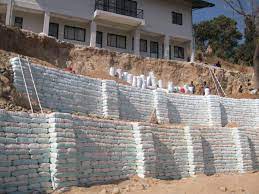
MSE (Mechanically Stabilized Earth) walls hold up slopes and retain fill by reinforcing the soil itself. Layers of reinforcement, such as geogrids or steel strips, are laid in compacted backfill and connected to a facing of precast panels, segmental blocks or wrapped geotextile. The reinforced soil block then acts as one heavy, coherent mass that retains the soil behind it. Ocean supplied 200 GSM geotextile for RE wall panel work in Ganganagar, Rajasthan.
MSE walls are flexible, so they tolerate settlement and withstand seismic loads better than rigid concrete walls. They are also quick to build, and usually cheaper than reinforced concrete walls for greater heights.
Few Tips for choosing the right retaining wall for your property
1. Kind of wall
Before you sign a contract with a builder, decide what material you want the wall made of. Common options are timber, natural stone, concrete and gabions. Timber walls are used less now because they don’t last as long as concrete or stone: wood warps and rots over time, which is costly to fix.
2. Decide how you want to use the wall
Think about how the wall will fit into how you use the space. A low wall might double as a sitting area for the family, which gets more out of the money spent.
3. Be unique
A retaining wall doesn’t have to be plain. A stone wall can frame a garden bed or a fountain area in your yard.
4. Be aware of the height
Height changes everything. Taller walls, and any wall that supports a road, building or steep slope, need to be designed by a qualified engineer, and local building rules may require approval. Skipping this risks a wall failure, and you could be liable if someone is hurt.
If you are unsure whether your wall needs reinforcement at all, our decision guide on geogrid in retaining walls explains when a gravity wall runs out of height and the signs that call for geogrid.
5. Drainage plan
Plan for drainage. Water building up behind a wall adds pressure and is a common cause of failure, and it also leaves standing water in the yard. Place free-draining gravel behind the wall, wrapped in a non-woven geotextile so soil does not clog it, with a perforated drain pipe or weep holes at the base to let the water out.

source on Google
 Namami Gange Project: Using Geosynthetics for Sustainable River Restoration
 How do retaining walls prevent landslides?
 What is Geomembrane lining?