Rajasthan, Army Area Ganganagar -> RE Wall Panel Work
Ocean Global supplied 44000 Sqm of Ocean Geotextile-200GSM for RE (reinforced earth) wall panel work in the Army Area of Ganganagar district, Rajasthan. The site sits on the India–Pakistan border, where the wall had to be built within tight boundaries and on ground that ruled out conventional retaining walls.
Product: Ocean Geotextile-200GSM
Quantity: 44000 Sqm
What an RE wall is
A reinforced earth wall combines compacted soil, which is strong in compression, with layers of reinforcement that are strong in tension. The reinforcement layers run back into the fill behind the facing and hold it together as one block, so the wall resists the lateral earth pressure from the higher ground behind it. Precast concrete panels form the face. RE walls are used where the ground level changes sharply, for example at bridge approaches and raised platforms. In India their design and construction are covered by IRC SP:102, Guidelines for Design and Construction of Reinforced Soil Walls.
Problem
The Army Area lies in the border zone of Sri Ganganagar district. The project needed a strong wall that would not encroach on adjacent land. The soil conditions and type of foundation base made conventional reinforced concrete and gravity retaining walls unsuitable. Other constraints included difficult design conditions, obstructions within the soil mass and restricted working space.
The climate adds its own demands. Ganganagar has very hot summers, cold winters and low rainfall, and the soils are largely fine windblown sand.
Solution
An RE wall suited the site. It is economical and quick to build compared with reinforced concrete walls, needs a lighter foundation, and tolerates some differential settlement because the reinforced soil block is flexible. The wall panels were built with Ocean Geotextile 200 GSM incorporated in the reinforced soil structure.
In RE panel walls, geotextile does several jobs. It is fixed behind the joints between facing panels so that fill cannot wash out through the gaps while water still drains. It separates the select reinforced fill from the native soil behind it, and it wraps drainage layers to keep them clean. The geotextile also contributes to the wall’s resistance to soil movement and erosion. Polypropylene and polyester geotextiles are chemically inert in soil and tolerate the temperature range of the Thar region once buried.
Beyond holding the ground, the panel finish gives a neat appearance, the reinforced soil block helps stabilise the surrounding soil and prevent erosion, and walls of this type are also used in flood protection works.
For other retaining wall and reinforcement products, see Ocean’s geogrids and the case studies page.

source on Google
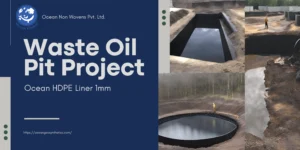 Ocean HDPE Liner 1mm in the Waste Oil Pit Project, Durgapur, West Bengal
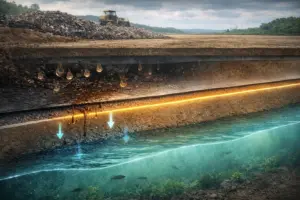 Landfill Protection Using GCL
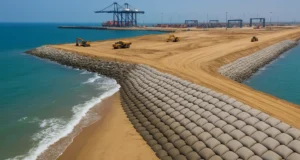 Tuna Tekra Container Development with Ocean Non Woven Geobags