Case Study: Power Grid Project in Gujarat
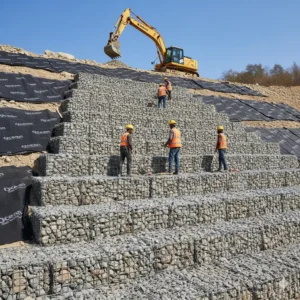
Ocean Non Wovens supplied and installed 1,250 Ocean Hexagonal Woven Double Twisted Gabion Boxes for a power grid project in Gujarat. The boxes protect embankments and foundation areas at the site from erosion and instability, so the grid structures above them stay on firm ground.
Why power grid sites need ground protection
Towers, substations and their access embankments sit on soil that rain, floodwater and wind can wash or blow away. Once a foundation is undermined, repairs mean outages and expensive work. Stone-filled gabions protect that ground in three ways:
- Erosion control: Gabions hold soil in place against water and wind, which matters most around foundations.
- Stability: As heavy, flexible gravity structures, they hold their shape through settlement, floods and ground movement that would crack a rigid wall. Parts of Gujarat, notably Kutch, lie in India’s highest seismic zone.
- Vegetation: Soil and seeds collect in the voids between stones, and plant growth binds the structure into the terrain over time.
Why double-twisted hexagonal mesh
- Galvanised steel wire: The boxes are made from high-tensile galvanised steel wire that carries heavy loads in harsh conditions.
- Double-twisted mesh: Each pair of wires is twisted together one and a half turns at every joint, so if one wire is cut the mesh does not unravel. Welded mesh has no such reserve.
- Free drainage: Water passes straight through the stone fill, so it does not pond or build up pressure behind the structure.
- Easy logistics: Boxes ship flat and light, are assembled on site and filled with local stone, which cuts transport cost.
Double-twisted hexagonal mesh gabions are covered in India by IS 16014 and internationally by ASTM A975. Service life depends mostly on the wire coating: heavy zinc or zinc-aluminium coatings suit dry inland sites, and an added PVC coating is used where water is aggressive or the site is coastal.
How the work was done
- Site assessment: The team surveyed the power grid site to find the areas most at risk of erosion and instability.
- Layout: The gabion layout was designed around the survey findings.
- Installation: Over 1,250 gabion boxes went in at critical points, including embankments and foundation areas, filled with locally sourced stone.
- Quality checks: The installed boxes were checked for structural integrity and alignment.
Good practice on a job like this is to lace adjacent boxes together along all touching edges, fill in layers with internal bracing wires so the faces stay flat, and place a geotextile filter behind the gabions wherever fine soil could wash out through the stone.
Other benefits of gabions
- Noise reduction: Thick stone-filled walls absorb and block sound, which helps where grid facilities sit near homes.
- Appearance: Natural stone faces blend into the landscape better than concrete.
Work with Ocean Non Wovens
Ocean Non Wovens manufactures and supplies gabions and geosynthetics for erosion control, infrastructure stability and environmental projects. Contact us to discuss your site, or see more of our case studies.

source on Google
 The Ultimate Guide to Geosynthetics in Infrastructure Projects in India
 Soil Stabilization with Gabion Boxes in Shujalpur Mandi, Madhya Pradesh
 Ocean Geonet Geocomposite for an RVNL Project in Vasco da Gama, Goa