Case Study: Strengthening Defense Infrastructure with Hexagonal Woven Double Twisted Gabion Boxes in Sirmaur, Himachal Pradesh
Ocean Non Wovens supplied and installed 500 Hexagonal Woven Double Twisted Gabion Boxes on a defence road project in Sirmaur, Himachal Pradesh. The gabions were used to stabilise the road, reinforce embankments and control erosion on a route used for military movement.
The Border Roads Organisation (BRO) builds and maintains the roads that serve as strategic lifelines for India’s armed forces in remote and mountainous areas. Roads like this one have to stay open through heavy monsoon rain and on hillsides prone to slips.
Location: Sirmaur, Himachal Pradesh
Product: Hexagonal Woven Double Twisted Gabion Boxes
Quantity: 500 boxes
Scope: supply and installation
Site challenges
- Steep, unstable slopes: Sirmaur lies in the lower Himalaya and Shivalik hills, where steep cut slopes and loose soils make landslides a constant risk. The slopes needed reinforcement quickly.
- Heavy rain and temperature swings: monsoon downpours saturate the slopes and scour drains and embankments, which limits how well conventional stabilisation methods hold up.
- Strategic importance: the road carries military traffic, so the solution had to be quick to build and durable.
Why gabions suit mountain roads
A gabion is a wire-mesh box filled on site with stone. Stacked and tied together, the boxes form gravity retaining walls, toe walls, breast walls and revetments.
- Soil retention and erosion control: a gabion wall holds back the slope by its weight, and the stone-filled face resists scour from runoff.
- Drainage: water drains freely through the stone fill, so pore pressure does not build up behind the wall, which is a common cause of failure in solid retaining walls after heavy rain.
- Flexibility: a gabion wall can deform and settle with ground movement without losing stability, where a rigid concrete wall would crack.
- Local materials: only the folded mesh travels to site. Stone is usually available locally in hill areas, and filling needs only basic tools and labour.
The double-twisted hexagonal mesh
In double-twisted mesh, adjacent wires are twisted together through one and a half turns to form each hexagon. If one wire is cut or corroded, the twists stop the mesh from unravelling. The galvanised steel wire resists corrosion; PVC-coated wire is used where water or soil is aggressive. In India, double-twisted hexagonal mesh gabions are covered by IS 16014, and ASTM A975 is the corresponding international specification.
The boxes supplied for Sirmaur were selected for:
- Load-bearing capacity: as filled stone units, the boxes can support road embankments carrying military and supply vehicles.
- Durability: galvanised steel wire for corrosion resistance and a long service life.
- Tolerance of ground movement: the double-twisted mesh stays intact through minor shifts in the slope.
- Vegetation: soil washes into the voids over time and plants take root, which helps the wall blend into the hillside.
Other advantages on this site
- Seismic performance: Sirmaur is in a seismically active region. Flexible gabion structures can deform under shaking rather than failing suddenly, which suits earthquake-prone hill roads.
- Maintenance: gabion walls need little routine upkeep. If a section is damaged, it can be repaired by re-lacing mesh or adding boxes instead of demolishing and recasting.
- Speed: gabions are assembled and filled in place with no curing time, which suits projects where the road needs to reopen quickly.
Ocean Non Wovens supplies gabion boxes, rockfall protection and other geosynthetics for hill roads and slope work. See more case studies or call +91 84472 26007.

source on Google
 Geosynthetics for Railway ballast stabilization
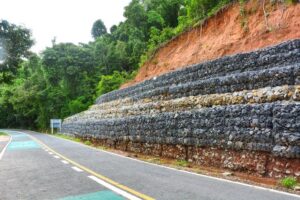 Landslide Protection and Slope Protection With Gabion Retaining Wall
 Advanced Leachate Drainage Infrastructure with Ocean Drainage Geocomposite 5.5 MM in Odisha Landfill Project
