Rockfall Protection & Barriers
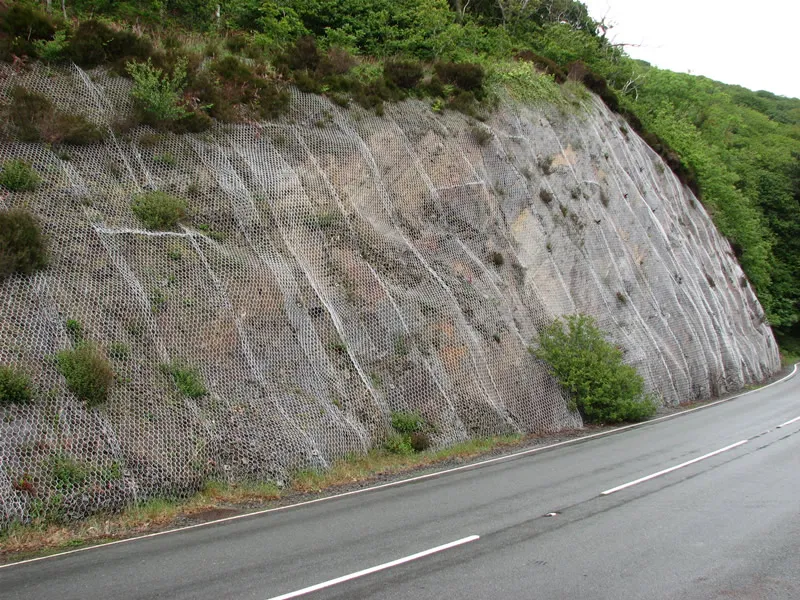
Ocean Geosynthetics supplies steel wire mesh for rockfall protection on road and railway cuttings, hill slopes and mine faces. Our rockfall protection products are made of coated, high-tensile steel wire and are available in different wire diameters and mesh strengths to suit the geology and geometry of the slope. This page explains how rockfall systems work, how to choose between them and what to check in a specification.
Table of Contents
What is rockfall protection?
Rockfall protection covers the measures used to stop boulders and debris from detaching from a slope, or to catch and control them once they fall. Rockfall is a hazard on hill roads, railway cuttings, quarry and mine benches, and new construction where cut slopes have not been fully stabilised.
Mitigation measures fall into two groups:
- Engineered measures: source stabilisation (scaling, anchored mesh, rock bolts), protection works (drapery, barriers, embankments, catch ditches) and avoidance (realigning the road or tunnelling past the hazard). These either reduce how often rock falls or reduce the damage when it does.
- Non-engineered measures: warning signs, inspection and monitoring programmes. They do not change the rockfall process itself.
Rock slopes vary widely in joint pattern, weathering and block size, so there is no rule of thumb that fits every site. Each slope needs a geological assessment of the source zones, likely block sizes and fall paths before a system is selected.
Active and passive systems
Active systems
Active systems hold rock in place at the source so it cannot detach. The usual form is a secured drapery: high-tensile steel mesh pinned tight to the slope with rock anchors or soil nails on a grid, often with perimeter ropes. The anchored mesh applies a surface pressure that keeps loose blocks in place. Active systems are used where the slope surface is fractured and blocks are likely to loosen.
Passive systems
Passive systems accept that rock will detach and control where it goes. They include:
- Simple drapery: mesh hung from anchors at the crest so that falling rock is guided down between the mesh and the slope into a catch ditch at the toe, instead of bouncing onto the road.
- Flexible rockfall barriers (catch fences): steel posts, ropes, energy-dissipating brakes and a ring or mesh net, placed across the fall path to stop moving blocks.
- Rockfall embankments (bunds): reinforced soil embankments built at the toe of the slope as a last line of defence.
Embankments are used when the source areas are too large for meshing alone, and some residual risk remains after treatment at source. They are usually built on flat or gently sloping ground at the toe, with space on the uphill side so intercepted rock can be cleared out. Reinforced soil embankments are ductile: they absorb impacts by deforming rather than collapsing, so they need little maintenance beyond clearing debris. Geosynthetic reinforcement and facing for these embankments is covered on our slope stabilisation page.
What the mesh is made of
Ocean’s rockfall protection mesh is supplied in two grades:
- High-tensile steel wire mesh made of coated wire with a minimum tensile strength of 1770 MPa. The high wire strength gives a lightweight mesh that carries large loads with low deformation, so fewer and lighter anchors are needed. This grade suits secured drapery and areas with larger blocks.
- Coated wire mesh with a wire tensile strength of at least 400 MPa. This is the strength range of standard galvanised double-twisted hexagonal mesh, which is widely used for simple drapery on weathered and fractured slopes. In India, double-twisted rockfall netting is covered by IS 16014.
Both grades are available in various wire diameters and mesh strengths. The wire is coated for corrosion protection; for wet, coastal or aggressive conditions, ask for a heavier zinc or zinc-aluminium coating, or PVC coating over galvanised wire.
How to choose a system
- Block size and energy: small, frequent falls from a weathered face are usually handled with drapery. Larger blocks with a long fall path need a barrier or embankment designed for the impact energy.
- Slope condition: a fractured face that will keep shedding needs active, anchored mesh. A competent slope with isolated loose blocks may need only scaling plus simple drapery or a barrier at the toe.
- Space at the toe: embankments and catch ditches need room between the slope and the road or track. Where space is tight, drapery or a barrier on the slope is used.
- Access for maintenance: every system collects debris. Plan how it will be cleared.
Barrier energy ratings
Flexible rockfall barriers are rated by the impact energy they can stop, measured in full-scale tests. The European assessment document EAD 340059-00-0106 (which replaced ETAG 027) classifies kits by Maximum Energy Level (MEL) and Service Energy Level (SEL), in classes from 100 kJ upwards. When a barrier is specified, ask for the tested MEL, SEL and residual height, and the declaration of performance for the exact kit. In India, IRC:SP:106-2015 (engineering guidelines on landslide mitigation measures for Indian roads) covers slope investigation, hazard assessment and remediation on road projects.
Applications
- Railways and roads: cuttings and hill sections where falling rock threatens traffic.
- Slopes and walls: rock slope protection and stabilisation of fractured faces.
- Mining: benches, haul roads and quarry faces.
- Areas with natural rockfall and landslide risk near buildings and infrastructure.
Our projects include a landslide prevention project in Uttarakhand and rockfall barriers in Wayanad, Kerala.
Installation basics
- Scale the slope first to remove loose blocks and vegetation that would load the mesh.
- Install crest anchors and top support rope, then unroll the mesh panels downslope from the crest.
- Overlap or lace adjacent panels along their full length so there are no gaps for rock to pass through.
- For secured drapery, install slope anchors on the design grid and tension the mesh against the face with spike plates.
- Leave the toe of simple drapery open above a catch ditch so debris can discharge and be cleared.
Related products
- Gabion boxes: toe walls and breast walls at the base of cut slopes.
- Geocells: surface protection and erosion control on soil slopes. See also how geocells help with soil stabilisation and their role in source stabilisation of soil slopes.
- Erosion control mats and blankets: vegetation establishment on slopes after stabilisation.
Frequently asked questions
What is the difference between active and passive rockfall protection?
Active protection holds rock in place at the source, usually with anchored high-tensile mesh. Passive protection lets rock fall and then guides or stops it, using simple drapery, barriers or embankments.
What is drapery mesh?
Drapery is steel wire mesh hung over a rock slope from anchors at the crest. Falling rock is held close to the face and directed into a catch ditch at the bottom.
What does 1770 MPa mean for rockfall mesh?
It is the minimum tensile strength of the steel wire. High-tensile wire lets the mesh carry higher loads at a lower weight than standard galvanised wire mesh.
How is a rockfall barrier rated?
By the impact energy it can stop in full-scale testing, expressed in kJ as a Maximum Energy Level and a Service Energy Level under EAD 340059-00-0106 (formerly ETAG 027).
Does rockfall mesh need maintenance?
Yes. Debris collected behind barriers and at the toe of drapery must be cleared, and the mesh, ropes and anchors should be inspected after major rockfall events and the monsoon.


Related Case Studies