Geosynthetic Clay Liner for Ponds

Table of Contents
An introduction to Geosynthetic Clay and Bentonite Liners
Geosynthetic clay liners (GCLs), also called prefabricated bentonite clay liners, are a factory-made alternative to compacted clay liners. A GCL replaces a thick layer of compacted clay with a sheet less than 10 mm thick that is rolled out on site. Ocean Geosynthetics manufactures and supplies GCLs for these applications.
Besides ponds, GCLs are used in landfills and solid waste containment, canals, reservoirs and ditches, dams, aquaculture, horticulture, decorative ponds, liquid and secondary containment, mining heap leach pads, slag and tailings facilities, and other industrial sites. See Ocean’s GCL landfill case study in Odisha for one example.
A GCL is a layer of bentonite held between two geotextiles (woven or non-woven). Most are needle-punched, so fibres pass through the bentonite and lock the two geotextiles together; some are also thermally treated to anchor those fibres, and others are stitch-bonded. The reinforcement holds the bentonite in place and gives the liner shear strength on slopes. GCLs resist physical and chemical breakdown, which suits them to containment systems and landfills.
Perks of Prefabricated Bentonite Clay Liner:
Ponds are built for water storage, irrigation and fish farming, or as ornamental features. Designing, excavating and maintaining one takes work, and a geosynthetic pond liner makes the sealing part much simpler.
Bentonite liners are called active liners because the bentonite has to hydrate to seal. Sodium bentonite is a natural sealant: it swells when it gets wet and forms a clay layer of very low permeability, typically a hydraulic conductivity of about 1×10⁻¹¹ to 5×10⁻¹¹ m/s for a hydrated GCL. Passive liners, such as RPE or HDPE sheets, are waterproof as delivered and need no activation.
Installed correctly and kept under confining cover, the bentonite swells around small punctures and seals them, including minor damage from installation. Sodium bentonite is one of the most effective pond sealers available.
Because GCLs are made indoors under controlled conditions and tested and inspected before dispatch, their quality does not depend on site weather, temperature or wind, unlike a compacted clay liner. They also take less time and labour to install. Panels are laid with overlaps rather than welded, and the overlaps are usually dressed with extra bentonite powder or paste so they seal when hydrated.
GCL pond liners are flexible, so they do not restrict the shape of the pond. They self-seal, resist chemicals and weather, tolerate differential settlement, and cost less to install than compacted clay. Two points to plan for: a GCL needs a soil cover (commonly at least 300 mm) to confine the bentonite and stop it drying out, and it should first be hydrated with fresh water, because water rich in calcium or salt reduces how far bentonite swells.
Ocean Geosynthetics supplies prefabricated geosynthetic clay liners with low permeability and high internal shear strength, in roll sizes to suit your project.
Contact us with your project requirements, and our sales team will recommend a suitable product and arrange manufacture and delivery to your job site.

source on Google
 The Ultimate Guide to Geosynthetics in Infrastructure Projects in India
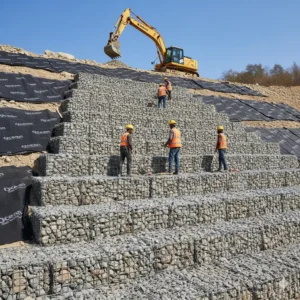 Soil Stabilization with Gabion Boxes in Shujalpur Mandi, Madhya Pradesh
 Ocean Geonet Geocomposite for an RVNL Project in Vasco da Gama, Goa