Case Study: Inland Green Energy’s Ramgarh Project with Ocean HDPE Geomembrane
Introduction
Ocean Non Wovens supplied 8000 Sqm of Ocean HDPE Geomembrane-1.5 mm to Inland Green Energy, a unit of Inland Power, for a facility at Ramgarh, Jharkhand. The liner was installed to contain and manage industrial waste on site so that it could not contaminate the surrounding land and water.
Project Overview
Client: Inland Green Energy (Unit of Inland Power)
Location: Ramgarh, Jharkhand
Product Used: Ocean HDPE Geomembrane-1.5 mm
Quantity: 8000 Sqm
Application: Lining for a sustainable energy facility
Why HDPE geomembrane
High-density polyethylene (HDPE) geomembranes are the standard liner for industrial waste containment because they are effectively impermeable to liquids, resist a wide range of chemicals and hold up under prolonged UV exposure. The widely used specification for smooth and textured HDPE geomembranes is GRI-GM13, which sets minimum values for density (at least 0.940 g/cc), tensile properties, tear and puncture resistance, carbon black content and long-term durability.
Key features of Ocean HDPE Geomembrane-1.5 mm
- Thickness: 1.5 mm (1500 micron), a common thickness for industrial and waste containment that gives good puncture resistance
- Chemical resistance: resistant to a wide range of acids, alkalis and salts found in industrial effluent and leachate
- Durability: carbon black and antioxidants give UV resistance for exposed sections such as side slopes
- Installation: supplied in wide rolls that cover large areas with relatively few seams
Project details
Objective
Inland Green Energy wanted a facility that used local resources efficiently with minimal environmental impact. The HDPE geomembrane was central to that: it contains and manages industrial waste and keeps it out of the surrounding land and water bodies.
Installation process
The 8000 sqm of Ocean HDPE Geomembrane-1.5 mm was installed in four stages:
- Site preparation: the area was cleared and levelled, removing sharp objects and smoothing irregularities that could puncture or stress the liner.
- Liner deployment: the sheets were unrolled and positioned, and adjacent panels were joined by thermal fusion welding to make a continuous watertight lining. On HDPE, the main seams are typically made with a dual-track hot wedge welder, with extrusion welding for patches and details.
- Seam inspection: each seam was checked for continuity and strength using non-destructive tests. The usual methods are air-pressure testing of the channel in dual-track seams (ASTM D5820) and vacuum-box testing of extrusion welds (ASTM D5641).
- Anchor trench: the liner edges were buried in an anchor trench so the liner cannot slip or pull out during operation.
Site challenges
Uneven terrain
Ramgarh sits on the undulating Chota Nagpur plateau, so the subgrade was not uniform. HDPE is fairly stiff, so the liner has to be laid with enough slack to follow changes in level without bridging or being stretched tight, and seams are planned to run up and down slopes rather than across them.
Weather conditions
Installation took place during the monsoon, with heavy rain and muddy ground. HDPE itself is unaffected by water, but fusion welding needs a clean, dry seam area, so wet-weather installation depends on keeping the overlap dry, welding in breaks in the rain and protecting the prepared subgrade from erosion.
Benefits of the HDPE lining
Environmental protection. Inland Green Energy chose Ocean HDPE Geomembrane-1.5 mm mainly for its barrier properties: it stops contaminants leaching into soil and groundwater.
Cost over the life of the facility. A well-installed and covered HDPE liner lasts for decades, so it does not need frequent replacement, which keeps long-term maintenance costs down.
Ocean Non Wovens supplies HDPE geomembranes and other geosynthetics for industrial containment, energy, water and waste projects across India. Contact us to discuss your project, or see more case studies.

source on Google
 Case Study: Enhancing Sustainability in Allahabad’s Bioenergy Project with Ocean HDPE Liners
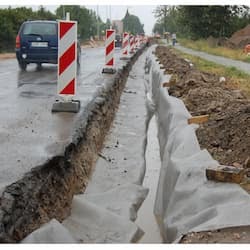 Geotextiles in Pavement and Drainage Applications
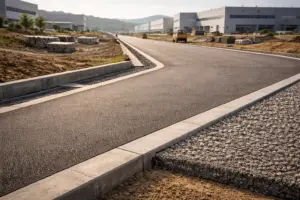 Reliance Project, Jabalpur (Madhya Pradesh): Application of Non Woven Geotextiles for Ground Stabilisation and Drainage Performance
