HDPE vs PVC Geomembrane: Which Liner Material Is Actually Better for Containment?
HDPE and PVC are the two geomembrane materials engineers argue about most. The debate isn’t academic. Pick the wrong liner for a containment project and you’re looking at premature failure, contamination risk, or a budget blowout on repairs. Pick the right one and the system quietly does its job for decades.
The short answer: HDPE wins for most serious containment work. But PVC has legitimate advantages in specific situations, and dismissing it outright is a mistake. Here’s how the two actually compare across the properties that matter.
Material Composition and Why It Matters
HDPE (high-density polyethylene) is a semi-crystalline thermoplastic with minimal chain branching. That tight molecular structure gives it higher density, greater rigidity, and lower permeability compared to other polyethylene variants. Typical HDPE geomembranes contain 2 to 3% carbon black for UV stabilization, plus antioxidants and thermal stabilizers.
PVC (polyvinyl chloride) takes a fundamentally different approach. The base resin isn’t naturally flexible, so manufacturers add plasticizers to make it pliable enough to function as a liner. That’s the core trade-off baked into PVC’s chemistry: the very additives that make it workable can migrate out of the material over time, causing embrittlement and reducing long-term durability.
The additive profile of PVC raises environmental and health concerns that HDPE simply doesn’t share. According to AGRU America, citing the National Institutes of Health, PVC can contain phthalates, traces of bisphenol A (BPA), and may release dioxins. All three are listed as toxins with suspected endocrine-disrupting effects. HDPE is non-toxic and one of the easiest polymers to recycle.
Mechanical Strength and Durability
This is where HDPE pulls away decisively.
BPM Geomembrane’s technical specifications put HDPE tensile strength at 20 to 35 MPa versus 10 to 20 MPa for PVC. Elongation at break favors HDPE as well: 700 to 900% compared to PVC’s 250 to 400%. And puncture resistance data from EcoGeo shows HDPE at 356 N versus PVC at 267 N.
These aren’t marginal differences. HDPE is roughly 33% more puncture-resistant, which matters enormously on sites with rocky subgrades, heavy equipment traffic, or sharp-edged waste materials.
HDPE geomembranes are available in thicknesses from 0.5 to 3.0 mm, while PVC liners typically max out at 1.5 mm. For a 1.0 mm HDPE sheet, yield strength runs 25 to 27 kN/m with break strength of 35 to 40 kN/m. At the heavy end, a 3.0 mm HDPE liner delivers 65 to 70 kN/m yield and 95 to 100 kN/m break strength.
Service Life
The lifespan gap is the single most important differentiator for long-term projects. HDPE geomembranes consistently deliver 30 to 50 years of service, with some buried installations projected to last up to 80 years. PVC liners typically last 10 to 25 years.
That’s not a minor difference. It’s the difference between installing a liner once and installing it three times over the life of a facility.
Chemical Resistance
HDPE’s chemical resistance is rated excellent against acids, bases, and hydrocarbons. PVC’s resistance is moderate at best and notably weaker against solvent-based contaminants. For any project involving hazardous waste, industrial leachate, or chemical storage, this comparison isn’t close.
AGRU America notes that HDPE’s chemical resistance is “among the best of commonly used lining materials and far better than PVC, especially against acids, bases, and hydrocarbons.” PVC liners can break down when exposed to aggressive chemicals, and the plasticizers that give PVC its flexibility are themselves vulnerable to leaching under chemical exposure.
The permeability difference compounds this problem. PVC permeability runs about two orders of magnitude higher than equivalent-thickness HDPE. That means contaminants are significantly more likely to migrate through a PVC liner into surrounding soil and groundwater, even before accounting for chemical degradation of the liner itself.
Temperature and UV Performance
Both materials handle heat reasonably well. Cold weather is where they diverge sharply.
PVC becomes brittle at around -40°C. HDPE maintains flexibility down to approximately -90°C. For projects in northern climates, high-altitude sites, or anywhere that sees hard freezes, HDPE is the only sensible choice. PVC’s plasticizers can harden in freezing conditions, reducing flexibility and requiring additional anchoring measures.
UV resistance follows a similar pattern. HDPE geomembranes with carbon black stabilization offer excellent long-term UV resistance without requiring a protective cover. PVC liners generally need to be covered or otherwise protected from prolonged sun exposure, as extended UV exposure accelerates aging.
Installation: Where PVC Has a Real Advantage
Credit where it’s due. PVC is genuinely easier to install.
PVC liners are lighter, more flexible, and can be supplied as prefabricated panels that reduce field seaming by as much as 80%. They conform readily to irregular shapes, complex geometries, and uneven subgrades. For small ponds with odd contours or decorative water features, PVC’s pliability is a legitimate practical benefit.
HDPE installation demands more. The material requires hot-wedge or extrusion welding with specialized equipment, performed by certified welding technicians under strict temperature and speed controls. More field seams are needed. The process is slower and more expensive.
But here’s the counterpoint: HDPE’s heat-welded seams create stronger, more reliable bonds than PVC’s adhesive-based seams. PVC seams made with chemical adhesives can weaken over time, making them more vulnerable to leaks and seam failures. You’re trading easier installation for lower long-term seam integrity.
HDPE can also be manufactured with a conductive layer that supports spark testing per ASTM D7240, enabling enhanced construction quality assurance testing for holes, punctures, tears, and other breaches during and after installation. PVC lacks this capability.
Cost: Upfront vs. Lifecycle
PVC costs less to buy and less to install. That’s the beginning and end of its cost advantage.
HDPE carries higher material and installation costs due to thicker sheets, specialized welding equipment, and the need for trained technicians. For a budget-constrained temporary project, PVC’s lower upfront price makes sense.
For anything meant to last, the math flips. A PVC liner replaced every 15 to 20 years will cost more over a 50-year project lifespan than a single HDPE installation. Add in the downtime, environmental risk, and remediation costs associated with a premature liner failure, and HDPE typically provides lower lifecycle cost.
When to Choose HDPE
HDPE is the right material for the majority of engineered containment applications:
- Landfill primary and secondary liners, and final caps
- Mining tailings ponds and process water containment
- Industrial wastewater lagoons
- Chemical treatment and storage ponds
- Any project with a design life exceeding 20 years
- Cold-climate or high-UV-exposure installations
- Sites where hazardous or aggressive chemicals will contact the liner
For landfills specifically, HDPE remains the benchmark material per global sanitary standards due to its proven impermeability and compatibility with composite lining systems pairing geosynthetic clay liners (GCL) with geotextile protection layers.
When PVC Actually Makes Sense
PVC isn’t the wrong choice everywhere. It fits a narrower set of applications:
- Temporary containment and covers for non-hazardous materials
- Small decorative ponds and water features with complex shapes
- Aquaculture systems where flexibility and ease of field modification matter more than chemical resistance
- Short-duration projects under 15 years where budget is the primary constraint
If the liner won’t contact aggressive chemicals, doesn’t need to survive extreme temperatures, and won’t be expected to perform for more than two decades, PVC can be a reasonable, cost-effective option.
Common Questions
Which geomembrane material has lower permeability?
HDPE, by a wide margin. PVC permeability is roughly two orders of magnitude (100x) higher than equivalent-thickness HDPE. This makes HDPE far more effective at preventing contaminant migration into soil and groundwater.
Can PVC and HDPE liners both be welded?
Yes, but with different methods and results. HDPE seams are heat-welded, producing strong, durable bonds that can be tested with specialized equipment. PVC typically uses chemical adhesives or solvent welding, which is simpler but produces weaker seams that may degrade over time.
Is HDPE or PVC better for pond liners?
It depends on the pond. For large agricultural irrigation reservoirs, stormwater basins, or any pond holding potentially contaminated water, HDPE is the better choice. For a small backyard decorative pond with irregular contours, PVC’s flexibility makes installation easier and the lower durability requirements are acceptable.
What thickness of HDPE geomembrane should I use?
Thickness selection depends on the application. HDPE geomembranes range from 0.2 mm to 3.0 mm. Thin liners (0.5 to 1.0 mm) suit small ponds and secondary containment. Landfills and mining applications typically require 1.5 to 2.5 mm. A mining process water containment facility covering 90,000 m² selected 1.5 mm HDPE based on chemical exposure conditions and a target service life exceeding 40 years.
For most engineered containment projects, HDPE is the stronger choice across nearly every performance metric that matters: strength, chemical resistance, UV stability, cold-weather performance, permeability, service life, and lifecycle cost. PVC’s advantages are real but narrow, limited to situations where flexibility, ease of installation, and low upfront cost outweigh long-term performance requirements. If you’re designing a system meant to protect the environment for decades, the material science points clearly in one direction.

source on Google
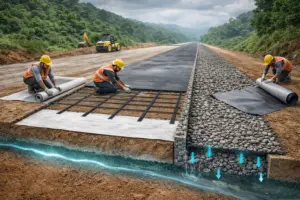 Multi-Geosynthetic Highway Project
 How Thick is a Geotextile?
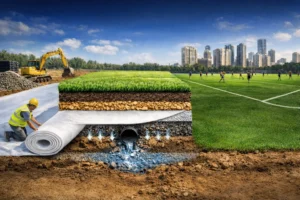 Football Project: How Ocean Non Wovens’ 120 GSM Nonwoven Geotextile Delivered a Durable, Drainage-Ready Field in Mumbai