NHAI Project in Raebareli, UP: A Case Study on the Use of Ocean Geogrid-20Kn PP
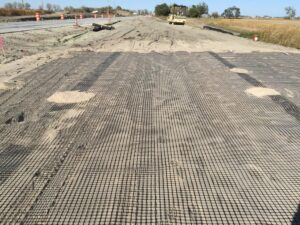
For a National Highways Authority of India (NHAI) road project in Raebareli, Uttar Pradesh, 37,500 square meters of Ocean Geogrid-20Kn PP were used to reinforce the pavement over weak, unstable soil. This case study covers the ground conditions, why a polypropylene geogrid was chosen, and how it was installed.
The challenge: unstable soil
Raebareli lies on the Gangetic plain, and the soil along the alignment is predominantly silty and clayey. Soils like this are moisture-sensitive: they lose strength when wet, and they move as they wet and dry, which leads to subsidence and low load-bearing capacity under a road. Lime or cement treatment of the subgrade was considered and judged unsuitable for this project.
Why Ocean Geogrid-20Kn PP
Ocean Geogrid-20Kn PP is a polypropylene geogrid. Placed beneath the granular layers, the grid’s apertures lock the aggregate in place, so it cannot spread sideways under wheel loads. The confined layer spreads load over a wider area of weak subgrade, which reduces rutting and settlement. The reasons it was chosen:
- Tensile strength: the geogrid has a tensile strength of 20 kN/m (tested to methods such as ASTM D6637 or ISO 10319), enough to reinforce the base and reduce the risk of subsidence.
- Durability: polypropylene resists chemical and biological degradation in soil, so the buried grid keeps working long term.
- Ease of installation: the rolls are light and easy to handle, which cuts installation time and labour and helps the project keep to its programme.
- Cost: a more stable pavement needs less frequent maintenance, and reinforcement can reduce the granular thickness needed over weak soil.
Implementation
- Site preparation: the existing soil was excavated and levelled to form a stable base for the geogrid.
- Geogrid installation: rolls of Ocean Geogrid-20Kn PP were laid across the prepared formation and anchored so they would not shift during later construction. Adjacent rolls are normally overlapped, with wider overlaps on softer ground.
- Filling and compaction: aggregate was spread over the geogrid and compacted in layers until the design thickness was reached. Good practice is to tip and spread aggregate from the already-covered area, so construction traffic never runs directly on the bare grid.
- Surface layers: the upper pavement layers and final surfacing were then built on the reinforced base.
IRC SP:59, the Indian Roads Congress guidelines for geosynthetics in road pavements, covers the design and installation of geogrid-reinforced bases of this kind.
The outcome
The Raebareli road built with Ocean Geogrid-20Kn PP met its performance requirements. Reinforcing the base reduces the risk of subsidence on this soil and is expected to extend the road’s service life.
Other applications
The same geogrid can reinforce the embankments of reservoirs and other water storage facilities, as well as working platforms, hardstands and unpaved roads over soft ground.
Ocean Non Wovens manufactures and supplies geogrids and other geosynthetics for roads and infrastructure. See more case studies or contact us to discuss your project.

source on Google
 Football Project: How Ocean Non Wovens’ 120 GSM Nonwoven Geotextile Delivered a Durable, Drainage-Ready Field in Mumbai
 How Ocean Non-Wovens Biaxial Geogrid helped ensure the success of a construction project in Bhubaneswar, Odisha
 Slope and Drainage Protection Using GCCM in Jaipur, Rajasthan