Geocells and Geogrids, Performance and Comparison
Geosynthetics are used more in civil engineering every year, because they are quick to install, durable and often cheaper than traditional methods. Geocells and Geogrids are two of the most widely used, both for reinforcement and stabilization. They work in different ways, they are not interchangeable, and the project decides which one fits. Here is how geocells and geogrids compare in performance.
Demand for both is rising with investment in roads, railways and other transport infrastructure. Ocean Geosynthetics manufactures and supplies both Geocells and Geogrids.
What are Geocells?
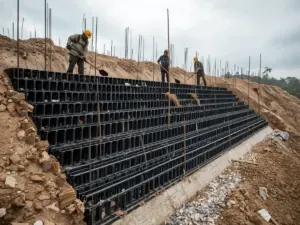
Geocells are three-dimensional, interconnected cells that look like a honeycomb. The cells are filled with soil, granular material or concrete, depending on the project. Once filled, the geocell layer acts as a stiff mattress that spreads load and improves bearing capacity. Also known as Cellular Confinement Systems (CCS), geocells are usually made of high-density polyethylene (HDPE) strips welded together at regular intervals. When the panel is pulled open, perpendicular to the strips, it forms the honeycomb.
What are Geogrids?
Geogrids are flat, two-dimensional grids with large openings (apertures). They are made either by punching and stretching polypropylene or HDPE sheet (extruded geogrids), or by weaving or knitting polyester yarns and coating them with PVC, PE or bitumen. By structure they are uniaxial (strength in one direction, used in walls and steep slopes), biaxial (strength in both directions, used under roads and platforms) or triaxial. Good geogrids combine tensile strength, in-plane stiffness and aperture stability, so the aggregate locks into the apertures and is held in place.
Comparison of the performance and limitations of Geocells and Geogrids:
Both are used in roads, pavements and slope reinforcement. Both are strong, corrosion resistant and long-lasting. The differences below decide which suits a given site.
Physical Structure: a geocell is three-dimensional, so its walls confine the infill on all sides. That lets it work with poorer, locally available fill, and on slopes and channels it holds topsoil or gravel in place against erosion. A geogrid is two-dimensional: it reinforces the aggregate that interlocks with it, so it relies on a well-graded granular base above it.
Performance: soft subgrades are a challenge for any road or loaded surface. Geocells give a stiff, confined layer that works well over very soft ground and where good aggregate is scarce. Geogrids are also widely used on soft subgrades, usually with a geotextile separator beneath; they are cheaper per square metre and quicker to lay, while geocells take more time to expand, pin and fill.
Bearing capacity: a single geocell layer filled with aggregate forms a self-supporting slab, which suits heavily loaded areas such as haul roads and container yards. A geogrid design may need more than one layer, or a thicker base, to carry the same load.
In short, geocells give stronger lateral confinement, can reduce pavement thickness over soft subgrades and can use lower-grade infill. Geogrids are the more economical choice where good aggregate is available and the subgrade is not extremely weak. On some projects the two are used together.
Contact Ocean Geosynthetics to discuss which geosynthetic products suit your project.
Frequently Asked Questions (FAQ)
What is the typical thickness of Geocell panels?
Geocell is usually specified by cell height (depth) rather than sheet thickness. Common cell heights range from 50 mm to 200 mm, chosen according to the load and the depth of infill needed.
Can Geocell be used in landfill applications?
Yes, Geocell is often used in landfill applications to provide stability and prevent soil erosion on slopes.
Does Geocell provide any sound insulation benefits?
Not by itself. Geocell is a soil confinement product. Soil-filled, vegetated earth berms or walls built with geocell can act as noise barriers, but the reduction comes from the mass of soil, not from the cells.

source on Google
 Are Gabions Cheaper Than a Retaining Wall?
 Gabion Walls In Landscaping
 The role of Geocells for Soil Stabilization
