Case Study: Advanced Pond Lining with Ocean Geotextile 250 GSM in Bhopal, MP
Ocean Non Wovens supplied 4400 sq m of Ocean Geotextile 250 GSM for a pond lining project in Bhopal, Madhya Pradesh. This case study covers why the pond needed a lining system, what a 250 GSM non-woven geotextile does in one, and how it was installed.
Project at a glance
- Location: Bhopal, Madhya Pradesh
- Application: pond lining for water conservation
- Product: Ocean Geotextile 250 GSM (non-woven)
- Quantity: 4400 sq m
The challenge: holding water through the dry season
Bhopal is known as the City of Lakes, but water supply still swings with the seasons, and demand from agriculture and industry keeps rising. Unlined or poorly lined ponds lose a large share of their water to seepage into the ground. The project needed a lining system that would hold water reliably and last.
What the geotextile does in a pond lining
A non-woven geotextile is permeable, so on its own it does not stop seepage. In a pond lining system it works with an impermeable layer, usually an HDPE pond liner. Placed between the prepared pond bed and the liner, a 250 GSM needle-punched non-woven:
- Cushions the liner: it protects the geomembrane from puncture by stones, roots and angular soil particles in the subgrade, both during installation and once the weight of water is on it.
- Separates and filters: it keeps fine soil in place while letting water and gas beneath the liner move freely, which helps prevent soil loss and the build-up of trapped gas or water under the liner.
- Resists site handling: its tensile and puncture strength lets it survive placement on a rough bed without tearing.
- Is easy to lay: it is light and flexible, so crews can roll it out quickly over sloped and uneven surfaces.
Polypropylene and polyester geotextiles resist the chemicals found in normal soils and water. Like most polymers they degrade under prolonged sunlight, so they should be covered by the liner or soil soon after placement.
Installation in Bhopal
- Site preparation: the pond bed was cleaned and sharp objects removed so they could not damage the lining layers.
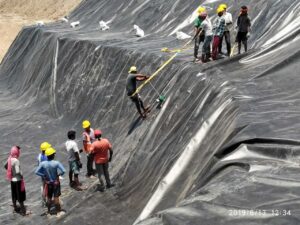
- Geotextile placement: Ocean Geotextile 250 GSM was laid out systematically with overlaps at every joint, so the bed stayed fully covered with no gaps.
- Seaming and anchoring: seams were thermally bonded, and the edges were anchored with concrete blocks to hold the fabric in place.
- Inspection: the installed geotextile was inspected for correct overlaps, bonded seams and any damage before the next layer went on.
On jobs like this, it is worth checking each roll on delivery against the specified mass per unit area (ASTM D5261) and keeping rolls wrapped and off the ground until they are laid.
Benefits
- Better water retention: a protected liner is far less likely to be punctured, so the lining system keeps holding water for agricultural and other uses.
- Lower maintenance: fewer liner repairs over the life of the pond.
- Soil and water protection: the geotextile holds the bed soil in place, which helps limit erosion and keeps the water cleaner.
Ponds like this one improve local water availability and support farming through the dry months. For geotextile or pond liner requirements, contact Ocean Non Wovens, or see more of our work on the case studies page.

source on Google
 How geomembranes can be used for rainwater harvesting?
 Slope and Drainage Protection Using GCCM in Jaipur, Rajasthan
 A Comprehensive Guide on What is Jute Geotextile
