Anti Hail Netting
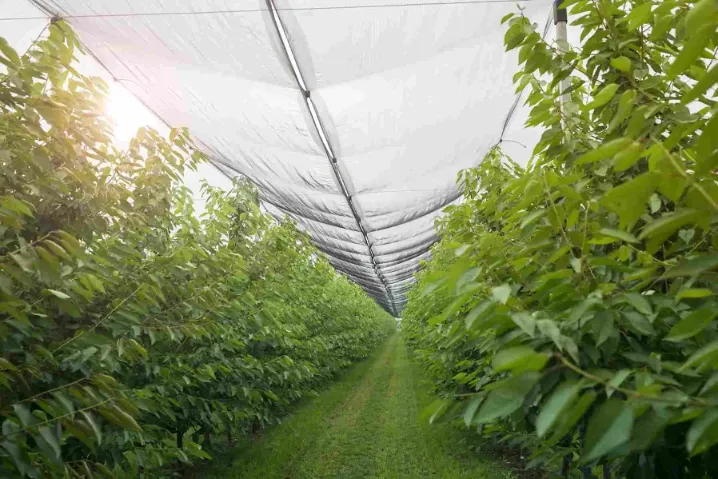
Ocean Geosynthetics manufactures and supplies anti-hail netting knitted from UV-stabilised HDPE. The net is stretched over orchards, vineyards and nurseries so hailstones bounce off before they reach the fruit, and it also keeps birds off the crop. It is knitted up to 9 metres wide, with other widths on request.
Table of Contents
What is anti-hail netting?
Anti-hail nets shield crops from hailstorms, strong wind and birds. A single hailstorm can strip leaves, bruise and split fruit, and break shoots, and bruised fruit loses its market grade even when it survives. Hail wounds also give fungal and bacterial infections a way in, which can cut the following season’s yield. In India, hail nets are used most widely in the apple orchards of Himachal Pradesh, Jammu and Kashmir and Uttarakhand, and increasingly over grapes, pomegranates, stone fruit and nurseries in other hail-prone areas of agriculture.
Ocean’s hail net is knitted from high-density polyethylene (HDPE) with a 4 mm x 7 mm mesh, and UV-stabilised to withstand years of strong sunlight. The result is a light but tough fabric that resists rips, tears and abrasion. Sector: agriculture. Function: protection from hail, wind and birds.
How anti-hail netting works
The mesh openings are smaller than damaging hailstones, so the stones are stopped above the canopy. The net is elastic, so it absorbs the impact rather than transmitting it to the fruit. On an orchard frame the net is held up along ridge wires over each row and pulled down into valleys between rows with special clips. Hail lands on the net, rolls down into the valley and falls between the rows, away from the trees. Ridge wire supports and valley connectors take the load at the reinforced centre and edges of the net.
Because the net is open and translucent, light, air and rain pass through. Shading under a light-coloured hail net is low, so photosynthesis and fruit colour are not seriously affected.
Composition of anti-hail netting
The net is knitted from virgin HDPE monofilament on a specialised machine, which gives high tensile strength and some elasticity. Knitted (rather than woven) construction means a cut or a broken strand does not unravel across the net. UV stabilisers in the polymer slow the degradation that sunlight causes in unprotected polyethylene.
The net is flexible, light and easy to spread, and it can be supported on simple structures as well as engineered orchard frames. It can be taken down and reinstalled each season if needed.
Grades and choosing a net
Ocean supplies hail nets in different densities, including 30% and 50% shade grades. A denser net blocks more light and gives more shade. Points to consider:
- Hail size in your area: the 4 x 7 mm mesh stops typical hailstones; very large hail calls for a strong frame and well-tensioned net.
- Crop light needs: fruit crops that need full sun for colour and sugar do better under a lighter net. Nurseries and leafy crops can take more shade.
- Colour: white or clear nets shade least; darker nets shade more.
- Width: choose a width that spans your row spacing with enough for the valley overlap. Ocean knits up to 9 m wide.
- Subsidy: anti-hail nets are covered under the Mission for Integrated Development of Horticulture (MIDH), and several state horticulture departments give subsidies. Check the current rate with your district horticulture office before buying.
Installation
Anti-hail netting can be draped directly over trees or held in a ridge-and-valley system with clips. A permanent frame typically uses poles along each row, a ridge wire on top, and anchored side and end wires, with the net tensioned over the ridges and clipped together in the valleys. Install the net before the hail season and the fruit-set stage. In heavy-snowfall areas, roll up or remove the net in winter so snow load does not damage the frame. The nets are designed to be simple to install and remove; Ocean can advise on the layout for your orchard.
Salient features
- Easy to install
- Lightweight
- UV stabilised
- High strength and durability from knitted HDPE monofilament
- Designed to stop hail before it reaches the canopy
- Low shade factor, letting in natural sunlight and ventilation
- Long-lasting, reusable season after season
Applications
- Apple, pear, cherry and stone fruit orchards
- Vineyards
- Pomegranate and other fruit orchards in hail-prone districts
- Covers on greenhouses and over tunnels
- Nurseries, buds and seedlings
- Protection from wind and birds
- Pest control to an extent, by keeping out birds and some larger insects
Advantages of anti-hail netting
(i) Hail
Hailstones are lumps of ice formed in thunderstorm clouds. Falling on a crop, they can break shoots, strip leaves and bruise or split fruit. An anti-hail net stops the stones above the canopy, so most of the crop is saved, and the harvest is no longer at the mercy of a single storm.
(ii) Bird screening
Birds peck fruit and eat seeds and buds, and a damaged fruit cannot be sold at full grade. A net that covers the crop, closed at the sides, keeps birds away from it.
(iii) Wind and heavy rain
The net slows strong wind across the canopy, which reduces fruit rub, leaf damage and fruit drop. Rain still passes through the mesh, so irrigation and natural rainfall reach the soil, but the net breaks up heavy drops and so reduces their impact on flowers and soft fruit. It does not keep the crop dry; for that, a rain cover or polyhouse is needed.
(iv) Frost
On clear, still nights a net cover reduces heat loss from the canopy slightly, which can give limited protection against light frost. It is not a substitute for proper frost protection in severe conditions.
Frequently asked questions
What mesh size is anti-hail net?
Ocean’s HDPE anti-hail net has a 4 mm x 7 mm mesh.
Does anti-hail net reduce sunlight?
A little. Light-coloured hail nets have a low shade factor; denser grades shade more. Choose the grade to suit how much light your crop needs.
How wide is the net?
Knitted up to 9 m wide. Other widths are available on request.
Is there a subsidy for anti-hail nets?
Anti-hail and anti-bird nets are an eligible component under MIDH, and several states run their own subsidy schemes. Rates change, so confirm with your state horticulture department.
Does the net stop rain?
No. Rain passes through the mesh. The net reduces the force of heavy drops but does not keep the crop dry.

Related Case Studies
