Pros and Cons of Gabions: A Comprehensive Look
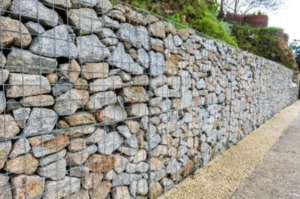
Gabions are wire-mesh cages filled with stone, used for retaining walls, slope protection and river bank work. This post covers what they are, the main types, and where they work well and where they don’t.
Table of Contents
What are Gabions?
The word comes from the Italian gabbione, meaning “big cage”. A gabion is a wire-mesh cage filled with stone, cobbles or other durable inorganic fill. Stacked and laced together, the cages form a heavy, free-draining wall or lining.
Civil engineers have used gabion walls for a long time to control slope erosion and to protect shorelines, river banks and road embankments. In gardens and landscaping, the same cages serve as retaining walls, boundary walls and planters.
A gabion retaining wall works by its own weight, as a gravity wall. Most are built with a stepped or battered face, each course set back so the wall leans into the soil it retains, which adds to its stability.
The Types of Gabion Walls
Gabions are grouped by shape, use and mesh type:
- Gabion baskets (boxes): rectangular cages, typically 0.5–1 m deep, stacked in courses to build retaining walls, abutments and check dams.
- Gabion wire mesh: the mesh itself, either double-twisted hexagonal woven mesh, which flexes with ground movement, or welded square mesh, which keeps a flatter face and is common in landscaping.
- Gabion mattresses: wide, shallow units (often 0.15–0.3 m thick) laid flat or on gentle slopes to line channels, protect river beds and armour banks.
Pros of Gabions
- Quick to build: the cages arrive flat-packed, are opened, laced and filled on site, and need no curing time, so walls go up faster than masonry or concrete. A structural wall still needs an engineered design and a supervised crew.
- Easy to transport and handle: folded cages are light and compact, and the fill is often local stone. Units can be dismantled and reused.
- Economical: where suitable stone is available near the site, a gabion wall usually costs less than a reinforced concrete wall of the same height.
- Free-draining: water passes through the voids in the stone fill, so water pressure does not build up behind the wall. This makes gabions a good choice for retaining walls in wet climates and along rivers.
- Durable: with galvanised or PVC-coated wire and hard, non-weathering stone, gabions last for decades.
- Flexible: the mesh deforms with settlement and ground movement instead of cracking. Rigid brick, stone-masonry and concrete walls tend to crack under the same movement, seepage and wear.
- Lower embodied carbon: a gabion wall uses far less cement than a concrete wall, and vegetation can grow into the fill over time.
- Appearance: the stone face suits gardens, landscaped slopes and residential boundaries.
Cons of Gabions
- Filling cages by hand is labour-intensive, so assembly on a large project takes time.
- They cost more than a wooden fence.
- Large projects need heavy machinery to place stone and lift filled units.
- Wire corrosion is the main long-term risk. In saline, polluted or abrasive water, specify PVC-coated or heavier galvanised wire, and place a geotextile filter behind the wall so fine soil does not wash out through the stone.
Ocean Global supplies gabion boxes and mattresses for retaining walls, river bank protection and slope work. Our team can help you pick the mesh, wire coating and unit size for your site.
FAQs
Are gabions suitable for high-flow water channels?
Yes, gabions are often used in high-flow water channels as they allow water to pass through the gaps in the mesh, reducing the risk of erosion and providing stability.
How are gabions connected to each other?
Gabions can be connected using wire or fasteners to form a continuous structure, ensuring stability and strength.
Can gabions be used for bank stabilization?
Yes, gabions are commonly used for bank stabilization along rivers, lakes, and other water bodies to prevent erosion and maintain the integrity of the banks.

source on Google
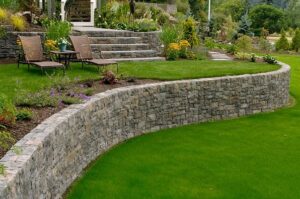 How to Choose the Right Walls Retaining Walls
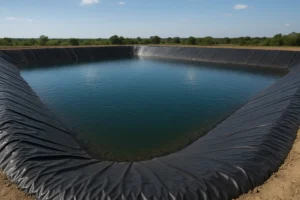 Case Study: Enhancing Water Retention Efficiency in Jaipur with Ocean HDPE Liner 750 Micron (5,500 SQM)
 Case Study: Preventing Landslides in Nanded, Maharashtra with Ocean HDPE Liner – 1000 Micron
