Gabion Box

Ocean Geosynthetics supplies wire mesh gabions for retaining walls, river training, slope protection and landscape work: double-twisted hexagonal gabion boxes, welded mesh gabions, gabion and revet mattresses, gabion sacks and loose wire mesh, in galvanised or PVC-coated wire. This page explains how gabions work, what to specify, and how to install them so the structure behaves as designed. For a plain-language overview, see our article on what gabions are used for.
Table of Contents
What are gabions?
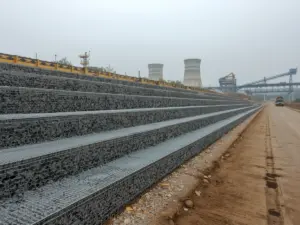
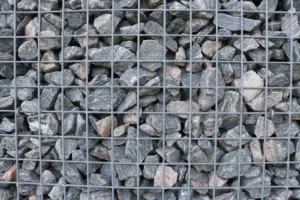
Gabions take their name from the Italian word for a large cage. A gabion is a wire mesh container that is delivered flat, assembled on site, laced shut and filled with hard stone. Stacked and tied together, the filled units act as one flexible, free-draining gravity structure.
The cages can be made from galvanised steel, PVC-coated galvanised steel, stainless steel or bare steel, depending on the exposure. Infill is usually quarried rock or river boulders; architectural gabions sometimes use crushed concrete, glass rock or cut stone. Sand and soil are not used as gabion fill on their own because they wash out through the mesh; where finer fill has to be contained, it goes into geo bags instead.
Three properties explain why engineers choose gabions over a rigid wall:
- Permeability: water drains freely through the stone, so little hydrostatic pressure builds up behind the wall. A separate weep-hole system is usually not needed, although a geotextile filter is still required between the gabion and the retained soil.
- Flexibility: the mesh lets the structure settle and deform on soft ground or under scour without cracking, which suits riverbanks and unstable slopes where a concrete wall would fail.
- Strength: a filled gabion wall resists earth pressure by its own weight, and the stone face withstands floods, heavy rain and debris impact.
On cost, a gabion wall uses local stone and unskilled labour, and needs no formwork or curing time. Whether it works out cheaper than a reinforced concrete wall depends on stone availability and wall height; our article on gabions versus conventional retaining walls covers the comparison.
Types of gabions Ocean supplies
Double-twisted hexagonal gabion box
The standard civil engineering gabion. Pairs of wires are twisted together through three half-turns to form a hexagonal mesh. If a wire is cut, the twist stops the mesh from unravelling, and the hexagonal pattern lets the box deform without losing its shape. This is the type covered by IS 16014 in India, ASTM A975 and EN 10223-3. It is the usual choice for retaining walls, river training, bridge approach protection and slopes in seismic or settlement-prone areas. Ocean also lists this product as hexagonal gabion box, woven mesh gabion box and wire crate; these are names for the same double-twisted product.
Welded mesh gabion box
Made from welded steel mesh panels (square or rectangular openings) joined with spiral binders or clips. The panels are stiffer, so the face stays flat and square, which is why welded gabions are used for architectural cladding, garden walls, boundary walls and decorative work. Welded mesh accommodates less settlement than double-twisted mesh, so it is a poorer fit for scour-prone riverbanks. Welded gabions are covered in Europe by EN 10223-8. Ocean’s range includes welded gabion baskets and grid gabion boxes.
Gabion mattress and revet mattress
A gabion mattress (also called a revet mattress) is a shallow, wide unit, typically 0.15 to 0.30 m thick, divided into cells by internal diaphragms. Mattresses line channels, canal beds and riverbanks, protect slopes from erosion and form launching aprons at the toe of embankments. Because they are thin, they follow uneven ground closely; the required thickness depends on flow velocity, and IRC:SP:116 gives design guidance for this.
Gabion sacks
Cylindrical mesh units that can be filled and placed quickly, often from a bank or a boat. They are used for emergency flood repairs and underwater placement where a box cannot be assembled in position.
Wire mesh
Ocean also supplies double-twisted and welded wire mesh in rolls for custom gabion fabrication, fencing and slope reinforcement. Hexagonal mesh is also used as drapery for rockfall protection.
Wire coating: galvanised or PVC-coated
Gabion life is set by the life of the wire coating, so the coating is the main durability decision.
- Galvanised (zinc-coated) gabions: heavily zinc-coated wire for retaining walls, drainage structures and river training in fresh water and normal soils. Zinc-aluminium alloy coatings (Zn-5%Al, often sold as Galfan) are also used for longer life in the same exposures.
- PVC-coated gabions: a polymer coating, typically around 0.5 mm thick, extruded over galvanised wire. Specify PVC coating for coastal and marine works, saline or polluted water, acidic soils and any structure that will be permanently wet or buried. The PVC also protects the zinc from abrasion by bed load in fast-flowing rivers.
- Stainless steel: used occasionally for architectural welded gabions where appearance matters more than cost.
When comparing quotes, check that the coating mass (g/m² of zinc) and PVC thickness are stated against a named standard, not described only as “heavy” or “high quality”.
Key specification parameters
A gabion specification should state at least the following:
- Mesh type: double-twisted hexagonal mesh is designated by the distance between twists, for example 6×8 (D = 60 mm), 8×10 (D = 80 mm) or 10×12 (D = 100 mm). Gabion boxes commonly use 8×10 or 10×12; mattresses use 6×8 or 8×10.
- Wire diameters: mesh wire, selvedge (edge) wire and lacing wire are specified separately. A common Indian specification for 10×12 gabions referencing IS 16014 is 2.7 mm mesh wire, 3.4 mm selvedge wire and 2.2 mm lacing wire for galvanised boxes. Confirm the exact values against the current IS 16014 tables and your project specification.
- Coating: zinc or zinc-aluminium coating mass, and PVC thickness if PVC-coated.
- Wire tensile strength and mesh tensile strength, tested to the standard named in the specification.
- Box dimensions and diaphragms: boxes longer than about 1.5 times their width are divided by diaphragms, usually at 1 m spacing, so the stone stays in place during filling and in service.
Standards and design guidance
- IS 16014: BIS specification for mechanically woven, double-twisted, hexagonal wire mesh gabions, revet mattresses and rockfall netting (galvanised or galvanised with PVC coating). The current edition is the 2024 revision.
- IRC:SP:116-2018: Indian Roads Congress guidelines for the design and installation of gabion structures, including mattress thickness, launching aprons and site checklists.
- ASTM A975 (double-twisted hexagonal mesh gabions and revet mattresses) and EN 10223-3 (hexagonal steel wire mesh products for civil engineering), often cited in international and consultant specifications.
- EN 10223-8: welded mesh gabion products.
Applications
- Retaining walls: gravity walls on highways, railways and hill roads, built from stacked stone gabion boxes, usually stepped on the face or the back. See our roads and highways sector page.
- River training and bank protection: revetments, spurs and groynes, launching aprons and toe walls that redirect flow and protect banks from scour. Our project at a lock-cum-bridge in Malappuram, Kerala used double-twisted gabions for this.
- Bridge and culvert protection: abutment and wing-wall protection, and aprons at culvert outfalls.
- Slope stabilisation: toe walls and breast walls on cut slopes, and protection against small rock and stone fall alongside roads and railways.
- Canal and channel lining: gabion mattresses on canal beds and side slopes.
- Coastal and embankment works: PVC-coated units for sea walls, embankments and flood control.
- Mining, waste and industrial sites: haul-road walls, drain linings and bunds; see our waste management sector page.
- Architecture and landscaping: welded gabion cladding, garden and boundary walls, seating, noise-barrier walls and fences; see landscaping and sports infrastructure.
Gabions are also used in sports and recreation facilities, ports and aviation projects, buildings and water supply works.
How to choose the right gabion
- Hydraulic works with scour or settlement: double-twisted hexagonal mesh, because it deforms without unravelling.
- Exposure: galvanised for dry or freshwater sites with normal soils; PVC-coated for saline, polluted, acidic or permanently submerged conditions.
- Wall or lining: gabion boxes for walls and vertical structures; mattresses where the job is protecting a surface from flowing water.
- Appearance: welded mesh for a flat, square architectural face.
- Stone supply: gabions need hard, durable, non-weathering stone larger than the mesh opening. If suitable stone is not available locally, compare the haulage cost against other wall types.
Installation basics
- Prepare and level the foundation; place a nonwoven geotextile under and behind the gabions so the retained soil cannot wash through the stone.
- Unfold each unit, raise the sides, ends and diaphragms, and lace all edges with lacing wire or approved fasteners. Lace adjacent empty units to each other before filling.
- Fill with stone in layers of about one-third of the box height, placing the face stones by hand for a tight, even face. Fit internal bracing wires at each third of the height on exposed faces to stop bulging.
- Stone for gabion boxes is typically 100 to 250 mm, and smaller (about 75 to 150 mm) for mattresses, but always larger than the mesh opening. Overfill slightly to allow for settlement, then close and lace the lid.
- Stagger vertical joints between courses, as in brickwork, and lace each course to the one below.
Related products
- Geocells: cellular confinement for lighter slope and erosion protection, often used alongside gabions.
- Geo bags: sand-filled geotextile containers for bank protection and flood fighting.
- Rockfall protection and barriers: wire mesh drapery and barriers for rock slopes.
- Geotextiles: filter fabric behind and beneath gabion structures.
More gabion projects are listed on our case studies page.
Frequently asked questions
What is the difference between a gabion box and a gabion mattress?
A gabion box is roughly cube-shaped (for example, 1 m high) and is stacked to build walls. A mattress is shallow, typically 0.15 to 0.30 m thick, and covers a large area to protect channel beds, banks and slopes from erosion.
Which Indian standard covers hexagonal gabions?
IS 16014 covers mechanically woven, double-twisted hexagonal wire mesh gabions, revet mattresses and rockfall netting. For design and installation on road projects, IRC:SP:116-2018 is the reference.
Should I specify galvanised or PVC-coated gabions?
Galvanised gabions suit freshwater and normal soil conditions. Choose PVC-coated gabions for sea water, saline or polluted water, aggressive soils, or structures that will stay wet or buried.
What size of stone should be used to fill gabions?
Use hard, durable stone that will not break down when wet. It must be larger than the mesh opening; 100 to 250 mm is typical for gabion boxes and about 75 to 150 mm for mattresses.
Are stone gabion boxes delivered filled?
No. Gabions are delivered folded flat and filled with stone on site, which keeps transport costs low and lets the stone be sourced locally.
Do gabion walls need drainage?
Gabions are free-draining, so they do not need weep holes. They do need a geotextile filter between the stone and the retained soil, or fine soil will migrate into the wall over time.


Related Case Studies