Role of Geosynthetics in Tunnel Engineering
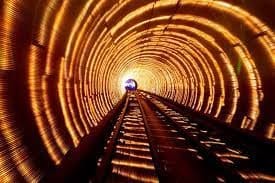
A tunnel is an underground passage through hills, rock or soil, built to carry people, freight, water or sewage. Tunnelling is old: one of the earliest recorded tunnels, built in Babylon about 4000 years ago, is said to have run beneath the Euphrates to connect the royal palace with a temple. It was brick-lined and about 910 m long. Modern tunnels depend on geosynthetics, mainly for waterproofing and drainage, and this post explains where they fit in tunnel engineering.
Table of Contents
Some interesting tunnel facts
The Gotthard Base Tunnel under the Swiss Alps, opened in 2016, is the world’s longest and deepest railway tunnel at about 57 km, and it links northern and southern Europe. Before it opened, the record for the longest railway tunnel belonged to the Seikan Tunnel in Japan, 53.85 km long, much of it under the sea.
What is tunneling/tunnel engineering?
Tunnelling, or tunnel engineering, covers the science and engineering of building tunnels. The main construction methods are:
- Cut and cover: a trench is dug from the surface, the tunnel is built in it, and the ground is replaced over the top
- Bored (mechanised) tunnelling, using a tunnel boring machine (TBM) that excavates in place without removing the ground above
- Drill and blast, the conventional method in rock
A conventionally built tunnel goes up in three basic steps:
- Excavation (drilling and blasting, or mechanical excavation).
- Primary support: shotcrete (sprayed concrete), usually with rock bolts.
- The final cast concrete lining. Because the surrounding ground usually holds groundwater, the tunnel needs waterproofing and drainage. In conventional tunnels the waterproofing membrane and drainage layer sit between the shotcrete and the final concrete lining.
Role of Geosynthetics in Tunnel Engineering
The two main jobs of geosynthetics in tunnels are drainage and waterproofing. Geomembranes and geotextiles are both used extensively. A typical sandwich in a drained tunnel is a nonwoven geotextile fixed to the shotcrete, which protects the membrane from the rough surface and carries seepage to the side drains, then a 2–3 mm thermoplastic geomembrane (usually PVC or a polyolefin), then the inner concrete lining. Drainage capacity can fall over time through clogging, often from calcite deposits, and under ground pressure, so the system has to be designed and installed with that in mind; poor design or workmanship is the usual cause of long-term failures.
Hydraulic Tunnels: Tunnels that carry water are lined with steel, cast-in-place concrete or shotcrete for structural stability and to stop seepage. Over time, voids and cracks form in conventional linings. A geomembrane liner installed inside or behind the lining keeps the tunnel watertight even when the concrete cracks, and is a cost-effective way to waterproof it.
Transportation Tunnels: Depending on the groundwater, road and rail tunnels are either fully sealed (undrained) or drained. Which approach suits a tunnel depends on the project, the groundwater pressure and the environmental effect of lowering the water table. Geosynthetics are used for both the waterproofing and the drainage and filtration.
Advantages of using Geosynthetics in tunnel engineering
- Geomembranes have very low permeability and form the waterproof barrier, while geotextiles protect the membrane and drain the water behind it.
- They are easy to fix in any orientation, horizontal, vertical or overhead, and their high elongation lets them bridge existing and new cracks in the concrete.
- They resist rotting, ageing, puncture and chemicals in the ground.
- Quick installation saves time.
- Geomembranes are thin, so they take up very little of the tunnel cross-section.
- Correctly designed systems stay watertight under high water pressure.
- Geosynthetics are also used to rehabilitate and repair old tunnels.
Ocean Geosynthetics supplies geomembranes and geotextiles for tunnel waterproofing and drainage. Contact us to discuss your next project.

source on Google
 Biofloc Fish Farming
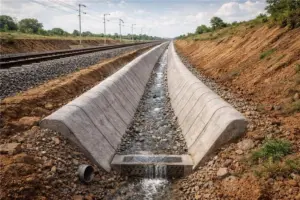 Railway Drainage and Erosion Protection Using GCCM in Wardha, Maharashtra
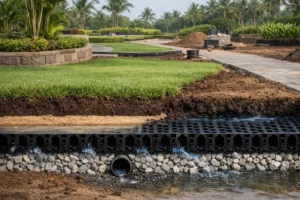 Case Study: Landscaping Drainage Upgrade in Khorda, Odisha