Case Study: Slope Erosion Control Project in Jaipur, Rajasthan
For a local government authority in Jaipur, Rajasthan, Ocean Non Wovens supplied 11,600 square metres of Ocean Erosion Control Mat (Jute Type-2) to stop severe erosion on a slope that was threatening its own stability and the infrastructure around it. The project ran for 3 months.
Project details
- Location: Jaipur, Rajasthan
- Product used: Ocean Erosion Control Mat (Jute Type-2)
- Quantity: 11,600 square metres
- Duration: 3 months
- Client: Local Government Authority
The aim was a sustainable erosion control solution. After a site assessment, our team recommended the jute mat: a biodegradable product that protects the soil surface while vegetation establishes.
Why bare slopes erode
Slope erosion is the removal of topsoil by runoff, wind or human activity. In Jaipur, most of the year’s rain falls in the July–September monsoon, often in short, heavy bursts that strip bare soil quickly. Left unchecked, erosion causes:
- Loss of fertile topsoil
- More sediment in nearby water bodies
- Less usable land
- Damage to infrastructure
Common erosion control methods
- Vegetative cover: grass, shrubs and trees whose roots bind the soil.
- Terracing: steps cut into the slope to slow runoff.
- Retaining walls: structures that hold back the soil.
- Erosion control mats: synthetic or natural mats that cover the soil and stop it moving.
Vegetation is the long-term answer on most slopes, but seed and young grass wash away in the first heavy rain. A mat protects the surface during that window.
Ocean Erosion Control Mat (Jute Type-2)
The jute mat is made for slope stabilisation and erosion prevention. Its open weave breaks the impact of raindrops and slows runoff across the surface, while grass grows up through the gaps. Reasons it was chosen:
- Biodegradable: made from natural jute fibres, it breaks down over time and adds organic matter to the soil. By then, the roots have taken over its job.
- Tensile strength: holds together on the slope and supports the soil surface.
- Moisture retention: jute absorbs water and keeps the soil beneath it damp, which helps seeds germinate in a dry climate.
- Easy installation: rolls are laid quickly over large areas.
Technical specifications
- Material: 100% natural jute fibres
- Weight: 500 grams per square metre
- Thickness: 6 mm
- Tensile strength: 20 kN/m
Installation
Site preparation
The slope was cleared of debris and loose soil, and existing vegetation was trimmed so the mat could lie flat against the soil. Good contact matters: water running under a mat that bridges hollows can erode the soil beneath it.
Laying, anchoring and seeding
- Laying: the mat was rolled out over the prepared slope, with overlaps so no soil was left exposed.
- Anchoring: biodegradable stakes at regular intervals held the mat against wind and water.
- Seeding: grass seed was spread so plants could grow through the jute.
As standard practice, the top edge of the mat is buried in an anchor trench at the crest of the slope, rolls run downslope, and each upslope roll overlaps the one below so runoff flows over the joint rather than into it.
Monitoring and maintenance
The mat was inspected regularly. Displaced sections were repaired promptly, and bare patches were reseeded where needed.
Results
Within weeks of installation, the mat was working: the slope stayed stable through heavy rain, with no noticeable soil displacement. Over the longer term:
- Vegetation: grass and other plants established through the mat and now hold the soil.
- Soil enrichment: as the jute decomposed, it added organic matter and improved fertility.
- No residue: the mat biodegrades, leaving no synthetic material on the slope.
Lessons for similar projects
- Match the solution to the site: slope angle, soil, rainfall and how long protection is needed decide between a biodegradable jute or coir mat and a permanent synthetic one.
- Monitor: early inspection and repair during the first monsoon decides whether vegetation takes hold.
- Involve the community: local involvement in upkeep makes the result last longer.
Erosion control from Ocean Non Wovens
In Jaipur, 11,600 square metres of Ocean Erosion Control Mat (Jute Type-2) held a bare slope through the rains until grass could take over. Ocean Non Wovens supplies natural and synthetic erosion control products, including jute geotextiles, for slopes, embankments and landscaping. Contact us to discuss your site, or see more case studies.

source on Google
 Case Study: Enhancing Runway Performance at Bangalore Airport with 63,602 SQM of Non-Woven Geotextile (200 GSM)
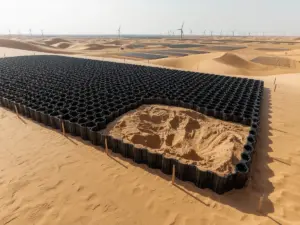 Holding the Desert in Place: Ocean HDPE Geocell 712 × 75 mm at Continuum Green Energy’s 99 MW Project, Jaisalmer
 Case Study: Enhancing Railway Infrastructure in Gadchiroli, Maharashtra with Ocean Geocomposite 700 GSM