Sports Infra Project – Rug/PO/SR in Mumbai, Maharashtra – Case Study
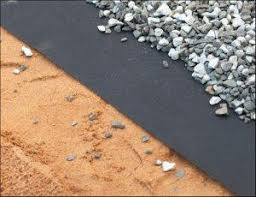
For a sports infrastructure project in Mumbai, Ocean Non Wovens supplied 12000 Sqm of non woven geotextile (PET) 120 GSM for the playing field. Sports fields now see far heavier use than they were designed for, and many older grounds have worn out under it. A modern field has to stay stable, drain fast after rain, cope with heat and heavy use, and stay affordable to maintain. In Mumbai, where the south-west monsoon dumps over two metres of rain in four months, drainage decides whether a field is playable at all.
Product – Non woven Geotextile(PET) 120 GSM
Quantity – 12000 Sqm
Location – Mumbai, Maharashtra
Problem
Natural grass fields are hard to maintain. They develop bald patches that take time to grow back, turn to mud in the rain and dust in the dry season, and wear quickly under constant play.
Artificial or synthetic turf solves much of this. It is durable, quick to install and uses far less water than grass. But a turf field depends on what lies beneath it. The surface has to shed water through the turf and into the base quickly so the field dries soon after rain. If the drainage under the turf fails, water stands in the base, the surface stays wet, and mould, mildew and bacteria build up in the infill.
The usual cause of that failure is the subgrade. When soft soil and the drainage aggregate above it mix under the weight of play and maintenance machinery, fines clog the stone, the base loses its drainage and the surface starts to undulate.
Solution
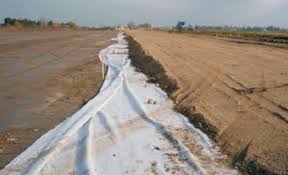
The Mumbai project used a non-woven geotextile under the field to keep the base stable and draining for the long term. In a turf build-up the geotextile is typically laid on the prepared subgrade, below the drainage aggregate, where it does three jobs:
Separation: it keeps subgrade soil and drainage stone apart, so the stone layer keeps its thickness and voids.
Filtration: water passes freely through the fabric into the subsoil drains while soil particles are held back, so the drainage layer does not silt up.
Stability: by stopping the base mixing with the soil, it keeps the field level and firm under play and maintenance traffic.
Ocean’s geotextile for this project was a needle-punched PET (polyester) non-woven at 120 GSM. Polyester resists the soil chemicals and moisture it lives with under a field and keeps its strength over time. Like all geotextiles it must be kept out of prolonged sunlight, so it is covered with aggregate soon after laying. Laid beneath the field, the geotextile also limits weeds growing up into the base, which cuts down on weed killer.
Installation notes
The subgrade is graded to the design falls and compacted, then the geotextile is rolled out with overlaps between strips and the drainage aggregate is placed by end-tipping and spreading, so machines do not drive directly on the fabric. Drain pipes or a drainage geocomposite collect the water that the geotextile passes.
Ocean Non Wovens supplies geotextiles for sports fields, running tracks and landscape works. More projects are in our case studies.

source on Google
 Case Study: Enhancing Sustainability in Allahabad’s Bioenergy Project with Ocean HDPE Liners
 Geotextiles in Pavement and Drainage Applications
 Reliance Project, Jabalpur (Madhya Pradesh): Application of Non Woven Geotextiles for Ground Stabilisation and Drainage Performance
