8 Ways to Prevent Beach Erosion: What Works on Indian Coasts
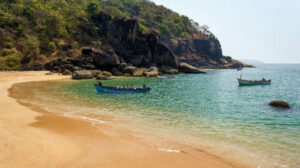
Beach erosion happens when waves, currents and storms carry sand away faster than nature puts it back. Every breaking wave lifts sediment, and longshore currents move it along the coast or out to deeper water. On a healthy beach, calmer seasons return that sand. When the supply is cut off by a port, a dam upstream, sand mining or a hard wall, the beach keeps losing ground and the land behind it starts to go.
This guide covers eight ways to prevent beach erosion, how each one works, where it fails, and which suit the Indian coast.
Table of Contents
Why beach erosion matters in India
A shoreline change assessment by the National Centre for Coastal Research (NCCR), Chennai, found that about a third of India’s mainland coast (33.6%) was eroding between 1990 and 2018, with erosion heavier on the east coast. West Bengal, Puducherry, Kerala and Tamil Nadu have some of the highest shares of eroding shoreline. At Uppada in East Godavari district, the shoreline retreated by an average of 1.23 m a year between 1989 and 2018, and houses in the village were lost to the sea.
What erosion destroys goes well beyond sand. It undermines roads, fishing harbours, homes and temples, pushes salt water into farmland and wells, and removes the beach that protects everything behind it during a cyclone. Once a building’s foundation is exposed to wave attack, repair is rarely an option.
Shore protection works in India fall under the Coastal Regulation Zone (CRZ) Notification, 2019. Check clearance requirements with the State Coastal Zone Management Authority before any construction on the beach.
8 ways to prevent beach erosion
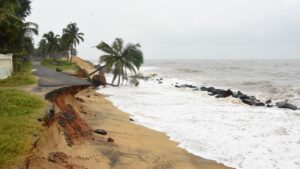
The methods fall into three groups: hard structures that block or redirect waves and currents, soft measures that add or hold sand, and managing what people do on the beach. Most successful coastal erosion schemes combine at least two.
1. Groynes
Groynes (spelt “groins” in American English) are walls of rock, concrete, timber or sand-filled geotextile built across the beach, at right angles to the shoreline, out into the surf. They interrupt the longshore current, which slows and drops its sand on the up-drift side, so the beach there widens.
The catch: the down-drift side now receives less sand and erodes faster. That is why groynes are usually built in a series (a groyne field) and often paired with nourishment, so that sand trapped by the groynes doesn’t starve the next village along the coast.
2. Jetties
Jetties look like large groynes but have a different job: they are built in pairs at a river mouth or harbour entrance to keep sand out of the navigation channel. They are usually made of stone or concrete, sometimes steel or timber.
Sand piles up against the up-drift jetty, and the beach on the other side erodes because the sand that used to feed it is now stuck behind the jetty or dredged out of the channel. Many harbours in India use sand bypassing, where the trapped sand is dredged or pumped across and placed on the starved beach.
3. Offshore breakwaters
Offshore breakwaters sit in the water, parallel to the shore or at an angle to it. Waves break on the structure instead of on the beach, so the water behind it is calmer and drops its sediment. Over time the beach builds out towards the breakwater in a bulge called a salient.
Submerged breakwaters and artificial reefs work the same way but stay below the water line, which keeps the sea view. Like groynes, breakwaters protect only the stretch behind them, and the coast beyond them can still erode.
4. Seawalls and revetments
A seawall is a vertical or stepped wall along the back of the beach; a revetment is a sloping layer of rock, concrete blocks or mattresses laid on the bank. Both stop waves reaching the land behind them, which makes them the default choice when a road or settlement is already at the water’s edge.
They protect the land, not the beach. Waves bounce off a hard wall and scour the sand at its toe, so the beach in front often narrows or disappears, as happened in Puducherry, where the beach in front of the rock wall along the promenade almost disappeared. Good designs reduce this with a sloping, rough face, a toe apron, and a geotextile filter layer under the rock so that sand isn’t sucked out through the gaps.
5. Geotextile tubes and geobags
Geosynthetic sand containers do the job of rock structures using the beach’s own sand. They can be built as seawalls, revetments, groynes or submerged reefs.
- Geotextile tubes (geotubes): long tubes of high-strength woven geotextile, laid along the shore and filled on site by pumping in a sand-water slurry. The water drains through the fabric and the sand stays, forming a continuous heavy mass several metres around. A geotextile scour apron underneath stops waves undermining the tube.
- Geobags: smaller non-woven geotextile bags filled with sand and stacked like blocks. They suit remote sites, emergency work and places where heavy equipment can’t reach, and damaged bags can be replaced one at a time.
At Uppada, a geotube seawall built along 1,463 m of the shore in 2010 held for more than a decade (see the Uppada geotube case study). In the Maldives, Ocean Non Wovens supplied 2,500 Geobags-450 GSM for a beach protection project, filled with local sand because shipping rock to the islands is expensive.
Their weak points are sunlight and damage. Exposed fabric degrades under UV, so specify UV-stabilised geotextile and, where possible, cover the structure with sand. Vandalism and floating debris can also cut the fabric, so plan for inspection after every monsoon and cyclone.
6. Beach nourishment
Nourishment is a soft solution: sand is dredged from offshore or from a harbour and placed on the eroding beach to widen it. A wide beach absorbs wave energy the way the natural one did, and it keeps the beach usable for fishing boats and tourists.
The same waves that removed the original sand will remove the new sand, so nourishment has to be repeated every few years. It works best with a source of sand that matches the beach grain size and alongside structures (groynes, a submerged reef) that slow the losses.
7. Dunes, vegetation and sand fences
Sand dunes are the beach’s reserve. During a storm, waves take sand from the dune and spread it on the beach, and wind slowly carries it back. Protecting and rebuilding dunes is one of the cheapest ways to prevent beach erosion.
- Vegetation: creeping dune plants such as Ipomoea pes-caprae (beach morning glory) and Spinifex littoreus, both native to Indian beaches, bind the sand with their roots and runners. On muddy, sheltered coasts, mangroves do the same job; Odisha’s Bhitarkanika and the Sundarbans are the best-known examples.
- Sand fences and windbreaks: low fences of bamboo, coir or slatted wood set back from the high-tide line slow the wind so it drops the sand it is carrying, building the dune up.
- Erosion control mats: biodegradable coir or jute mats hold the surface of a new dune or bank in place until the plants take root.
Vegetation alone won’t stop erosion on a coast facing strong waves, but it makes every other measure last longer.
8. Controlling human damage
Many eroding beaches lose sand because people take it or block it. The measures here cost little:
- Stop beach and river sand mining, which removes the sediment that feeds the coast.
- Keep vehicles, construction and heavy loads off the dunes, and use fixed walkways so foot traffic doesn’t trample dune plants.
- Assess the down-drift effect of every new harbour, jetty or groyne before it is built.
- Explain to residents and visitors why the dunes and plants matter; community buy-in is what keeps fences and planting intact.
Comparing the methods
| Method | Type | Protects | Main drawback |
|---|---|---|---|
| Groynes | Hard | Beach up-drift of the groyne | Erosion down-drift |
| Jetties | Hard | Harbour or river channel | Starves the down-drift beach |
| Offshore breakwaters | Hard | Beach behind the structure | High cost; local protection only |
| Seawalls and revetments | Hard | Land behind the wall | Beach in front is often lost |
| Geotubes and geobags | Hard (built from sand) | Land and beach, depending on layout | UV and puncture damage if left exposed |
| Beach nourishment | Soft | The whole beach | Must be repeated |
| Dunes and vegetation | Soft | Back of the beach | Not enough on its own on a high-energy coast |
| Controlling human damage | Management | Sand supply | Needs enforcement and local support |
For engineers planning a project, the solution pages on coastal and marine structures and shoreline stabilisation techniques cover the geosynthetic options in more detail.
Frequently asked questions
What are three ways to prevent beach erosion?
Three of the most widely used are beach nourishment (adding sand), groynes or breakwaters (trapping sand and calming waves), and protecting dunes with vegetation and sand fences. Geotextile tubes and geobags are a common fourth option where rock is scarce.
Do seawalls stop beach erosion?
They stop the land behind them from eroding, but they often make erosion of the beach in front worse, because reflected waves scour the sand at the toe of the wall.
What is the most natural way to stop coastal erosion?
Restoring dunes, native beach plants and, on sheltered muddy coasts, mangroves. Beach nourishment is also a soft method, though it relies on dredging.
How long do geotubes last on a beach?
It depends on UV exposure, wave attack and damage. Covered with sand and inspected regularly, they can last many years; the Uppada geotube seawall in Andhra Pradesh lasted more than a decade. Tubes left bare in the sun degrade much faster.
Can a homeowner prevent beach erosion alone?
Small measures like dune planting and sand fences help, but a wall built in front of a single plot usually pushes the erosion onto the neighbours. Erosion is a coastline problem, and lasting protection is planned for the whole stretch with the local authority.

source on Google
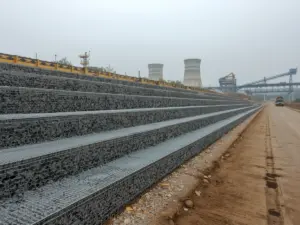 Built for Coal Country: Ocean Double-Twisted Hexagonal Wire Mesh at a Coal Plant in Singrauli, Madhya Pradesh
Geogrids, Geosynthetics, Insights
Geosynthetics in Construction of Roads Subgrade Stabilization with Geogrids Geomembrane Thickness: How to Specify the Right Grade
