Case Study: Ocean Non Wovens’ Contribution to the iPhone Factory Construction in Bengaluru
Ocean Non Wovens supplied 20,000 Sqm of Ocean Non Woven Geotextile for the construction of an iPhone manufacturing facility in Bengaluru. The geotextile went into the factory’s ground preparation, its site drainage and its internal roads. This case study covers what the site needed and what the geotextile does in each of those places.
What the site needed
An electronics plant of this size carries heavy production equipment, runs continuously and has little tolerance for floor movement or water problems. The groundworks had to deliver:
- Soil stability: extensive groundwork so the soil could carry manufacturing equipment without settling.
- Drainage: an effective drainage system to prevent waterlogging, which could damage sensitive electronic components.
- Durability: infrastructure that stands up to continuous operation and heavy machinery.
Where the geotextile was used
Ocean’s team worked with the project engineers and contractors to fit the geotextile into the construction sequence. The 20,000 Sqm supplied was used in:
- Foundation and floor preparation: to keep the factory floor stable under heavy machinery.
- Drainage system: as the filter layer in the site’s water management network.
- Internal roads: to improve the durability of roads used to move materials and finished products.
How a nonwoven geotextile does these jobs
Separation and soil stabilisation
Laid between the natural subgrade and the granular layers above it, the geotextile keeps the two from mixing. Without it, fine soil pumps up into the aggregate under repeated loading, the aggregate punches down into the soil, and the base loses thickness and strength. Keeping the layers separate spreads load more evenly and reduces settlement under floors and roads. This is the same separation function IRC SP:59 describes for geosynthetics in road pavements.
Filtration and drainage
Wrapped around drain aggregate or lining a trench, the geotextile lets water pass while retaining soil particles. That keeps the drains from silting up, so they continue to carry water away from the buildings for longer.
Cost and material savings
Because a separated base keeps its full thickness, designers can often reduce excavation and imported fill compared with an unseparated section. Less material hauled to site lowers both construction cost and the carbon footprint of the groundworks.
Choosing a geotextile for industrial sites
For factory floors, yards and internal roads, the geotextile grade is usually chosen on the survivability it needs during construction: heavier aggregate, thinner cover and heavier compaction plant call for a higher mass per unit area and higher CBR puncture strength (ASTM D6241). For drainage, the apparent opening size (ASTM D4751) is matched to the surrounding soil so the fabric retains fines without clogging.
Ocean Non Wovens manufactures and supplies nonwoven geotextiles and other geosynthetics for industrial, infrastructure and soil stabilization projects across India. Contact Ocean Non Wovens to discuss the right grade for your site, or browse more case studies.

source on Google
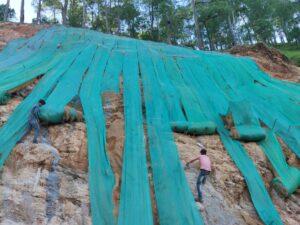 Biodegradable Erosion Control Matting, the Clean Green Choice for Erosion Control
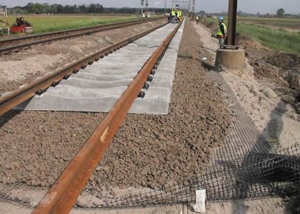 Application of Ocean Geogrids in Railways
 Build Green, Build Smart: Eco-friendly Solutions for Contractors and Builders!