Waste Management Project at MP – Case Study
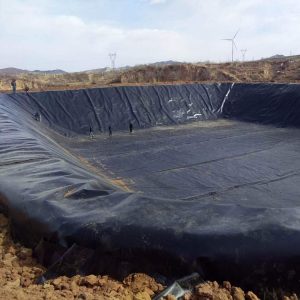
For a government waste management project in Madhya Pradesh, Ocean Non Wovens supplied 16560 Sqm of Ocean Geomembrane 1500 Micron and 16400 Sqm of Ocean Geotextile 200 GSM to line a solid waste landfill.
- Product: Ocean Geomembrane 1500 Micron & Ocean Geotextile 200 GSM
- Quantity: 16560 Sqm & 16400 Sqm
- Location: Madhya Pradesh
Background
India’s waste management policy rests on the principles of sustainable development, precaution and “polluter pays”, which require municipalities and businesses to manage the environmental harm their waste causes. As waste generation has grown with economic development, rules for regulating waste disposal have been issued under the umbrella of the Environment Protection Act, 1986 (EPA), including the Solid Waste Management Rules, 2016.
Efficient waste management depends on segregating waste at source and sending it through recycling and resource recovery. What is left is placed in sanitary landfills, the final destination for municipal solid waste that processing facilities cannot use and for inorganic waste that cannot be reused or recycled. In many cities, informal-sector workers collect waste door to door for a fee and sell the recyclables, which keeps a large amount of material out of landfills.
Problem
Waste volumes grow with population. Without proper systems, that waste ends up dumped on open land with no engineering, administration or monitoring.
Waste management in Madhya Pradesh had well-known gaps. The main risk from unlined dumps is leachate: rainwater percolating through waste picks up dissolved contaminants and seeps into the ground, polluting groundwater and degrading soil. The landfill was part of a government initiative to address that threat to the environment and public health.
Solution
Engineered landfills use a geomembrane as the hydraulic barrier and geotextile for protection, separation and filtration. Between them, geosynthetic systems in a landfill can provide separation, drainage, filtration, a hydraulic barrier, a gas barrier and protection.
The two materials do different jobs:
- Geomembrane (1500 micron HDPE): the low-permeability barrier that stops leachate seeping out of the landfill into soil and groundwater. The Solid Waste Management Rules, 2016 call for a non-permeable lining at the base and walls of a sanitary landfill: a composite barrier of 1.5 mm HDPE geomembrane (or equivalent) over a compacted clay or amended soil layer, with permeability below 1 x 10⁻⁷ cm/s. The 1500 micron geomembrane supplied here matches that thickness.
- Geotextile (200 GSM): a permeable fabric. In a liner system it separates soil layers, filters fines out of drainage layers so they do not clog, and cushions the geomembrane against puncture from stones in the subgrade or the drainage aggregate above.
HDPE geomembranes are widely used in landfills because they combine low permeability, flexibility, chemical resistance to leachate and resistance to weathering. Panels are joined by thermal welding, with no adhesives, and seams are tested on site before the liner is covered.
Installation on a landfill cell generally follows a set sequence: the subgrade or clay liner is graded smooth and inspected, geotextile is laid where cushioning is needed, geomembrane panels are deployed and welded, seams are tested, liner edges are anchored in trenches at the crest of the cell, and the protection and leachate drainage layers are placed on top before any waste arrives.
See more case studies of Ocean liners in landfill projects.

source on Google
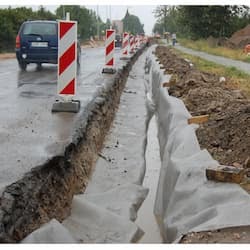 Geotextiles in Pavement and Drainage Applications
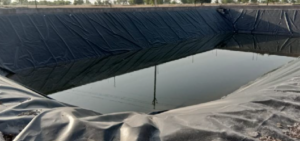 What is the Best Pond Liner to Use?
 What is the process of Geocell Manufacturing?