What is the process of Geocell Manufacturing?
Ocean Global’s geocell is a light but strong three-dimensional honeycomb of HDPE cells. Filled with soil, sand, aggregate or concrete, it confines the infill so it cannot spread sideways. That confinement does two jobs. Under roads, container yard pavements and foundations it acts as a reinforcement mattress that spreads the load over a wider area of weak soil. On slopes it holds the topsoil or infill in place against rain and runoff.
On slopes the cells can be filled with vegetated soil for a green finish or with concrete for a permanent hard cover.
Manufacturing
Geocells are made from HDPE strips. The polymer is extruded into sheet, which is usually textured and often perforated to improve friction with the infill and let water pass between cells. The sheet is cut into strips of the cell depth, and the strips are stacked and joined by ultrasonic welding at fixed intervals along their length. When the finished panel is pulled open on site, the welded joints form the honeycomb. The weld spacing sets the cell size and the strip width sets the cell depth, which is why geocells are specified as, for example, 330 × 100 mm. Weld (seam) strength is the critical quality check, because a failed seam opens the cell and releases the infill.
Applications
Ocean Global supplies geocells and the related geosynthetics for the applications below.
Erosion control
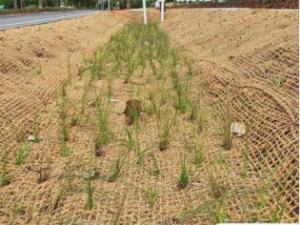
The cells hold soil on the slope against erosion from rain and wind. The layout can be designed for the slope, from steep 60-degree slopes to gentler 27-degree slopes. Once the slope is dressed and compacted, the geocell panels are opened out and fixed quickly with connectors and anchor pins.
Ocean Global also makes erosion control mats from coir geotextile and jute geotextile for projects with erosion problems.
Geocells can be filled with vegetation, concrete, stone or another material that suits the site. Depending on local material costs, a geocell cover can cost less than stone pitching or paver blocks, and it lasts far longer than jute or coir mats, which biodegrade within a few years.
Slope liner Protection

Where a geomembrane liner or similar covering on a slope must not be damaged or punctured, a geocell layer filled with soil or concrete protects it. The geocell sits on the liner (usually over a protective geotextile) and is anchored at the crest of the slope, so the liner is never pierced by pins. The crest anchorage is designed to take all the sliding forces on the cover system, which allows it to be used on very steep slopes.
Load Support

Because each cell confines its infill, the geocell layer behaves as a stiff mattress: it spreads the load from above over a larger area and raises the effective modulus of the infill. Ocean Global geocells are used in pavements, ground improvement below embankments and access roads, and on very poor subgrades such as expansive black cotton soil. The design can be adjusted for heavy loading and different site conditions.
The panels are opened out and pinned by hand, so installation is quick and needs little specialist equipment beyond normal earthmoving plant for the infill. Geocell load support suits low-CBR ground with heavy loads, and it can reduce the thickness of aggregate layers needed.
Retaining Wall

Where a project has a change in ground level, a retaining wall is needed. Concrete retaining walls are expensive and slow to build. A geocell wall can be built either as a gravity wall of stacked, filled geocell layers or as a geogrid-reinforced soil wall with a geocell face. The geocell sections are factory-made and arrive flat, so little site work is needed beyond standard earthwork.
Combined with geogrids, geocell walls go up quickly with little disruption on site, and the open outer cells can be planted to give a green face.
FAQs
Does Geocell require regular maintenance?
Geocell requires minimal maintenance once it is installed. Periodic inspections to ensure proper performance are recommended.
Can Geocell be used for load support in parking areas?
Yes, Geocell is often used for load support in parking areas as it distributes the load and reduces the stresses on the underlying soil.
What are the factors to consider when selecting Geocell for a project?
Factors to consider include soil type, project requirements, anticipated loads, environmental conditions, and installation constraints.

source on Google
 Case Study: Slope Protection and Sustainable Infrastructure Development Using Ocean Geosynthetic Cementitious Composite Mat 10 MM for a Coal Mining Project in Purba Medinipur, West Bengal
 Enhancing Railway Infrastructure with Geotextiles in UP State
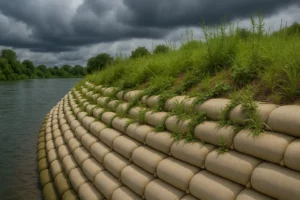 Flood Control with Geobags: A Sustainable and Effective Approach