Assam Landfill – Case Study
Ocean Global supplied 5000 sqm of Ocean Geomembrane 1.5mm thick for a landfill in Assam. The geomembrane lines the site so that leachate and landfill gas from the waste stay inside the landfill instead of contaminating the surrounding soil, groundwater and air.
Product: Ocean Geomembrane, 1.5mm thickness
Quantity: 5000 sqm
Location: Assam, India
Problem
A landfill takes the waste that cannot be recycled or reused, which makes it a core part of waste management. Built badly or left unmanaged, it becomes a source of pollution in its own right. Households, schools, hospitals, industry, refineries and farms all send waste to landfill, and as it decomposes it produces two things that have to be contained:
- Leachate: rainwater that percolates through the waste picks up dissolved organics, ammonia, heavy metals and other contaminants. Without a liner it soaks into the soil and reaches groundwater.
- Landfill gas: mostly methane and carbon dioxide. Methane is a potent greenhouse gas, it can migrate through soil, and it feeds the landfill fires common at unlined dump sites.
Assam has heavy monsoon rainfall and shallow groundwater across much of the Brahmaputra valley. That means more leachate per tonne of waste and a short path from the base of a landfill to the water table, so the liner matters even more here than in drier states.
Solution
Geomembranes are flexible polymer sheets, welded together on site into a continuous liner. They have extremely low permeability, so they stop liquids and gases migrating from one side to the other. In a landfill they are used in two places: the base liner, which keeps leachate from escaping downwards, and the final cap, which keeps rain out and holds landfill gas in so it can be collected.
HDPE geomembranes (high-density polyethylene) are the most widely used liners in landfills and waste management because they combine:
- High strength and puncture resistance
- Resistance to a wide range of chemicals in leachate
- Tolerance of temperature changes and weathering, with carbon black for UV stability
- Hard-wearing toughness with enough flexibility to follow settlement
HDPE geomembranes are also quick to install. Wide rolls are unrolled and welded on site, so a landfill cell can be lined in far less time than it takes to place and compact an equivalent clay liner.
Why 1.5mm
1.5mm (1500 micron) is the minimum geomembrane thickness in Indian practice for municipal solid waste landfill liners, where it is used as part of a composite barrier over a low-permeability clay layer or geosynthetic clay liner. The thickness gives the puncture resistance and long-term stress-crack resistance needed under many metres of waste.
Installation
- Prepare a smooth, compacted subgrade free of stones and roots.
- Deploy panels with overlaps and weld them by double hot-wedge, with extrusion welds at patches and pipe penetrations.
- Test seams: air pressure on double-wedge seams, vacuum box on extrusion welds.
- Anchor the edges in a perimeter trench and cover the liner with a protection geotextile before placing drainage aggregate.
Ocean Global supplies HDPE geomembranes and the other layers of a landfill lining system. For more waste-management projects, see our case studies.

source on Google
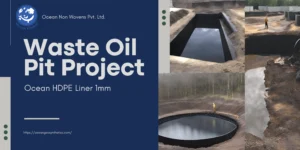 Ocean HDPE Liner 1mm in the Waste Oil Pit Project, Durgapur, West Bengal
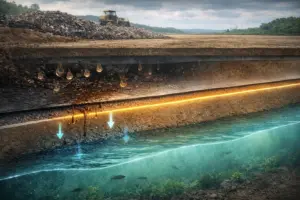 Landfill Protection Using GCL
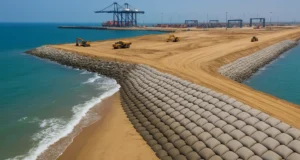 Tuna Tekra Container Development with Ocean Non Woven Geobags
