Chemical Storage Project in Kolkata – Case Study

Ocean Non Wovens supplied Ocean HDPE Liner (1000 micron) and Ocean Geobags (300 GSM) for a chemical storage project in Kolkata. The aim was to keep stored chemicals, and any spills or leaks from them, out of the soil and groundwater.
Product: Ocean HDPE Liner and Ocean Geobags
Grade: 1000 micron (liner) and 300 GSM (geobags)
Location: Kolkata
Problem
Storing hazardous chemicals safely means keeping them from harming people, property, other chemicals or the environment. That starts with a current inventory and an understanding of the hazards each chemical poses. Flammable, corrosive and reactive chemicals carry risks that poor storage makes worse.
Common storage failures include leaking or unsuitable containers, incompatible chemicals stored side by side, poor labelling, and spills left uncleaned. Even with good procedures, accidents happen. Once chemicals reach the ground they are very hard to remove, and contaminated soil can pass them into the groundwater used for drinking and by plants and animals. Badly stored chemicals can also degrade, losing quality, forming hazardous by-products and becoming waste that costs money to dispose of.
Solution
An HDPE geomembrane under the storage area gives a continuous, impermeable barrier between the chemicals and the ground, so a spill or leak is contained on the liner instead of soaking into the soil. HDPE resists most acids, alkalis and salts. At 1000 micron (1 mm), the sheet has good puncture and tear resistance for an industrial site, and panels are joined by heat welding so the barrier has no open joints.
Ocean Geobags are bags made of permeable nonwoven geotextiles, built to resist UV radiation and the abrasion, tearing and puncture that come with filling and placement. Filled with sand or soil, they are commonly used on lined sites to ballast and anchor the liner, form low bunds and protect slopes. See also Ocean’s geobags, and the related West Bengal chemical containment case study.

source on Google
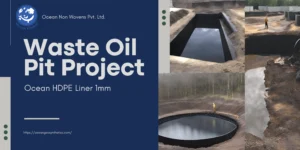 Ocean HDPE Liner 1mm in the Waste Oil Pit Project, Durgapur, West Bengal
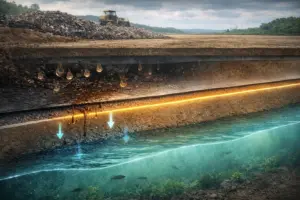 Landfill Protection Using GCL
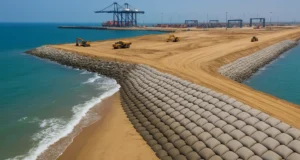 Tuna Tekra Container Development with Ocean Non Woven Geobags
