Case Study: Landslide Prevention Project in Uttarakhand Using Rockfall Barrier
Ocean Non Wovens carried out a landslide prevention project in Uttarakhand using Rockfall Barriers. The barriers catch falling rock and debris on an unstable hillside before it reaches the roads, buildings and people below.
The challenge
Landslides and rockfalls in Uttarakhand are driven by steep slopes, loose and fractured material, and heavy monsoon rain. They regularly destroy roads, bridges and buildings and put lives at risk. Conventional measures such as retaining walls and drainage are not enough on their own in many locations, because the geology produces falling blocks that a wall at the toe cannot stop.
This project covered one of the most vulnerable areas in the state. The solution had to be durable, fit the terrain, and survive extreme weather.
How rockfall barriers work
A flexible rockfall barrier is a steel net fence installed across the slope, in the path of falling rock. When a block hits the net, the net deforms and braking elements in the support ropes slide, converting the block’s kinetic energy into deformation and friction. The posts and ropes carry the remaining load back into ground anchors. Barriers deal with rockfall and small debris; deep-seated slope failures need other measures, such as drainage, soil nailing or anchoring.
Barriers are classified by the impact energy they can absorb, in kilojoules. In Europe, barrier kits are crash-tested and rated under EAD 340059-00-0106 (formerly ETAG 027), and those ratings are widely used in Indian specifications as well.
Key features
- High energy absorption: the system absorbs the kinetic energy of falling rock, limiting damage to the barrier and to structures below.
- Durability: made from high-tensile steel wire with corrosion protection for long service in harsh weather.
- Flexibility: the barrier follows the natural contours of the terrain, which makes installation on difficult ground easier.
- Low maintenance: once installed, the barriers need little upkeep beyond inspection and clearing.
Project implementation
The project started with a detailed site assessment, including geological surveys and risk analysis. The Ocean Non Wovens team worked with local authorities and engineers to design a Rockfall Barrier system for the site.
- Site assessment: geological surveys identified the most vulnerable areas and the likely volume of rockfall.
- Design: a customised Rockfall Barrier system was designed from the survey data, with additional features to improve durability and energy absorption.
- Installation: the barriers were anchored with high-strength steel cables and bolts, and their flexibility allowed them to follow the natural contours of the slope.
- Checks and monitoring: after installation, the barriers were checked against the predicted loads, and ongoing monitoring was set up to track their performance.
In barrier design generally, rockfall trajectory modelling along representative slope profiles gives the bounce height and impact energy at the barrier line, which set the barrier height and energy class.
Impact
Since installation, the barriers have intercepted multiple rockfalls, preventing damage to infrastructure and protecting local communities.
Inspection and combined measures
Rockfall barriers are low-maintenance but not maintenance-free. Regular inspections, especially after the monsoon and after any significant impact, should check for net damage, slipped braking elements and loose anchors, and debris collected behind the net should be cleared so the barrier keeps its full capacity.
Barriers work best as part of a combined system. Erosion control mats and geotextiles help hold surface soil in place, and drainage reduces the water pressure that loosens material in the first place. Involving local communities in installation and upkeep also helps: it improves maintenance and raises awareness of landslide risks.
Rockfall protection from Ocean Non Wovens
Ocean Non Wovens supplies rockfall barriers alongside geosynthetics for slope protection and erosion control, and designs systems around each site’s conditions. If you are dealing with landslides, rockfall or erosion, contact our team. More projects are in our case studies.

source on Google
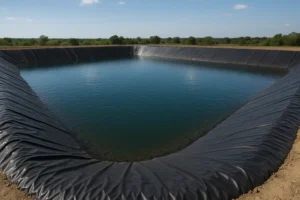 Case Study: Enhancing Water Retention Efficiency in Jaipur with Ocean HDPE Liner 750 Micron (5,500 SQM)
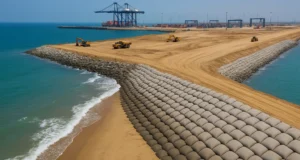 Tuna Tekra Container Development with Ocean Non Woven Geobags
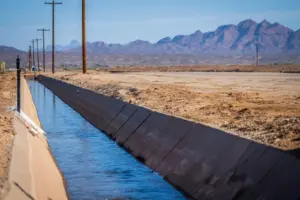 Irrigation Infrastructure Enhancement with Ocean Geotextile (PP) 2 MM in Howrah, West Bengal