Case Study: CPWD Project in Bhuj, Gujarat – Strengthening Infrastructure with Ocean Geogrid 60 Kn
For a Central Public Works Department (CPWD) project in Bhuj, Gujarat, Ocean Non Wovens supplied 17,000 sq m of Ocean Geogrid 60 kN to reinforce the soil under new roads and embankments. This case study covers the site conditions, where the geogrid went, and why a 60 kN/m reinforcement suits ground of this kind.
Project overview
- Client: Central Public Works Department (CPWD)
- Location: Bhuj, Kutch district, Gujarat
- Product: Ocean Geogrid 60 kN
- Quantity: 17,000 sq m
- Scope: road construction, embankment and slope stabilisation, soil reinforcement
Site conditions in Bhuj
Bhuj sits in the Kutch region, an arid area with poor soils that erode under wind and the occasional heavy monsoon downpour. Kutch is also one of the most seismically active parts of India: it lies in Seismic Zone V, the highest category in IS 1893, and Bhuj was close to the epicentre of the 2001 earthquake. Since then, new public works in the district have been designed with ground stability and earthquake loading in mind.
The CPWD project involved roads and embankments over ground with poor bearing capacity. The design needed to limit settlement and lateral movement of the fill, protect slopes from erosion, and keep maintenance low over the life of the works.
About Ocean Geogrid 60 kN
A geogrid is a polymer grid with open apertures. Soil and aggregate lock into the apertures, so when the fill tries to spread or shear, the load passes into the grid ribs, which carry it in tension. The rating of 60 kN/m is the ultimate tensile strength per metre width, measured in a wide-width test such as ASTM D6637 or EN ISO 10319. Ocean manufactures geogrids in polypropylene and high-tenacity polyester; a 60 kN/m grade sits in the mid-to-high range used for embankment basal reinforcement, reinforced slopes and heavily loaded pavements.
- Tensile strength: 60 kN/m ultimate, for heavily loaded fills and slopes.
- Durability: polymer grids resist the chemicals found in normal soils and do not rot or corrode. UV resistance matters only while the grid is exposed, so it should be covered with fill soon after placement.
- Handling: supplied in rolls that are light enough to place by hand and adapt to uneven formations.
How the geogrid was used
- Soil stabilisation under the roads: the geogrid was laid beneath the roadways to reinforce the weak subgrade and limit movement, giving the pavement layers a stable base.
- Slope reinforcement: on embankment sections, layers of geogrid were placed within the fill. Reinforced fill can stand at a steeper slope than unreinforced fill of the same soil, which saves land and fill volume.
- Load distribution: the grid spreads wheel loads over a wider area of subgrade, which reduces the risk of local failure and rutting on roads carrying heavy traffic.
- Erosion control: by holding the fill together, the reinforcement helps the slopes resist being washed or blown away. Surface erosion protection (vegetation or an erosion mat) is normally used alongside it on exposed faces.
Why reinforced soil suits a seismic zone
Geosynthetic-reinforced soil is a flexible system. It can tolerate some differential settlement and deformation without the cracking that a rigid structure would suffer, which makes it a sensible choice for embankments and slopes in a high-seismicity area like Kutch. Seismic loading still has to be included in the design: the reinforcement length, spacing and strength are checked for the earthquake case as well as the static one.
Geosynthetics in CPWD works
Using geosynthetics in public works can reduce the quantity of quarried aggregate needed for the pavement or a retaining structure, because a reinforced section can be thinner or built with local fill. Less aggregate means less quarrying and fewer truck movements, a real consideration in regions where stone mining is already heavy. Over the life of a road or embankment, a stable reinforced base also means less repair work.
To discuss geogrid grades for a road, embankment or reinforced slope, contact Ocean Non Wovens. More projects are listed on our case studies page.

source on Google
 Case Study: Enhancing Sustainability in Allahabad’s Bioenergy Project with Ocean HDPE Liners
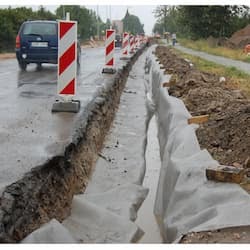 Geotextiles in Pavement and Drainage Applications
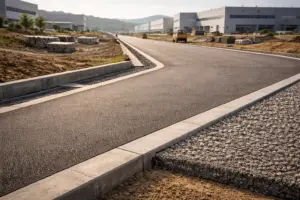 Reliance Project, Jabalpur (Madhya Pradesh): Application of Non Woven Geotextiles for Ground Stabilisation and Drainage Performance