Geogrid
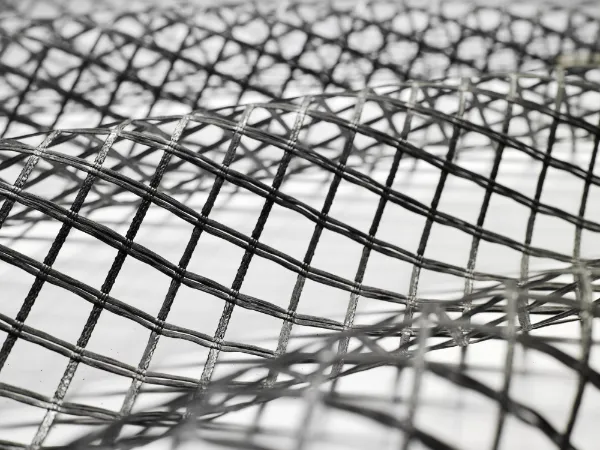
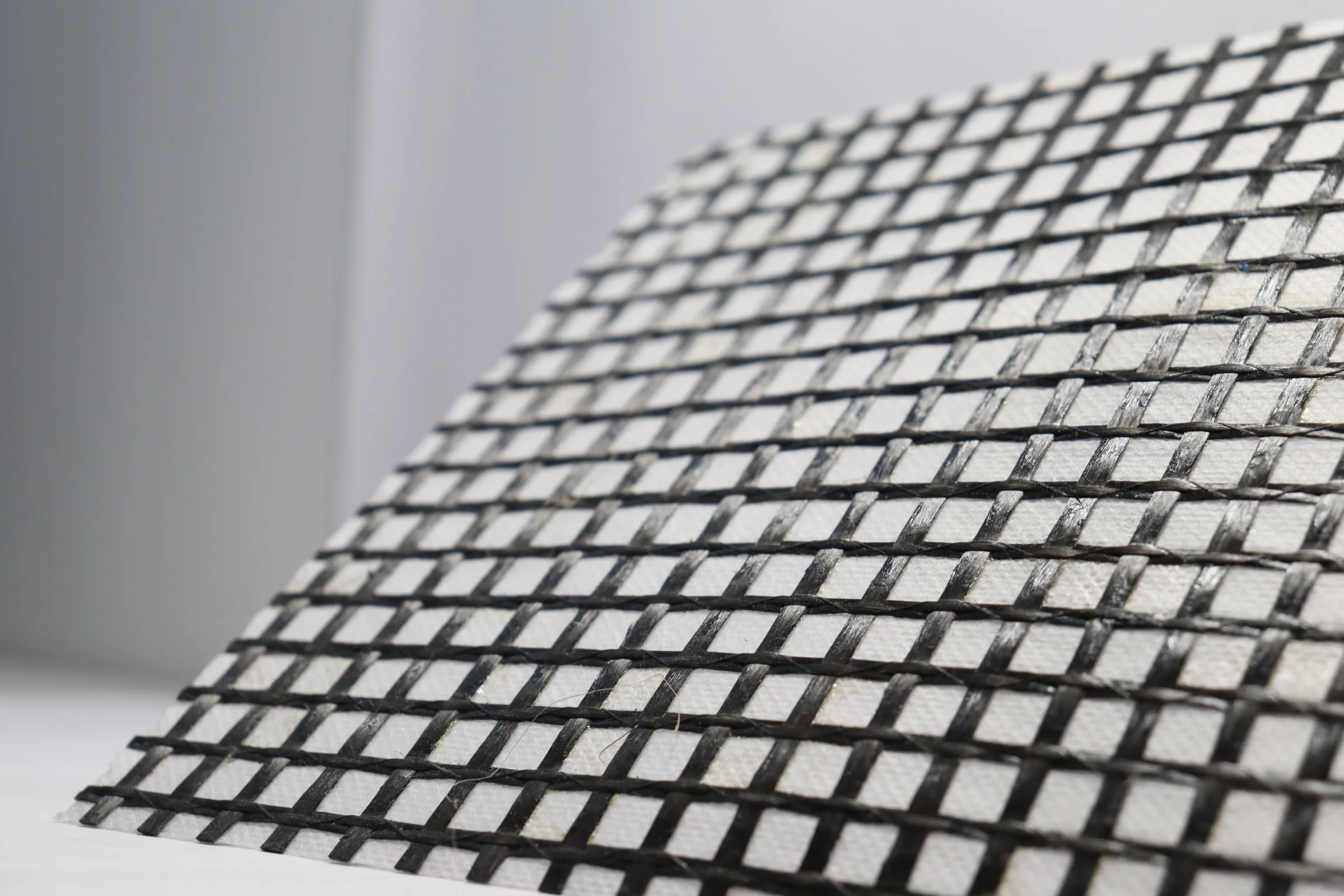
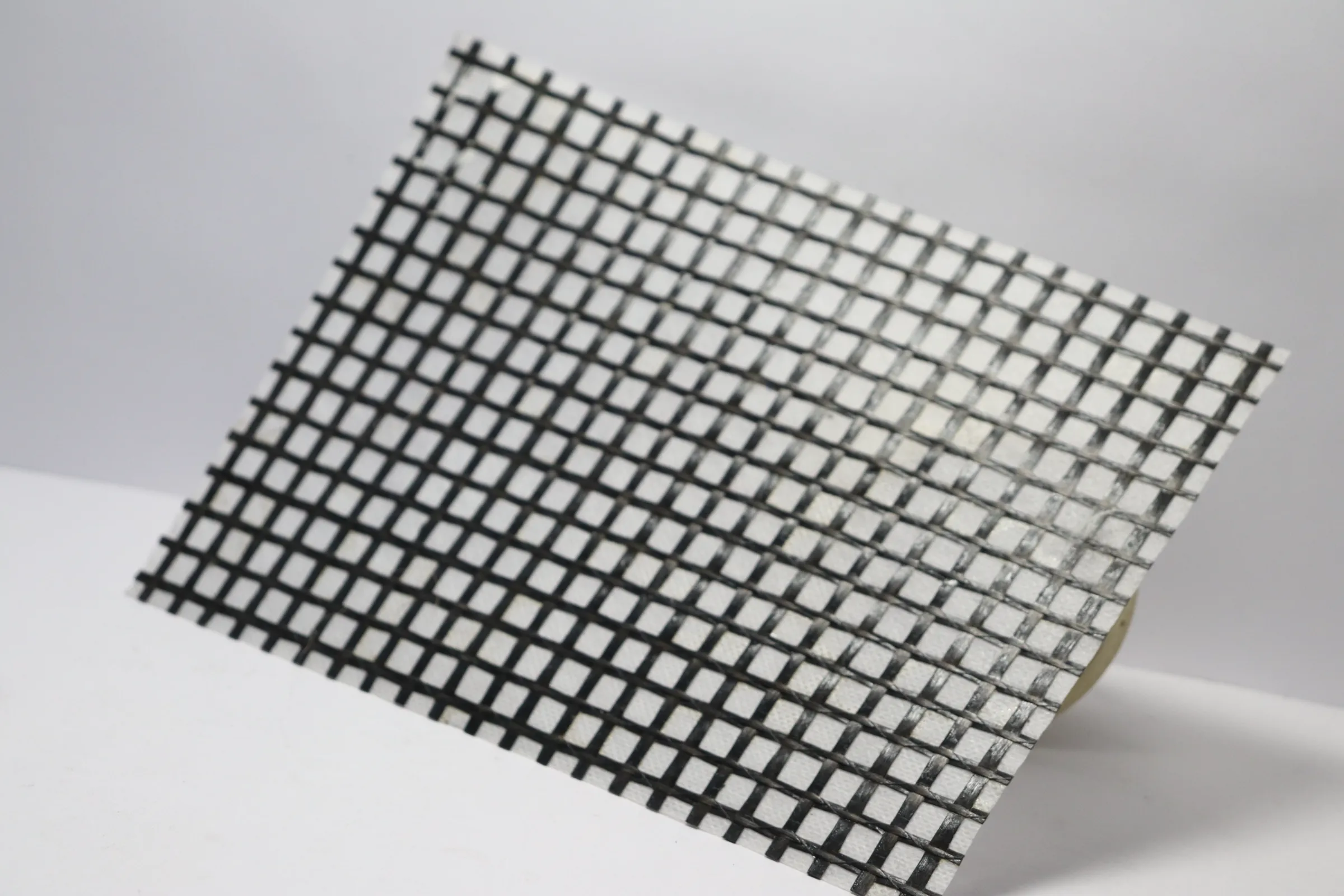
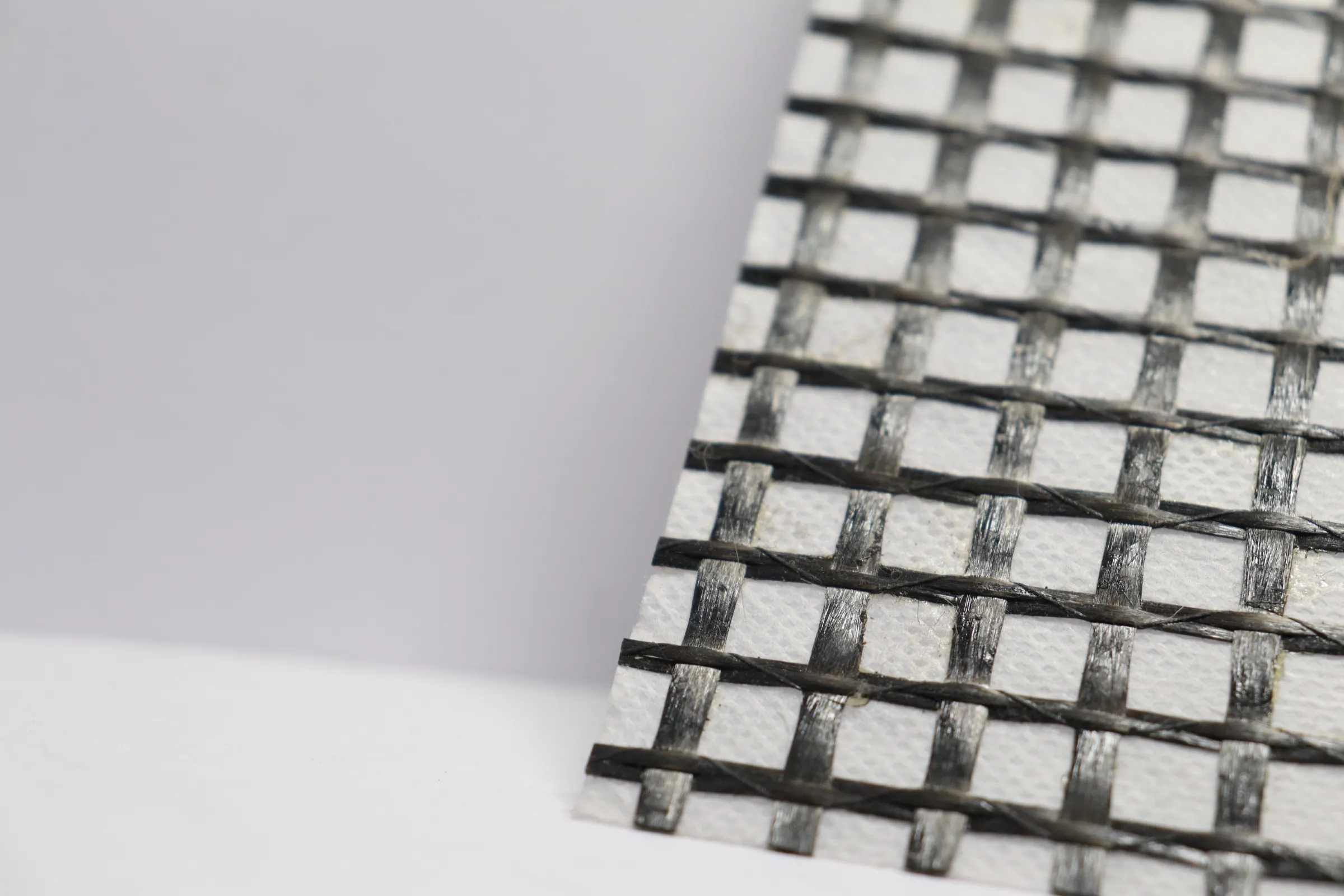
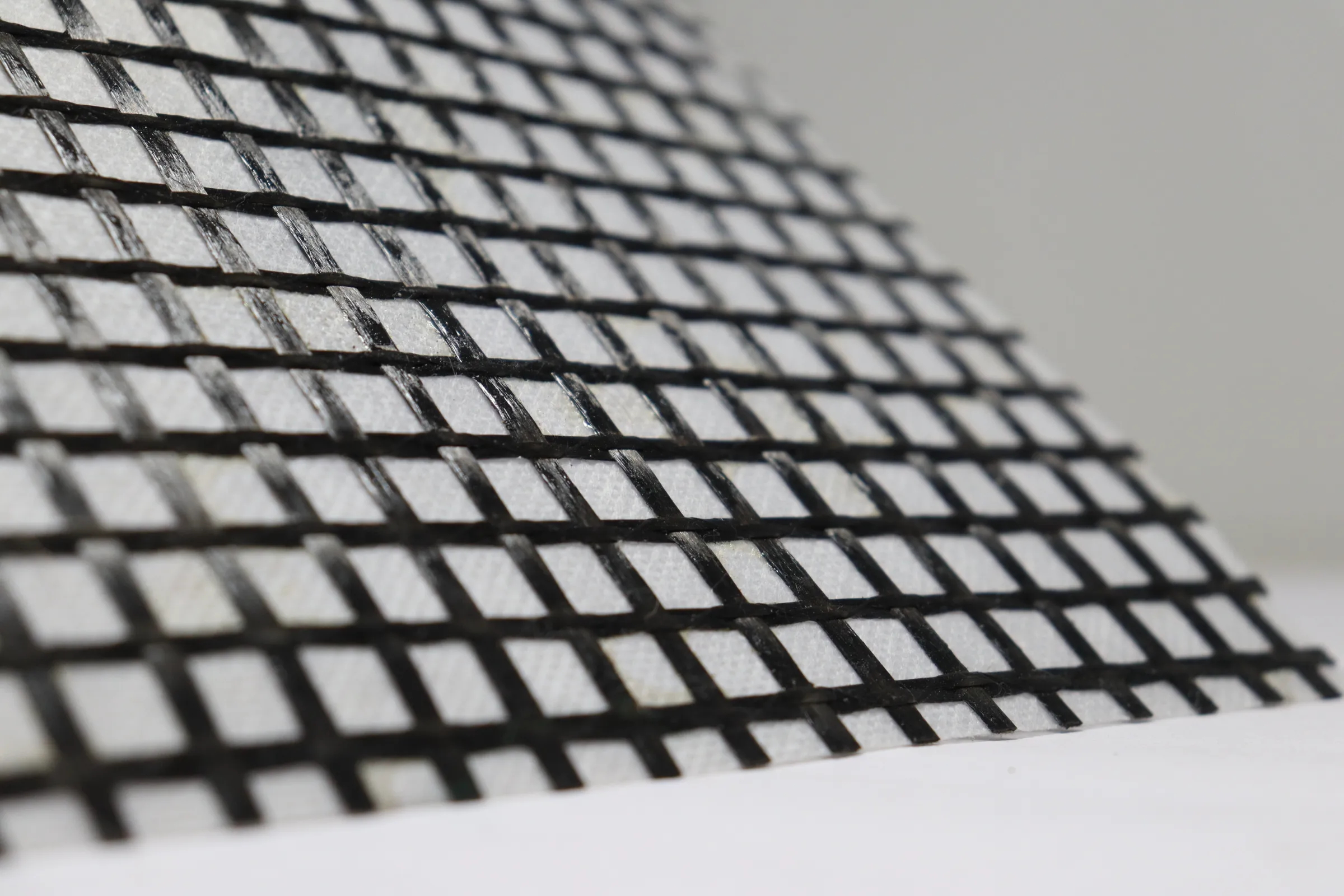
A geogrid is a polymer grid with open apertures, laid in soil or aggregate to reinforce it. Ocean Geosynthetics manufactures and supplies geogrids in India for road base and subgrade stabilisation, reinforced soil walls and slopes, and embankments over soft ground. This page explains the main types, the properties to specify and how to choose between them. For product-level detail, see our biaxial geogrid and polypropylene geogrid pages.
Table of Contents
What is a geogrid?
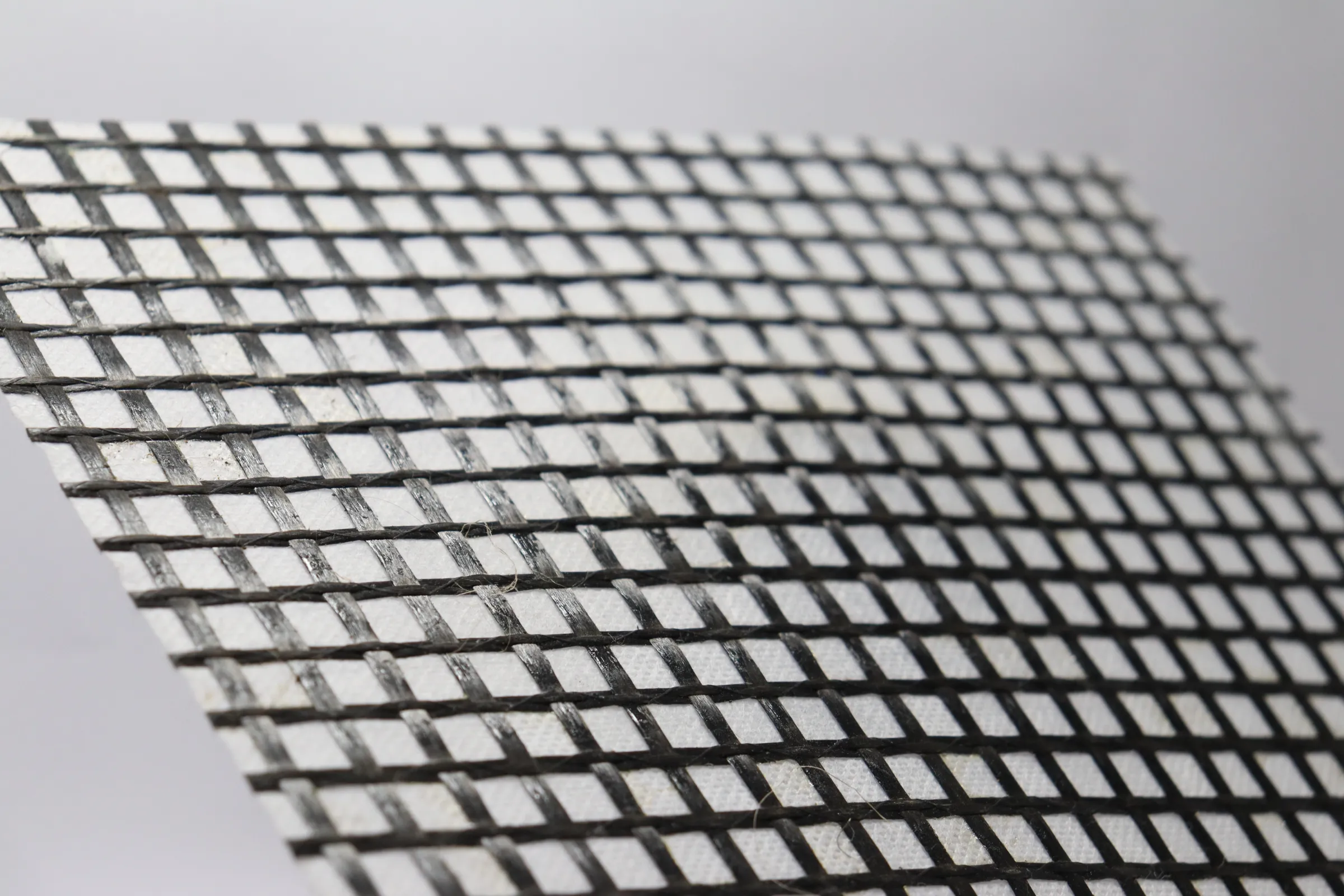
Geogrids are formed by ribs running in the machine direction (MD, along the roll) and the cross-machine direction (CD, across the roll), joined at junctions to leave a regular pattern of apertures. Compared with geotextiles they are much stiffer in tension, and their main job is reinforcement: carrying tensile load and spreading it over a wider area of soil.
The common polymers are polypropylene (PP), high-density polyethylene (HDPE) and polyester (PET). Glass-fibre grids are used for asphalt reinforcement, and polyvinyl alcohol (PVA) grids exist for some wall applications. Geogrids are made in three main ways:
- Extruded: a punched polymer sheet is stretched in one or both directions, giving a one-piece grid with integral junctions. Most PP and HDPE grids are made this way.
- Knitted or woven: bundles of high-tenacity polyester yarn are knitted or woven into a grid and then coated, usually with PVC or bitumen, to protect the yarns.
- Welded or bonded: extruded strips or coated straps are laid in a grid and welded at the crossings.
How geogrids work
Aggregate or soil particles partly penetrate the apertures and lock against the ribs. Under load, the grid restrains the particles from moving sideways, so the granular layer stays stiffer and spreads the wheel or foundation load over a wider area of the weaker soil below. In a road this means less rutting for the same thickness of granular base, or a thinner base for the same performance.
In reinforced soil walls and slopes the mechanism is different: long layers of grid act as tensile members inside the fill, anchored by friction and passive resistance on the ribs, and hold together a block of soil that behaves as a gravity structure.
Geogrids do not filter or separate. Where fine subgrade soil could pump up into the aggregate, a geotextile is placed as a separator, or a geogrid-geotextile composite is used.
Types of geogrid Ocean supplies
Biaxial geogrid
Similar strength in both MD and CD. Used under roads, working platforms, rail formations and embankment bases, where load spreads in all directions in plan. Ocean makes biaxial grids in polypropylene (20, 30 and 40 kN/m) and in high-tenacity polyester (20 to 200 kN/m). Details: biaxial geogrid.
Uniaxial geogrid
High strength in one direction only (the roll length), with light cross ribs to hold the shape. Used where load acts in one direction: reinforced soil retaining walls, steep slopes and bridge abutments. Uniaxial grids are made as extruded HDPE grids (punched and oriented) or as coated polyester grids.
Polyester (PET) and PVC-coated geogrids
Knitted or woven high-tenacity polyester yarn with a PVC coating. Polyester creeps far less than polyolefins under sustained load, so PET grids are the usual choice for high-strength, long-design-life walls and embankments over soft soil.
PP and HDPE geogrids
Polyolefin grids with good resistance to acids, alkalis and biological attack, carbon-black stabilised against UV. PP biaxial grids are the standard product for base reinforcement; HDPE is mainly used for extruded uniaxial grids. Details: polypropylene geogrid.
Geocomposite geogrids
A geogrid bonded to a nonwoven geotextile, so one layer gives reinforcement plus separation and filtration. Useful over wet, fine-grained subgrades. Ocean also supplies geogrids for road paving reinforcement and for use with wire crate (gabion) structures.
Technical Specifications
Ocean manufactures biaxial geogrids in both polypropylene (PP) and high-tenacity polyester (PET), tested to ASTM D6637 and EN ISO 10319, for soil stabilisation and ground reinforcement.
Biaxial PP Geogrid
| Property | Unit | Test Method | OG/GG PP-2020 | OG/GG PP-2020L | OG/GG PP-3030 | OG/GG PP-3030L | OG/GG PP-4040 | OG/GG PP-4040L |
|---|---|---|---|---|---|---|---|---|
| Ultimate Tensile Strength (MD) | kN/m | ASTM D 6637 / EN ISO 10319 | 20 | 20 | 30 | 30 | 40 | 40 |
| Ultimate Tensile Strength (CD) | kN/m | ASTM D 6637 / EN ISO 10319 | 20 | 20 | 30 | 30 | 40 | 40 |
| 0.5% Radial Stiffness | % | ASTM D 6637 / EN ISO 10319 | 350 | 350 | 380 | 380 | 450 | 450 |
| Tensile Strength at 2% Strain (MD) | kN/m | ASTM D 6637 / EN ISO 10319 | 7.0 | 7.0 | 10.0 | 10.0 | 14.0 | 14.0 |
| Tensile Strength at 2% Strain (CD) | kN/m | ASTM D 6637 / EN ISO 10319 | 7.0 | 7.0 | 10.0 | 10.0 | 14.0 | 14.0 |
| Tensile Strength at 5% Strain (MD) | kN/m | ASTM D 6637 / EN ISO 10319 | 15 | 15 | 20 | 20 | 28 | 28 |
| Tensile Strength at 5% Strain (CD) | kN/m | ASTM D 6637 / EN ISO 10319 | 15 | 15 | 20 | 20 | 28 | 28 |
| Aperture Size (±5 mm) | mm | 38 | 60 | 38 | 60 | 30 | 60 | |
| Roll Length | m | 100 | 100 | 100 | 100 | 100 | 100 | |
| Roll Width | m | 5.0 | 5.0 | 5.0 | 5.0 | 5.1 | 5.1 |
Biaxial Polyester (PET) Geogrid
| Property | Unit | Test Method | 20 kN | 30 kN | 40 kN | 60 kN | 80 kN | 90 kN | 100 kN | 150 kN | 200 kN |
|---|---|---|---|---|---|---|---|---|---|---|---|
| Ultimate Tensile Strength (MD) | kN/m | ASTM D 6637 / EN ISO 10319 | 20 | 30 | 40 | 60 | 80 | 90 | 100 | 150 | 200 |
| Ultimate Tensile Strength (CD) | kN/m | ASTM D 6637 / EN ISO 10319 | 20 | 30 | 40 | 60 | 80 | 90 | 100 | 150 | 200 |
| Elongation at Nominal Strength (MD) | % | ASTM D 6637 / EN ISO 10319 | 12 | 12 | 12 | 12 | 12 | 12 | 12 | 12 | 12 |
| Elongation at Nominal Strength (CD) | % | ASTM D 6637 / EN ISO 10319 | 12 | 12 | 12 | 12 | 12 | 12 | 12 | 12 | 12 |
| Tensile Strength at 2% Strain (MD) | kN/m | ASTM D 6637 / EN ISO 10319 | 3 | 4.5 | 6 | 9 | 12 | 13.5 | 15 | 22.5 | 30 |
| Tensile Strength at 2% Strain (CD) | kN/m | ASTM D 6637 / EN ISO 10319 | 3 | 4.5 | 6 | 9 | 12 | 13.5 | 15 | 22.5 | 30 |
| Tensile Strength at 5% Strain (MD) | kN/m | ASTM D 6637 / EN ISO 10319 | 5 | 7.5 | 10 | 15 | 20 | 22.5 | 25 | 37.5 | 50 |
| Tensile Strength at 5% Strain (CD) | kN/m | ASTM D 6637 / EN ISO 10319 | 5 | 7.5 | 10 | 15 | 20 | 22.5 | 25 | 37.5 | 50 |
| Aperture Size (±3 mm) | mm | 27×27 | 21×27 | 21×25 | 21×25 | 21×25 | 23×23 | 23×23 | 23×22 | 23×22 |
Key Applications
- Subgrade stabilisation over soft and weak soils
- Base and sub-base reinforcement for paved and unpaved roads
- Reinforced soil retaining walls and steep slopes
- Embankments and load transfer platforms over poor foundations
- Working platforms for heavy construction traffic
- Railway track bed and formation stabilisation
Key Features
- Biaxial structure distributes load in both machine and cross directions
- High tensile strength developed at low strain
- Strong junctions for effective aggregate interlock and confinement
- Resistant to chemical, biological and environmental degradation
- Available in PP and high-strength polyester (PET) grades up to 200 kN/m
Download PP Geogrid Brochure (PDF) Download Polyester Geogrid Brochure (PDF)
Key properties and test standards
| Property | Why it matters | Test method |
|---|---|---|
| Ultimate tensile strength (MD and CD), kN/m | Grade designation; governs wall and slope design | ASTM D6637, EN ISO 10319 |
| Tensile strength at 2% and 5% strain, kN/m | Stiffness at the small strains that occur in a road base; often more useful than ultimate strength for pavements | ASTM D6637, EN ISO 10319 |
| Elongation at ultimate strength, % | Higher elongation means the grid must stretch more before it carries load | ASTM D6637, EN ISO 10319 |
| Junction strength | Interlock depends on junctions holding when ribs are loaded | GRI-GG2 |
| Aperture size, mm | Must suit the fill grading so particles lock into the grid | Measured |
| Creep and long-term design strength | Allowable strength for walls after reduction factors for creep, installation damage and durability | ASTM D5262, ISO 13431, ISO/TS 20432 |
In India, IS 17371:2020 covers geogrids for flexible pavements and IS 17373:2020 covers geogrids for reinforced soil retaining structures. Geogrids for flexible pavements fall under the Ministry of Textiles’ Geo Textiles (Quality Control) Order and must comply with IS 17371. Pavement design with geogrids follows IRC:SP:59-2019, which gives the Layer Coefficient Ratio and Modulus Improvement Factor methods for use with IRC:37.
Applications
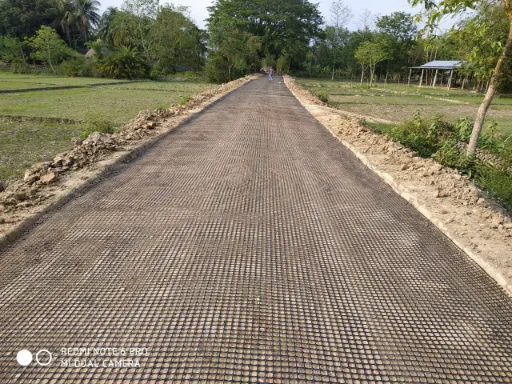
- Road base and sub-base reinforcement: biaxial grid at the base of the granular layer (or within it) on highways, rural roads, plant roads and mining haul roads, to cut rutting or reduce granular thickness.
- Subgrade stabilisation and working platforms: over soft clay or silt, where construction plant and cranes need a stable surface.
- Reinforced soil retaining walls: uniaxial or PET grids in the backfill behind block or panel facings. See when to use geogrid in a retaining wall.
- Steep slopes and embankment widening: layers of grid let fill stand steeper than its natural angle of repose, which saves land on highway widening.
- Embankments over soft foundations: a basal layer of high-strength PET grid improves stability during construction.
- Shallow foundations: layers under footings and rafts on weak soil to spread load.
- Bridge and railway abutments and track formation: reinforcing the approach fill and stabilising the formation under ballast.
How to choose a geogrid
- Load direction. Load spreading under traffic needs a biaxial grid. A wall or slope with load in one direction needs uniaxial or high-strength PET grid with its strong direction perpendicular to the face.
- Design life and sustained load. For permanent walls and basal reinforcement, design on long-term design strength, not ultimate strength. FHWA default creep reduction factors are roughly 1.4 to 2.5 for polyester against 4.0 to 5.0 for polypropylene, which is why PET dominates in high-strength walls.
- Soil chemistry. Polyester can lose strength by hydrolysis in strongly alkaline conditions, such as lime- or cement-treated soil or concrete-contact zones. FHWA guidance limits PET to a pH of about 3 to 9; PP and HDPE tolerate a wider range.
- Strength at low strain. For pavements, compare tensile strength at 2% and 5% strain, as listed in the specification tables above, rather than the headline kN/m.
- Aperture and fill. The aperture must suit the aggregate grading so particles interlock. Ocean’s PP range comes in standard and larger-aperture (L) versions for this reason.
- Subgrade. If the subgrade is fine and wet, add a separation geotextile or use a geocomposite grid.
Installation basics
- Prepare and level the formation, removing stumps and sharp objects. Proof-roll where the design calls for it.
- Roll the grid out in the direction specified by the designer and pull it taut. In walls, lay the strong direction perpendicular to the face with no joints along that direction.
- Overlap adjacent rolls in pavements as the design specifies. Overlaps are typically about 300 mm on firm subgrades and increase to 600 to 900 mm on very soft ground.
- Pin or weigh down edges so the grid does not move while fill is placed.
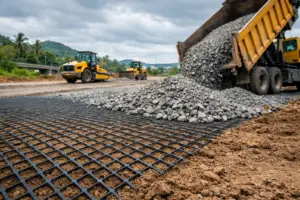
- Place fill by end-tipping and spreading forward. Do not drive tracked plant directly on the grid; keep a minimum cover (commonly 150 mm) under construction traffic, then compact.
- Store rolls off the ground and covered, and keep exposure to sunlight short during installation.
Related products
- Biaxial geogrid and polypropylene geogrid
- Geotextiles for separation under the grid
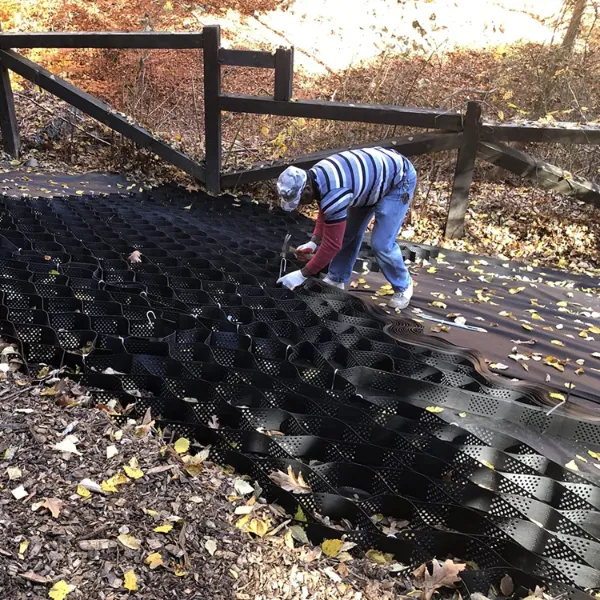
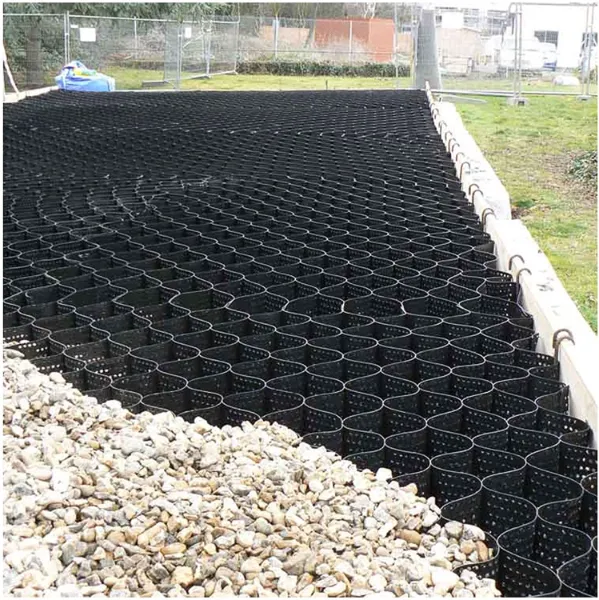
- Geocells for three-dimensional confinement where the base must be built over very soft ground or on slopes
- Gabion boxes for wall facings and river works
Frequently asked questions
What is the difference between uniaxial and biaxial geogrid?
A uniaxial geogrid is strong in one direction and is used in retaining walls and slopes. A biaxial geogrid has similar strength in both directions and is used for load spreading under roads and platforms.
Which Indian standard applies to geogrids?
IS 17371:2020 for geogrids in flexible pavements and IS 17373:2020 for geogrids in reinforced soil retaining structures. IRC:SP:59-2019 covers the design of pavements using geosynthetics.
Should I use PP or polyester geogrid?
PP biaxial grid is the usual choice for road base and subgrade stabilisation. Polyester is preferred where high strength must be held for decades under sustained load, such as tall walls and embankments over soft clay, because it creeps less. Avoid polyester in highly alkaline soil.
Does a geogrid replace a geotextile?
No. A geogrid reinforces; it does not separate or filter because its apertures are open. On soft, fine subgrades, use a geotextile under the grid or a geogrid-geotextile composite.
What roll sizes does Ocean supply?
Ocean’s PP biaxial geogrids come in 100 m rolls, 5.0 m or 5.1 m wide depending on grade. Ask for roll dimensions of polyester and uniaxial grades with your quote.
To get a grade recommendation, send us the application, design strength or pavement design, fill type and quantity.