Case Study: Ocean Geogrid 60KN for a Food Plant Project in Uluberia
For a food plant project in Uluberia, Howrah (West Bengal), Ocean Non Wovens supplied and installed 1,900 square meters of Ocean Geogrid 60KN to stabilise the ground beneath the plant’s pavements and foundations.
Food plants carry heavy processing machinery, forklifts and delivery trucks, and they run under strict hygiene rules. Floors and yards that settle or crack are hard to keep clean and unsafe to work on, so the ground beneath them has to stay stable.
What geogrids do in food plant infrastructure
Geosynthetics, and geogrids in particular, are used beneath pavements and foundations to spread load over weak soil. Compacted granular fill locks into the grid’s apertures; the grid stops the fill spreading sideways under load, and the reinforced layer acts as a stiffer platform that spreads load over a wider area of subgrade.
Ocean Geogrid 60KN was chosen for this project for its tensile strength, durability and chemical inertness.
Site challenges at Uluberia
- Unstable soil: Uluberia sits on the Hooghly in the Gangetic delta, where alluvial soils vary in compaction and drainage and the water table is often high. The site needed stabilisation to prevent settlement and give uniform bearing capacity. The geogrid spreads loads across the weak subgrade so no one area is overstressed.
- Hygiene requirements: food plants operate under strict sanitation regulations, so construction materials should be non-toxic and non-reactive. Ocean Geogrid 60KN is an inert polymer that does not rot or support microbial growth, and it sits buried beneath the pavement and floor slabs.
- Heavy and repeated loading: heavy equipment and vehicle traffic need a stable base. The 60KN geogrid gives the granular layer the stiffness to limit deformation under repeated loading.
Ocean Geogrid 60KN
Specifications
- Tensile strength: 60KN/m, for high-stress industrial applications.
- Material: high-density polyethylene (HDPE), resistant to chemicals, moisture and, with UV stabilisation, sunlight during storage and installation.
- Installation: light rolls that are quick to lay, which saves time and labour on site.
Performance
- Soil reinforcement: the grid and compacted fill act as one layer that resists soil displacement and spreads load.
- Environmental: HDPE is a recyclable thermoplastic, and the grid reduces the quantity of quarried fill needed.
- Longevity: buried polymer grids do not corrode or rot, so the reinforcement layer needs no maintenance.
Project outcomes
- Structural stability: Ocean Geogrid 60KN improved the load-bearing capacity of the subgrade, giving the plant a stable foundation.
- Cost efficiency: less excavation and replacement of weak soil was needed, saving cost without compromising quality.
- Lower environmental impact: less raw material extraction and a longer-lasting base.
Further benefits on industrial sites
- Uniform support under machinery: a geogrid-stabilised base settles less unevenly, which helps keep floor slabs and equipment bases level. Machine vibration itself is handled by the foundation design; the geogrid’s contribution is a stiffer, more uniform base.
- Room for expansion: a stabilised yard or base can often take additional loads later without major rework.
- Worker safety: level, stable floors and yards reduce trip hazards and accidents from subsidence.
A geogrid is often combined with a separation geotextile on very soft, wet soil. Ocean also supplied non-woven geotextile to a food plant project in Uluberia: see the case studies.
About Ocean Non Wovens
Ocean Non Wovens worked with the project stakeholders throughout the Uluberia food plant project. It supplies geosynthetics for food plants, industrial sites and infrastructure across India.

source on Google
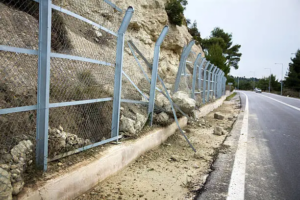 Landslide Prevention Project in Wayanad, Kerala, with Rockfall Barriers
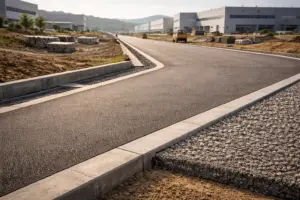 Reliance Project, Jabalpur (Madhya Pradesh): Application of Non Woven Geotextiles for Ground Stabilisation and Drainage Performance
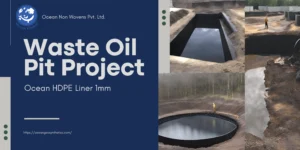 Ocean HDPE Liner 1mm in the Waste Oil Pit Project, Durgapur, West Bengal
