Geosynthetics in Construction of Roads Subgrade Stabilization with Geogrids

India has the second-largest road network in the world after the United States, at about 63 lakh km (6.3 million km) according to the Ministry of Road Transport and Highways, and the construction of roads, expressways and highways continues at pace. Roads carry almost 65% of the country’s goods and about 90% of its passenger traffic.
Road building has come a long way since the stone roads of Rome. Pavement thickness, alignment, slope gradients, layering, stability and materials have all changed.
Geosynthetics are now a common material in road construction because they cut the cost of building on poor ground and extend pavement life. They are most useful where construction is constrained, where subsoils drain poorly, or where the subgrade is cohesive or organic soil.
Table of Contents
On soft soils, geosynthetics lengthen maintenance intervals and service life. They are used for ground improvement across civil, geotechnical, environmental, hydraulic and coastal engineering.
Problems in Construction of Roads :
Potholes and ruts that keep coming back are the visible symptoms. Behind them are climate, traffic loads, road widening, the age of the road and, above all, the subgrade soil.
The main causes of damage are temperature extremes, poor drainage, weak subgrade soil and wear from traffic. They are cheapest to deal with at the design stage, either in new construction or during rehabilitation.
Water is the most common cause of pavement distress: surface water gets into the pavement and softens and weakens the subgrade.
Clay and silt subgrades hold water. Expansive clays, such as the black cotton soils found across much of central and western India, swell when wet and shrink when dry, and in cold regions frost heave and thaw weaken the subgrade further. Both break up the road base. Sandy, well-drained subgrades, by contrast, add years to a road’s life.
Geosynthetic Solutions – Geogrids:
The traditional fix for a weak subgrade is to dig it out and replace it with better material, which is expensive and slow.
Subgrade stabilisation with geosynthetics is now the usual alternative. Geogrids reinforce the granular layers, and geotextiles separate the aggregate from the soft subgrade so the two do not mix.
A geogrid is a polymer grid of intersecting ribs with open apertures. Geogrids are made as uniaxial, biaxial or triaxial products; biaxial geogrids are the usual choice under road bases because traffic loads spread in all directions.
Aggregate interlocks with the apertures, so the geogrid confines the granular layer and stops it spreading sideways under wheel loads. The base becomes stiffer and spreads load over a wider area of subgrade, which raises the load-carrying capacity of the pavement or allows a thinner aggregate layer for the same performance.
Geogrids are light, easy to transport and quick to install, and they stabilise the subgrade and extend the life of roads and pavements.
Why Geosynthetics for Road Construction:
Geosynthetics need less quarried aggregate and fewer truck movements than dig-and-replace, are easy to transport and install, and have many uses on a single project. In India, their use in pavements is covered by IRC SP:59 (Guidelines for Use of Geosynthetics in Road Pavements and Associated Works).
Ocean Geosynthetics manufactures and supplies geogrids in India for road reinforcement. For an example on a highway project, see our NHAI case study in Raebareli.
Explore our range of geosynthetics for the roadway sector.

source on Google
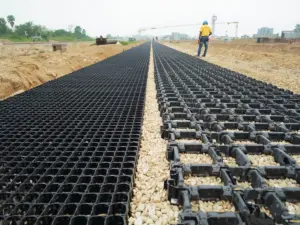 Geocells and Geogrids, Performance and Comparison
 The Light House Project: Enhancing Stability and Sustainability with Ocean HDPE Perforated Geocell
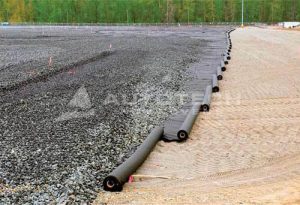 Does Water Go Through Geotextile Fabric? How Drainage Fabric Works