Case Study: Integrated Wastewater Management Using Ocean PP Geotextile and HDPE Geocell in Bengaluru, Karnataka
For a wastewater management project in Bengaluru, Karnataka, Ocean Non Wovens supplied two geosynthetics that do different jobs in the same system: 1,500 SQM of Ocean Non Woven Geotextile PP 1.8 MM and 2,300 SQM of Ocean Geocell 445 × 200 MM. The geotextile handles filtration and separation where soil meets water; the geocell confines soil or granular fill so that wet ground, slopes and channel edges hold their shape.
Wastewater sites around Bengaluru are hard on civil works. Ground near treatment units, channels and outfalls often stays wet for long periods, water moves across and through it constantly, and heavy monsoon rain adds surface runoff. Saturated soil loses strength, fines wash out, and an unreinforced gravel surface ruts and erodes quickly. The pairing of a geotextile with a geocell answers several of those problems at once.
Project overview
Project Name: Wastewater Management Project
Location: Bengaluru, Karnataka
Products supplied
- Ocean Non Woven Geotextile PP 1.8 MM: 1,500 SQM
- Ocean Geocell 445 × 200 MM: 2,300 SQM
Project scope
The project needed materials for ground stabilisation, filtration, drainage-related functions, erosion control and surface reinforcement. Which function each product served at a given location was set by the project design; the sections below explain what each material contributes in this kind of setting.
What the non woven geotextile does
A needle-punched non woven geotextile lets water pass through its thickness and along its plane while holding back soil particles. The 1.8 MM figure is the fabric’s thickness, not its weight per square metre.
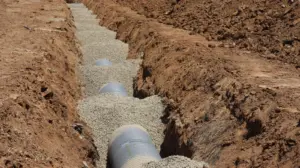
In a wastewater site, that filtration matters around drainage layers, channel linings, embankments and backfill against structures. Without a filter, fine soil migrates into gravel drains and clogs them, or washes out from behind structures and leaves voids. A correctly selected geotextile keeps water moving while keeping the soil in place.
The same fabric also works as a separator. Where a granular layer sits directly on soft, wet subgrade, traffic pushes stone down into the soil and pumps fines up into the stone, and the working layer gets thinner and weaker over time. A geotextile between the two keeps them apart.
Relevant Indian Standards
- IS 16362: geotextiles used in subgrade stabilisation in pavement structures (covering the separation and filtration that come with it)
- IS 16393: geotextiles used in subsurface drainage
- IS 16090: geotextiles used as protection (cushioning) materials
These specifications tie the fabric’s properties (grab strength, tear and puncture resistance, permittivity, apparent opening size) to the job it is meant to do. A geotextile should be chosen against those properties, not simply because a roll is available.
What the geocell does
A geocell is a honeycomb of HDPE strips welded together, delivered collapsed and stretched open on site. Each cell is filled with soil, sand or aggregate. In the 445 × 200 MM designation, 200 mm is the cell depth.
Under load, loose granular material spreads sideways, and that lateral movement is what produces rutting and settlement. The cell walls stop the infill from spreading, the wall friction and hoop stress hold it in place, and the filled mattress behaves as a stiffer slab that spreads wheel loads over a wider area of subgrade.
Around wastewater infrastructure this helps where surfaces see:
- Saturated soil conditions
- Repeated maintenance traffic
- Water movement
- Surface erosion
- Localised settlement
- Sloped ground
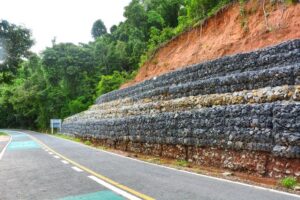
On slopes and channel banks, the cells hold topsoil or stone in place against runoff. Geocells now have their own Indian Standard, IS 17483: Part 1 covers load-bearing applications and Part 2 covers slope erosion protection.
Geocells compared with thicker aggregate
The conventional fix for weak ground is to dig out more and place a thicker granular layer. That works, but it means more excavation, more trucks, more placement and more compaction. A geocell improves the behaviour of the fill already placed, so the design can often reach the required performance with a thinner section, fewer truck movements and less disturbance to an operating site.
Geocells do not replace design. How much they help depends on cell geometry, infill, subgrade strength, loading, drainage and installation quality, and any reduction in aggregate thickness has to come from the project’s own design rather than a fixed rule of thumb.
Site conditions the design has to address
Weak, wet subgrade. Saturated soils generally have lower effective strength than drained, compacted ones. The geotextile keeps aggregate and soil separate; the geocell confines the reinforced layer above it.
Drainage. A geosynthetic does not fix poor drainage on its own. If water has nowhere to go, pore pressure builds and the soil underneath loses strength. The geotextile’s filtration role has to be designed together with the site’s overall drainage.
Erosion. Flowing water strips fines from exposed slopes, channels, outlets and embankments. Geocells hold the surface layer in place, and a geotextile beneath retains the soil behind it.
Installation practice
A geosynthetic system is only as good as its installation. The usual sequence for this pairing is:
- Subgrade preparation: remove sharp stones, debris and roots, fill voids and correct soft spots, so the geotextile is not punctured or torn.
- Geotextile placement: lay the fabric flat without folds, with overlaps, seams and anchoring as per the approved method statement.
- Geocell expansion: stretch each panel fully open and pin it before filling; a partly opened panel gives the wrong cell geometry. Anchoring and alignment matter most on slopes.
- Infill: use the specified material. Oversized, poorly graded or contaminated fill compacts badly and weakens the system.
- Compaction: reach the specified density without running heavy plant directly on unfilled cells or exposed fabric.
Quality checks
For the geotextile, check delivered rolls against the specified grab strength, tear resistance, puncture resistance, permittivity, apparent opening size and durability properties. For the geocell, check panel dimensions, cell geometry, joints, anchoring, expansion and infill placement. Inspection should cover the installed system, not only the material that arrived on site.
Long-term performance and maintenance
Wastewater environments expose geosynthetics to moisture, chemicals, biological activity, temperature changes and repeated loading. Polypropylene geotextiles are widely used for separation, filtration and drainage, but long-term behaviour still depends on exposure and on the specified properties. For geocells, it depends on polymer durability, confinement, interaction with the infill, load cycles and environmental exposure.
Two points need attention on site. Material left exposed before covering should not stay in sunlight longer than the manufacturer or specification allows, because UV degrades polymers. Where the system will sit in prolonged contact with aggressive effluent, the actual wastewater chemistry should be checked against the polymer.
A stabilised, well-drained surface needs fewer repairs for rutting, erosion, soil loss and settlement, and a working filter layer keeps drains from clogging early. The system still needs periodic inspection of exposed surfaces, drain outlets and erosion-prone zones. Where confinement lets the design use less aggregate, the project also moves less material and makes fewer truck trips; the size of that saving comes from the design, not a fixed percentage.
Where else these materials are used
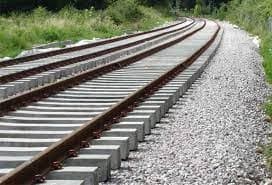
Non woven geotextiles: subsurface drainage, road construction, soil separation, filtration, erosion control, landfill systems, railway formations, irrigation projects and embankments.
Geocells: road stabilisation, access roads, industrial yards, slope protection, embankments, erosion control, drainage channels, load-bearing surfaces and construction over weak subgrades.
Ocean Non Wovens manufactures and supplies geotextiles, geocells, geomembranes, geogrids, geobags and drainage products for wastewater, irrigation, environmental, industrial and civil projects across India. More projects are listed on our case studies page.

source on Google
 Geosynthetics for Railway ballast stabilization
 Landslide Protection and Slope Protection With Gabion Retaining Wall
 Advanced Leachate Drainage Infrastructure with Ocean Drainage Geocomposite 5.5 MM in Odisha Landfill Project