Case Study: Enhancing Sustainability in Allahabad’s Bioenergy Project with Ocean HDPE Liners
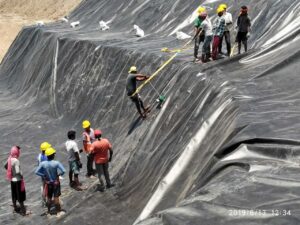
For a bioenergy project in Allahabad (Prayagraj), Uttar Pradesh, Ocean Non Wovens supplied and installed Ocean HDPE Liners in two thicknesses, 1500 micron and 500 micron, over a total of 13,200 square metres. The liners contain organic waste, leachate and biogas at a plant that turns waste into energy.
Project overview
- Project: Bioenergy Project
- Location: Allahabad, Uttar Pradesh
- Products used: Ocean HDPE Liner 1500 Micron (9240 Sqm) and Ocean HDPE Liner 500 Micron (3960 Sqm)
- Total area: 13,200 sq m
- Scope: Supply and installation
The facility processes organic waste into biogas, compost and electricity, which tackles the region’s waste management problem and adds local energy supply. Projects like this are part of India’s renewable energy push, which began with a 175 GW renewable capacity target for 2022 and has since been raised to 500 GW of non-fossil capacity by 2030. The plant’s main environmental risk is organic waste and leachate escaping into the ground, and that is what the geosynthetic lining addresses.
Why bioenergy plants use HDPE liners
Organic waste produces leachate that can contaminate soil and groundwater. HDPE (high-density polyethylene) geomembranes form an impermeable barrier under anaerobic digesters, storage ponds and landfill caps. HDPE resists the acids, ammonia and organic compounds in leachate, has very low permeability to liquids and gas, and can be welded on site into a continuous sheet. For a digester or covered lagoon, low gas permeability also keeps methane in the system where it can be collected.
Liners supplied
Ocean HDPE Liner 1500 Micron (1.5 mm)
- Quantity: 9240 Sqm
- Application: primary containment layer for the anaerobic digestion process
- Properties: high tensile strength under heavy loads, resistance to chemicals and UV, and low permeability to gas and liquid
Ocean HDPE Liner 500 Micron (0.5 mm)
- Quantity: 3960 Sqm
- Application: secondary containment and protective barrier in the leachate collection ponds
- Properties: light and quick to install, flexible enough to follow uneven surfaces, with puncture resistance suited to its role
The split follows a common pattern: the thicker 1.5 mm sheet, which has more puncture resistance, more allowance for long-term stress cracking and more tolerance of installation damage, goes where containment is critical, and the thinner sheet goes into secondary roles. HDPE geomembranes for containment are typically specified against GRI-GM13, which sets minimum properties such as density, tensile strength, puncture resistance and stress-crack resistance for each thickness.
Site challenges
Uneven ground
Soil composition and topography varied across the site. Ocean Non Wovens assessed the soil to select the liners and fitted the installation to the irregular surface contours, which reduced the risk of liner displacement and leaks. On ground like this, the subgrade is usually trimmed and compacted, and stones and roots removed, before the sheet goes down; a non woven geotextile cushion is often added where the subgrade is coarse.
Biogas containment
Besides holding the organic waste, the project needed to collect biogas efficiently to maximise energy output. The low permeability and high tensile strength of the Ocean HDPE Liner 1500 Micron kept the biogas contained, which improves the system’s efficiency and cuts methane escaping to the atmosphere.
Environmental compliance
The project set out to go beyond minimum environmental requirements. The HDPE liners support this by preventing soil and groundwater contamination and keeping leachate within the collection system.
Installation quality
An HDPE liner is only as watertight as its seams. As standard practice, panels are joined by dual-track hot-wedge welding, with extrusion welding for patches and details, and each dual-track seam is air-pressure tested along its length. Trial welds are made at the start of each shift, and sample seams are tested destructively for peel and shear strength.
HDPE liners from Ocean Non Wovens
At Allahabad, 13,200 square metres of Ocean HDPE Liner in 1500 micron and 500 micron gave the bioenergy plant primary and secondary containment for waste, leachate and biogas. Ocean Non Wovens supplies geomembranes and other geosynthetics for bioenergy, landfill and wastewater containment projects. See our case studies for more, or contact us to discuss your project.

source on Google
 How geomembranes can be used for rainwater harvesting?
 Slope and Drainage Protection Using GCCM in Jaipur, Rajasthan
 A Comprehensive Guide on What is Jute Geotextile