Geotextile Tubes for Riverbank Protection Under the Namami Gange Mission
The Ganga is the lifeline of northern India, but along thousands of kilometres of its course the river is quietly eating its own banks. Every monsoon, powerful flows carve into soft alluvial soil, swallowing farmland, homes and embankments and sending millions of tonnes of sediment downstream.
Protecting those banks is now a central concern of the Namami Gange Mission, and one of the most effective tools engineers are reaching for is not stone or concrete but a large, sand-filled geosynthetic container. Geotextile tubes, along with their smaller cousins the geobags, are transforming how India defends its riverbanks.
This article looks at how geotextile tubes are used for riverbank protection under Namami Gange, how the technology works, and why the right geosynthetic partner matters for the health of the river.
Namami Gange: A Mission to Rejuvenate the Ganga
The Namami Gange Programme is the Government of India’s flagship effort to clean and protect the river Ganga, run by the National Mission for Clean Ganga. Launched in 2014, it has grown into one of the largest river-rejuvenation programmes in the world.
Its second phase, Namami Gange Mission-II, carries a budgetary outlay of around 22,500 crore rupees extended to March 2026. The mission spans a wide range of activities:
- Sewage treatment
- Industrial pollution control
- Riverfront development
- Biodiversity and afforestation
- Protection and stabilisation of the riverbanks
Why Bank Protection Matters for a Clean River
Bank protection sits at the heart of a clean and healthy river. When banks erode, they dump vast quantities of silt into the water, destroy habitat, undermine the ghats and embankments that communities depend on, and displace the very people the mission serves.
Controlling that erosion in a way that is fast, affordable and environmentally sensitive is exactly the kind of challenge geosynthetics were built for. It is why geotextile tubes and geobags have become important instruments of the Namami Gange effort in states from West Bengal to Assam to Gujarat.
The Riverbank Erosion Problem on the Ganga
To understand why geotextile tubes matter, you have to understand the nature of the Ganga and its tributaries. These are large, sediment-laden rivers flowing across flat alluvial plains, and their banks are made of the same soft silt and fine sand that the water carries so easily.
During the monsoon the discharge multiplies, flow velocities rise, and the river attacks its banks with enormous energy. It undercuts the toe of the bank below the waterline, and once the toe is gone the soil above simply caves into the river in great slumping blocks. In meandering reaches the river migrates sideways year after year, erasing land on the outer bends.
Why Traditional Methods Fall Short
Traditional protection relied on boulder pitching, stone aprons and concrete revetments. But the Gangetic plains have almost no natural rock, so every boulder has to be quarried and hauled hundreds of kilometres at high cost and high carbon.
Rigid stone and concrete structures are also brittle, and when the river scours the bed at their toe they are undermined and collapse. What the river demands instead is protection that is:
- Heavy enough to resist the flow
- Flexible enough to follow the scouring bed
- Permeable enough to relieve water pressure
- Buildable from materials available on site
That is precisely what a geotextile tube provides.
Geotextile Tube Technology: How Geotubes Work
A geotextile tube, often called a geotube, is a large tubular container fabricated from high-strength woven geotextile, engineered specifically to be filled with sand and to hold its shape under a river’s attack.
Filling and Consolidation
Understanding how geotubes tackle river erosion in India begins with how they are filled. The empty tube is positioned along the bank or bed, and a sand-and-water slurry, usually dredged from the river itself, is pumped into it through filling ports spaced along the crown.
Here the cleverness of the fabric comes in. The woven geotextile is engineered with a controlled pore opening that retains the sand particles inside while letting the water bleed out through the fabric walls. This dewatering action lets the tube consolidate into a dense, heavy, stable mass, and repeated fill cycles bring it up to its design height.
Deployment Configurations
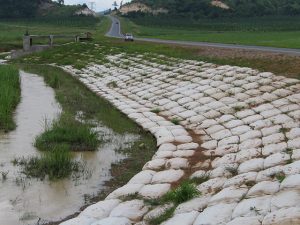
Once filled and consolidated, a geotube becomes a large monolithic unit, often several metres across and tens of metres long, that resists the drag and lift of the river through sheer weight. Tubes can be deployed in several configurations:
- Laid as a continuous revetment along the bank
- Stacked in pyramids to form larger bunds and dikes
- Built out into the river as groynes and spurs that deflect the current away from a vulnerable bank
Because they are flexible, they conform to the bed and settle with it rather than cracking, and because they are permeable, they relieve the pore-water pressure that destroys rigid structures.
Above all, a geotube is filled with locally dredged sand rather than imported rock, which makes it dramatically faster and cheaper to build on an alluvial river. On the Ganga, where dredging is already part of river management, that alignment of sediment handling and bank protection is a powerful advantage.
Geobags for Scour Protection
Geotextile tubes rarely work alone. Their essential partner is the geobag, a smaller sand-filled geotextile container that handles the parts of the job a large tube cannot.
Effective geobag riverbank protection is built on the same principle as the tube – a permeable geotextile skin holding a mass of sand – but at a scale that can be placed by hand or dropped from a barge to armour specific zones.
The Role of Geobags at the Toe
The most important role of geobags is toe and scour protection. The greatest threat to any bank structure is the river gouging the bed at its foot, so a launching apron of geobags is laid along the toe.
When the river scours the bed, the edge bags launch, rolling down to blanket the newly exposed slope and arrest the scour – a self-healing action that a rigid apron cannot match. This falling-apron behaviour protects the foundation on which the geotubes stand.
Geobags are also used for a range of complementary tasks:
- Filling the gaps between and behind tubes
- Building up levels
- Repairing and reinforcing existing structures
Together, a geotube core with a geobag apron and infill forms a complete, flexible, self-adjusting bank-protection system, which is why the two are so often specified side by side on Namami Gange works.
Woven Geotextiles for Filtration
Filtration and Separation
Beneath and behind these sand-filled units lies another essential geosynthetic layer: the woven geotextile filter. Before any tubes or bags are placed, a filter fabric is laid over the prepared bank and bed.
Its job is filtration and separation. It lets water pass through freely while holding the fine foundation soil in place, preventing the river from washing the bank material out from underneath the protection through a process called piping.
Without this filter, water moving in and out of the bank with the changing river level would slowly flush away the fine soil, hollowing out the foundation until the whole structure settled or failed.
Fabric Engineering and Testing Standards
The same woven geotextile also provides the raw material strength of the tubes and bags themselves, since it is the engineered fabric that must retain the sand fill and withstand the abrasion of sediment-laden flow for decades. These fabrics are specified and tested by:
- Opening size – ASTM D4751
- Water flow – ASTM D4491
- Tensile strength – ASTM D4632 and D4595
- Ultraviolet durability – ASTM D4355
Guidance from the Central Water Commission, the Ganga Flood Control Commission and the Central Board of Irrigation and Power shapes their use on Indian rivers.
Ganga River Stabilization With Geosynthetics: How It All Works Together
The Complete System
The full picture of Ganga river stabilization geosynthetics is a layered system in which each element does a distinct job:
- The woven geotextile filter protects the foundation soil.
- The geotube core provides the heavy, flexible, permeable mass that holds the bank line.
- The geobag apron guards the toe against scour and lets the structure self-adjust as the bed changes.
- Geocells and erosion control mats green and hold the surface against rain and runoff on slopes exposed above the waterline.
This system resists the river not by opposing it with a rigid wall, but by absorbing and adapting to its forces, which is what allows it to survive floods that would destroy conventional protection.
Environmental Fit With Namami Gange
The environmental fit with Namami Gange is close. Key advantages include:
- Uses locally dredged sand rather than quarried stone, avoiding heavy mining, long-distance haulage and carbon
- The dewatering ability of geotextile tubes doubles as a sediment-management tool, since the same technology dewaters dredged and treated sludge
- Aligns bank protection with the mission’s wider goal of a cleaner river
Fast to build, gentle on the environment and made largely from what the river itself supplies, geosynthetic bank protection is a natural match for a programme dedicated to the health of the Ganga.
Project Case Studies
The value of this technology is clearest in the situations it solves along India’s great rivers.
West Bengal – Ganga Erosion Reaches
On the erosion-battered reaches of the Ganga in West Bengal, where districts like Malda and Murshidabad have lost land and homes to the migrating river for decades, sand-filled geotube revetments and geobag aprons offer a way to hold the bank line using dredged river sand. These systems are built quickly during the working season before the next flood arrives.
Assam – Brahmaputra Dyke Protection
On the Brahmaputra in Assam, one of the most aggressively braided and erosive rivers in the world, geotextile solutions have been used to protect vulnerable dykes and embankments where stone is scarce and the river is merciless. Documented projects demonstrate how well sand-filled geosynthetic structures perform under extreme flows.
Gujarat – Shoreline and Bank Protection
Along the coast and rivers of Gujarat, geotextile tubes have been deployed for shoreline and bank protection and for reclamation bunds, showing the same technology working across very different water conditions.
In each of these settings the pattern repeats: a costly, slow, stone-hungry, failure-prone problem is converted into a fast, local, flexible and durable solution. As Namami Gange extends bank-protection works across the Ganga basin, this is the model that increasingly wins out.
Product Specifications at a Glance
The table below summarises the main geosynthetic products used for riverbank protection on a programme like Namami Gange, with representative properties and the standards that govern them.
| Product | Function | Where Used | Key Benefit | Reference Standards |
|---|---|---|---|---|
| Geotextile Tube (Geotube) | Bank revetment, bunds, groynes | Along and into the river | Heavy, flexible, filled with local sand | ASTM D4595, D4751, IGS / PIANC guidance |
| Geobag | Scour and toe protection | Launching aprons, infill | Self-launching, arrests bed scour | ASTM D4632, D4751 |
| Woven Geotextile Filter | Filtration and separation | Beneath tubes and bags | Prevents soil piping and washout | ASTM D4751, D4491 |
| Non-woven Geotextile | Filtration, cushioning | Filter and protection layers | Retains fines, relieves pore pressure | ASTM D4491, D4355 |
| Geocell / Erosion Mat | Slope confinement and cover | Upper bank slopes | Greens and holds slopes above water | IRC:56, ASTM D5397 |
The exact grade for any location depends on the flow velocity, bank height, scour depth and design life, which is why matching the product to the reach is as important as the product itself.
Why Ocean Non Wovens for Riverbank Protection Projects
Protecting India’s rivers at the scale Namami Gange demands calls for a manufacturer who can combine engineering quality with dependable, high-volume supply to difficult riverside sites. That is where Ocean Non Wovens fits.
As a leading Indian manufacturer and supplier of geotextile tubes, geobags, woven and non-woven geotextiles, geocells, geogrids and HDPE liners, Ocean Non Wovens produces materials tested to Indian and international specifications and built for the harsh, abrasive conditions of a working river.
Ocean Non Wovens supports a broad range of applications:
- Riverbank protection and flood control
- Scour defence and erosion control
- Dewatering and sediment management
- Highways, expressways and defence infrastructure
- Railways, water resources and industrial developments
For the engineers and agencies delivering Namami Gange bank-protection works, that means a reliable single source for the geotextile tubes, geobags and filter fabrics that river stabilisation depends on, backed by technical support to specify the right product for every reach and flow condition.
If your project involves geotextile tubes, geobag riverbank protection, scour defence, filtration or erosion control, Ocean Non Wovens can help you hold the bank, protect the community and keep the river healthy for generations. Talk to Ocean Non Wovens and put engineered strength on the banks of India’s greatest rivers.

source on Google
 Irrigation Department Work Project at Patna – Case Study
 Industrial Ground Stabilization with Ocean Non Wovens Geotextile 3 MM at Reliance Project, Vijayawada, Andhra Pradesh
 Case Study: Effective Waterproofing with Dimple Board in Chikhali, Pune