Namami Gange Project: Using Geosynthetics for Sustainable River Restoration
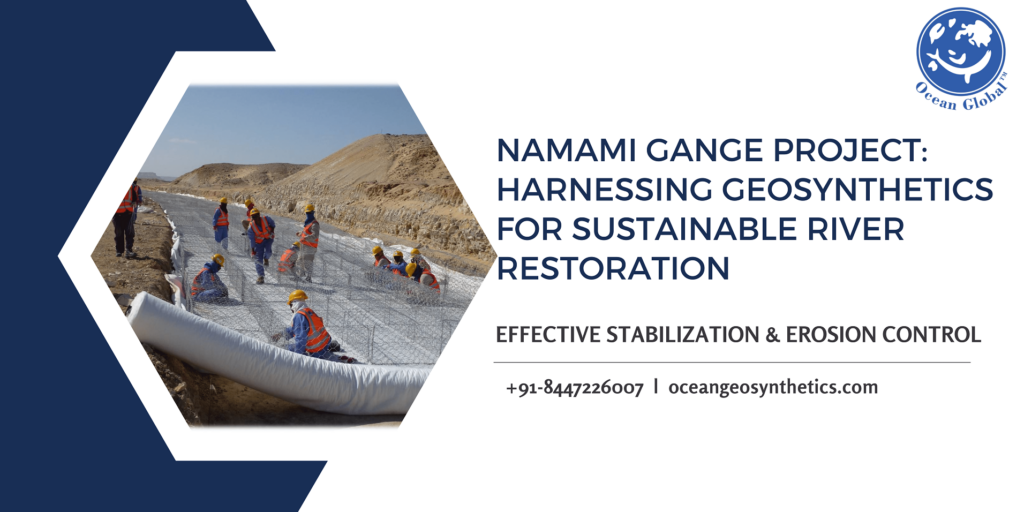
For a Namami Gange riverbank protection project at Mirzapur, Uttar Pradesh, Ocean Non Wovens Pvt Ltd supplied 520 Nos Gabion Boxes (Double Twisted Wire Mesh) to protect the banks of the Ganga against erosion.
About the programme
The Government of India launched Namami Gange in 2014 to reduce pollution in the Ganga and rejuvenate the river basin. Alongside sewage treatment and riverfront development, the programme includes works for riverbank protection, erosion control and channel stabilization, where geosynthetics and gabions offer economical alternatives to concrete.
Project details
- Location: Mirzapur, Uttar Pradesh
- Programme: Namami Gange
- Application: Riverbank protection against erosion
- Product: Gabion Box (Double Twisted Wire Mesh)
- Quantity: 520 Nos
The Ganga at Mirzapur carries high monsoon flows that scour unprotected banks. The project needed bank protection that would hold up to that flow over the long term.
How a gabion box protects a riverbank
A Gabion Box (Double Twisted Wire Mesh) is a rectangular cage of hexagonal, double-twisted steel wire mesh, filled on site with stones. Boxes are laced together into a continuous wall or revetment along the bank. Double twisting means a broken wire does not unravel the whole mesh. In India this mesh is specified under IS 16014 (mechanically woven, double-twisted hexagonal wire mesh gabions, revet mattresses and rockfall netting).
The weight of the stone fill resists the hydraulic forces that cause erosion. Because the structure is porous, water drains through it freely, so pressure does not build up behind the wall, and because it is flexible, it settles with the bank instead of cracking like rigid concrete. Over time, silt collects in the voids and vegetation can establish, which helps the revetment blend into the bank.
The open stone fill does not retain fine soil by itself. A nonwoven geotextile filter is normally placed between the bank soil and the gabions so that water can drain out while the soil stays in place behind the structure.
Outcome
The 520 Nos Gabion Boxes supplied by Ocean Non Wovens Pvt Ltd reinforced the riverbanks along the Mirzapur stretch of the Ganga, giving the project a long-lasting bank protection solution.
FAQs
Why are gabion boxes used for riverbank protection?
Gabion boxes combine weight, flexibility and permeability. The stone fill resists hydraulic forces, the mesh lets the structure settle without cracking, and water drains freely through it. Vegetation can establish in the voids over time.
Can gabion boxes be made to suit different project requirements?
Yes. Gabion boxes are made in a range of sizes, mesh openings and wire coatings (galvanised or PVC-coated), and can be filled with locally available stone, so they can be matched to the site and design.
Are gabion boxes a cost-effective solution?
Often, yes. They can be filled with locally sourced stone, need little specialised equipment to install, and need little maintenance, which keeps the overall cost of riverbank protection and erosion control low.
Learn more about the Namami Gange Project, browse Ocean’s case studies, or contact us to discuss gabions and geosynthetics for your river protection project.

source on Google
 Geo-Tubes as Sea Walls to check Coastal Erosion in Andhra Pradesh
 Oil Pit Containment System
 Blanket Hydro Ceiling In Terrain Area – Nagaland Case Study
