Case Study: Strengthening Pollution Control and Waste Management Infrastructure with Ocean HDPE Liner 1500 Micron in Sundergarh, Odisha
For a Pollution Control and Waste Management Project in Sundergarh, Odisha, Ocean Non Wovens supplied 960 SQM of Ocean HDPE Liner 1500 Micron. The liner’s job is to keep liquids generated inside the facility from reaching the surrounding soil and groundwater.
This case study covers what the 1500 micron liner does in a containment system, why the thickness suits this kind of work, and the installation and quality-control steps that decide whether a geomembrane actually holds.
Project overview
- Project Name: Pollution Control and Waste Management Project
- Location: Sundergarh, Odisha
- Product Used: Ocean HDPE Liner 1500 Micron
- Quantity Supplied: 960 SQM
- Application: Pollution control and waste management containment
The geomembrane was supplied as a low-permeability barrier within the project’s containment infrastructure. The waste characteristics, containment geometry, subgrade conditions and design configuration are project-specific and are not described here, so this case study does not assume a particular waste stream or installation arrangement. It explains the engineering role a liner of this kind plays.
Why waste facilities need a liner
Waste management facilities generate contaminated liquid in several ways. Rain infiltrates stored waste, decomposition releases liquid, and industrial or municipal waste streams carry moisture and dissolved contaminants. Left uncontrolled, that liquid moves down through the soil and can reach groundwater or neighbouring land.
The International Geosynthetics Society (IGS) describes geomembranes as low-permeability barriers used to control fluid migration, and its landfill guidance treats them as one part of an engineered containment system that also uses geotextiles and drainage materials. A geomembrane replaces reliance on natural soil with a barrier whose properties can be specified, tested, inspected and documented.
What an HDPE geomembrane is
HDPE stands for high density polyethylene. An HDPE geomembrane is a manufactured polymer sheet that acts as a barrier to liquid and, in some systems, gas. A geotextile is different: it is permeable and is used for filtration, separation, drainage, reinforcement or protection. The geomembrane provides the barrier.
The 1500 micron liner supplied for Sundergarh has a nominal thickness of 1.5 mm. Thickness is one part of performance, and it matters because the sheet has to survive handling, installation stresses, contact with the surfaces around it and environmental exposure. HDPE geomembranes for containment are commonly specified against GRI-GM13, which sets minimum properties including density, tensile behaviour, tear and puncture resistance, carbon black content and stress crack resistance.
Why 1500 micron suits containment
No single thickness suits every project. The right choice depends on the application, loading, subgrade, chemical environment, exposure, protection layers and design life. For waste and pollution control work, 1.5 mm is a common specification because a thicker sheet resists puncture and handling damage better than the thin liners used in less demanding applications. During construction and operation the liner takes stress from material placement, foot traffic, equipment, uneven surfaces, settlement and contact with adjacent layers.
Thickness does not replace good engineering. A 1.5 mm geomembrane laid on a badly prepared subgrade can still be punctured, and a well-made sheet can still leak through a poorly welded seam or because the drainage and protection layers were designed wrongly.
How the liner controls pollution
Without a barrier, rainwater and liquid generated within the waste move downward through pores and pathways in the soil, at a rate that depends on soil permeability, moisture, hydraulic gradient and the liquid itself. A geomembrane largely closes that pathway. Liquid stays in a defined containment zone where it can be collected, treated or removed. The IGS lists preventing infiltration, controlling seepage loss, protecting groundwater and isolating contaminated soil among the main uses of geosynthetic barriers.
The rest of the containment system
The liner works with other layers. A typical waste containment system can include:
- The geomembrane, as the primary low-permeability barrier
- A geotextile for cushioning and puncture protection
- A drainage layer to collect and carry liquid
- Other components for reinforcement, filtration or additional containment, depending on the design
The IGS notes that geotextiles serve as cushion layers protecting geomembranes from puncture and as filters within leachate collection systems. A heavy non-woven geotextile placed over or under the liner spreads point loads from angular stones or drainage aggregate so they do not concentrate on the sheet. How the 960 SQM liner at Sundergarh performs depends on how it interacts with these layers.
Subgrade preparation
Sharp stones, roots, construction debris and abrupt changes in level all concentrate stress beneath the liner. A small stone can look harmless during deployment, but once fill or waste is placed above, the load presses the sheet against it and can deform or puncture it over time. The surface should be graded, compacted where the design requires it, and cleared of damaging objects before any panel is unrolled. Experienced installers treat subgrade inspection as a quality-control step, with sign-off before deployment.
Installation issues to plan for
Handling large sheets
Geomembrane panels are large and catch the wind during deployment. Poor handling causes folds, damage or uncontrolled movement, so panels are usually ballasted with sandbags as they are laid.
Temperature
HDPE expands and contracts noticeably with temperature. A liner laid in the heat of the day behaves differently from one laid in the cool of the morning, so panel layout and seaming have to allow for thermal movement. Too little slack leads to bridging at corners and toes when the sheet contracts; too much leaves wrinkles.
Clean seam surfaces
Dust, moisture and mud interfere with welding. Seam areas have to be kept clean and dry.
Equipment movement
Vehicles and machinery must be kept off exposed geomembrane, or confined to protected routes, until the cover layers are in place.
Sequencing
Liner installation has to be coordinated with earthwork, drainage, protective layers and the construction that follows. A sound installation can still be damaged by a later activity.
Seam welding
The sheet is manufactured continuous, but a containment area of any size needs panels joined on site, and those field seams are where most leaks start. HDPE is joined by thermal methods: hot wedge welding for long straight seams, usually as a double-track weld with an air channel between the tracks, and extrusion welding for patches, corners and details. ASTM D6392 covers destructive testing of thermo-fusion seams made by both methods.
Good seams need correct equipment settings, suitable weather, trained welders, trial seams at the start of each session, and systematic inspection.
Quality control and seam testing
Quality assurance starts before installation with material documentation showing that the supplied product meets the specification. During installation, field staff monitor panel placement, overlaps, welding conditions and visible defects.
Seams are then tested. ASTM D6392 sets out peel and shear tests on seam samples cut from the work. Non-destructive tests run along the full seam length: air-pressure testing of the channel in double-track wedge welds, and vacuum-box testing of extrusion welds (ASTM D5641). Electrical leak location surveys can find holes in the sheet itself. The liner is complete only when seams, penetrations, edges and repairs have been inspected and accepted under the project quality plan.
Anchorage and edge details
Thermal movement, wind and water pressure can all shift a geomembrane, so its edges need an anchorage detail. An anchor trench at the crest is a common choice, though the right detail depends on the design. Transitions between the liner and other construction elements concentrate stress, and in a waste facility the details around drainage structures, pipe penetrations, corners and slopes need particular care.
Durability and chemical resistance
A pollution-control liner is expected to perform for many years. Its life depends on oxidation, UV exposure where the sheet is left uncovered, chemical interaction, mechanical stress and environmental stress cracking. The Geosynthetic Institute publishes guidance and test methods on HDPE geomembrane properties, stress cracking, seam performance, lifetime prediction and field integrity. The IGS has published work on assessing HDPE service life, noting that exposed HDPE degrades by oxidation. Covering the liner with soil, protection layers or waste slows that degradation considerably.
HDPE resists a wide range of chemicals, which is why it is used in waste containment, but chemical resistance has limits. Compatibility should be checked against the actual liquid or waste stream, since pH, temperature, concentration and exposure time vary between industrial facilities. That check is part of the design for any project like Sundergarh.
Maintenance after installation
A liner reduces leakage risk but does not remove the need for monitoring. Typical maintenance includes:
- Visual inspection of exposed areas
- Checking drainage systems
- Monitoring settlement
- Inspecting accessible edges and penetrations
- Repairing any damage found during operation
Once the geomembrane is covered by waste or protective material, direct inspection becomes difficult, so defects are cheapest to find and repair before the facility goes into operation.
Cost over the life of the facility
A cheaper containment material can cost more over time if it needs frequent repair, leaks contaminated liquid, or creates environmental liability. Remediating contaminated soil or groundwater generally costs far more than containing the liquid in the first place, which is why lining decisions for waste facilities are best judged over the facility’s life.
Lessons for similar projects
The Sundergarh supply illustrates principles that apply to waste management facilities across India:
- Containment is a system, not a single product.
- Installation quality matters as much as geomembrane quality.
- Seam testing and quality assurance are engineering work, not paperwork.
- Long-term performance is decided before the first panel is deployed: subgrade preparation, material selection, panel layout, drainage planning, anchorage and protection.
Other uses of HDPE liners
The same barrier is used wherever fluid migration has to be controlled, including:
- Landfill containment
- Leachate ponds
- Wastewater treatment facilities
- Industrial effluent ponds
- Mining containment
- Ash ponds
- Oil and gas secondary containment
- Water reservoirs
- Irrigation ponds
- Aquaculture ponds
- Canal lining
- Stormwater retention systems
The IGS lists landfill sealing, irrigation canals, pond sealing, mining barriers, structural waterproofing and secondary containment among the established uses of geosynthetic barriers.
Ocean Non Wovens HDPE liners
Ocean Non Wovens supplies HDPE geomembranes for pollution control, waste management, landfill containment, industrial, water management, aquaculture and irrigation projects across India. For details on available thicknesses, see HDPE sheets and, for cushion layers, non-woven geotextiles.
Related: HDPE geomembranes · 1500 micron HDPE liner at Avaragolla solid waste project

source on Google
 Geo-Tubes as Sea Walls to check Coastal Erosion in Andhra Pradesh
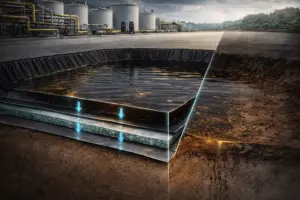 Oil Pit Containment System
 Blanket Hydro Ceiling In Terrain Area – Nagaland Case Study