Oil Pit Containment System
Agartala, Tripura
Project overview
Project Name: Oil Pit Project
Location: Agartala, Tripura
Products Used:
- Ocean HDPE Liner 1000 Micron (20,100 SQM)
- Ocean HDPE Liner 1500 Micron (960 SQM)
An oil pit has one job: keep hydrocarbons out of the soil and groundwater beneath it. At this project in Agartala, the containment was built with Ocean HDPE geomembrane in two thicknesses: 20,100 SQM of 1000 micron (1.0 mm) liner as the primary barrier across the pits, and 960 SQM of 1500 micron (1.5 mm) liner as a second, heavier layer in the critical zones. Doubling up where the risk is highest gives a backup barrier if the primary layer is damaged.
Why HDPE for oil containment
HDPE geomembranes are the usual choice for containment because they combine very low permeability, broad chemical resistance and good durability. Koerner (Designing with Geosynthetics) gives equivalent permeability values for HDPE as low as 10⁻¹⁴ m/s, several orders of magnitude below a compacted clay liner (typically specified at 10⁻⁹ m/s).
In an oil pit the liner:
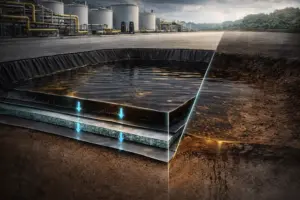
- Primary Barrier System: stops hydrocarbons seeping directly into the soil.
- Secondary Containment Layer: provides backup protection if the primary layer fails.
- Environmental Protection: protects groundwater and the surrounding land.
- Base Isolation Layer: keeps stored fluids from reacting with the subgrade soil.
HDPE resists most crude oils, fuels and produced water well. Some aromatic hydrocarbons and solvents can swell polyethylene, so where the stored fluid is unusual, a chemical compatibility test (immersion to ASTM D5322 and EPA Method 9090, then retesting properties) settles the question before the liner is specified.
Other layers in a containment system
A geomembrane rarely works alone. Geotextiles are placed above or below the liner as a cushion against puncture and to allow controlled drainage. Drainage geocomposites between two liners collect any leakage so it can be detected. Geosynthetic clay liners are sometimes added beneath the geomembrane as a further barrier. Which of these a pit needs depends on the fluid, the subgrade and the regulator.
Site challenges in Agartala
- High rainfall and surface water: Agartala receives over 2,000 mm of rain a year, most of it in the monsoon. Rainwater collecting in the pits raises the hydraulic load on the liner and the risk of overflow.
- Soil permeability: local soils often include permeable, loose strata, so any leak would let contaminants migrate quickly.
- Chemical exposure: the pits hold hydrocarbons, petroleum derivatives and industrial chemicals, which call for a liner with high chemical resistance and long-term stability.
- Temperature variation: HDPE expands and contracts with temperature, which stresses seams and anchorages. Liners are usually laid with some slack and seamed at moderate temperatures to allow for this.
Installation and quality control
A geomembrane is only as good as its installation and seams.
- Subgrade preparation: sharp stones and debris removed, uniform compaction, and falls set for drainage.
- Liner placement: the 1000 micron primary liner laid across the pits, with the 1500 micron liner added in critical zones, following the containment design and drainage layout.
- Seaming: panels joined by wedge (fusion) welding, with extrusion welding for patches and details. Seams checked non-destructively by air pressure testing of dual-track wedge welds and vacuum box testing of extrusion welds, with continuous inspection of seam integrity.
- Leak detection: a monitoring layer between liners to locate potential seepage points and catch failures early.
- Protection: cushioning geotextiles where required, controlled placement of backfill or protective layers, and care to avoid mechanical damage during construction.
One bad weld or an unnoticed puncture can let the whole pit leak, so seam testing and inspection carry as much weight as the material grade. Air channel testing follows ASTM D5820 and vacuum box testing ASTM D5641; destructive seam samples are tested for shear and peel to ASTM D6392.
Long-term performance
HDPE liners suit oil containment because they keep their low permeability, chemical resistance and puncture resistance over long periods. Service life depends mainly on exposure: a liner kept covered ages far more slowly than one left in sunlight, and the GRI’s lifetime studies (GRI White Paper 6) estimate covered HDPE geomembranes lasting many decades longer than exposed ones. For the owner, a sound liner means lower risk of soil and groundwater contamination, fewer remediation and clean-up costs, and an easier path to environmental compliance.
Ocean Non Wovens manufactures and supplies HDPE geomembranes and other geosynthetics for infrastructure and environmental protection projects across India, with on-site execution support for containment work from oil pits to large industrial sites.

source on Google
 Role of Geosynthetics in Tunnel Engineering
 Role of Geobags and Gabions in Flood Protection
 Oil Pit Containment System