Pond Liners

A pond liner is an impermeable geomembrane laid over a prepared earth pond to stop water seeping into the ground. Ocean Geosynthetics manufactures UV-stabilised HDPE pond liners in a range of thicknesses and colours, and supplies EPDM and PVC liners and the non-woven geotextile underlay that goes beneath them. We work with farmers, fish and shrimp farmers, industrial plants and contractors as pond liner manufacturers and suppliers in India.
Table of Contents
What a pond liner does
Pond liners hold water or other liquids that unlined soil would lose to seepage. They line reservoirs, farm ponds, fish ponds, artificial streams, retention basins and effluent lagoons. In sandy or fractured ground an unlined pond loses water fast; a welded geomembrane cuts seepage to a small fraction and keeps contaminated liquids out of the groundwater.
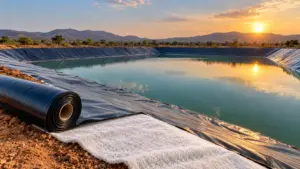
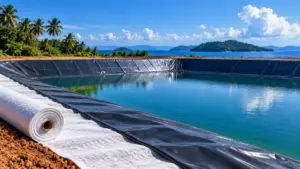
Most pond liners are polymer geomembranes. Black HDPE is the most widely used for fish ponds and reservoirs because it is UV-stabilised with carbon black, resists chemicals and can be welded on site into a continuous sheet. A geotextile underlay under the liner protects it from sharp stones, plant roots and other puncture risks in the subgrade. For a comparison of options, see pond liner materials and choosing an Ocean pond liner.
Function of HDPE pond liners
Retention, containment and collection of water and liquid effluent.
Sectors
Aquaculture, agriculture, industrial effluent and artificial water bodies.
Pond liner materials compared
| Material | Character | Typical use |
|---|---|---|
| HDPE geomembrane | Stiff, high chemical and UV resistance, welded seams. Density 0.940 g/cm³ or more. | Fish and shrimp ponds, reservoirs, canals, ETP lagoons, industrial containment |
| LLDPE geomembrane | More flexible, better at following uneven ground and settlement | Ponds with irregular shapes or soft ground, floating covers |
| EPDM rubber | Very flexible and easy to fold around features; seams are taped or glued, not welded | Ornamental and garden ponds, small water features |
| PVC | Flexible and easy to fabricate into large panels; plasticisers can migrate out with long UV exposure | Decorative ponds and covered linings |
| Laminated woven HDPE (to IS 15351) | Woven fabric coated on both faces; light and low cost | Farm ponds, water harvesting tanks, temporary storage |
Smooth HDPE geomembranes for lining are specified in India under IS 16352 and internationally under GRI-GM13, which sets minimum values for density, tensile properties, tear and puncture resistance, carbon black content and oxidative durability by thickness.
Properties of HDPE pond liners
- Low permeability: an intact HDPE geomembrane is several orders of magnitude less permeable than a compacted clay liner, and it does not crack when it dries out the way clay does.
- UV stabilised: 2–3% carbon black protects exposed liners on pond side slopes.
- Tear and puncture resistance: rises with thickness; a geotextile underlay adds protection on stony ground.
- Chemical resistance: handles acidic and alkaline effluent, fertiliser-rich water and most industrial liquids.
- Flexible and light compared with concrete: rolls are large and quick to deploy, and the liner tolerates minor settlement that would crack a rigid lining.
- Cost: usually cheaper and faster than concrete or a hauled clay liner. See what a pond liner costs.
How to choose liner thickness
Liner thickness is quoted in microns or millimetres (500 micron = 0.5 mm, 1000 micron = 1 mm). Thicker sheets resist puncture and tearing better and last longer when exposed, but cost more per square metre. Typical starting points:
| Application | Typical HDPE thickness | Notes |
|---|---|---|
| Small farm ponds and water harvesting | 300–500 micron | Covered or low-head ponds on well-prepared ground |
| Fish and shrimp ponds | 500–1000 micron | Side slopes exposed to sun and regular cleaning |
| Reservoirs and canals | 750–1500 micron | Higher head, larger panels, longer design life |
| ETP lagoons, industrial and biomedical waste yards | 1500 micron and above | Check chemical compatibility and any pollution control board requirement |
Move up a grade if the subgrade is stony, the water is deep, the liner stays exposed, or animals and machinery will work on the pond. The project designer or the state pollution control board specification, where one applies, overrides these ranges. Send us the pond size and use and we will recommend a thickness.
Applications
- Fish farming and aquamarine lining for fish, algae and shrimp culture
- Agricultural farm ponds and irrigation storage
- Rainwater harvesting and raw water storage reservoirs
- Canal lining, alone or beneath concrete lining panels
- Ornamental lakes and landscape water bodies
- Liners for effluent treatment plants
- Industrial geomembrane lining to prevent soil pollution
- Biomedical waste dump yards
- Floating geomembrane covers, which block sunlight to limit algae growth and cut evaporation on storage ponds
Installation basics
- Prepare the subgrade: compact it, trim side slopes to the design angle, and remove stones, roots and sharp debris. Lay a non-woven geotextile where the soil is stony.
- Anchor the edges: dig an anchor trench around the crest, set back from the edge, and backfill it over the liner.
- Deploy and weld: unroll panels down the slopes with the overlap the welding method needs, then join them with hot-wedge (fusion) welding, using extrusion welding for patches and pipe boots.
- Test the seams: double-track wedge welds are checked by air pressure in the channel, and extrusion welds by vacuum box. Repair and retest any failure.
- Allow for temperature: HDPE expands and contracts with temperature, so leave some slack and avoid welding in the hottest part of the day.
- Protect: keep vehicles off the bare liner, and fill the pond or ballast the liner before strong winds can lift it.
More on site practice: tips for installing a geotextile and liner.
Related products
- HDPE sheets for heavier containment
- Non-woven geotextile underlay and protection layer
- Geosynthetic clay liners as a secondary barrier
- Biofloc tanks for intensive aquaculture
Frequently asked questions
Which pond liner is used for fish farming?
Black UV-stabilised HDPE is the usual choice for commercial fish and shrimp ponds because it is chemically inert, can be welded into one sheet and withstands sun on the side slopes. Thickness is typically 500–1000 micron depending on pond size and how the pond is cleaned.
How long does an HDPE pond liner last?
Service life depends on thickness, exposure, temperature and installation quality. A buried or water-covered liner lasts much longer than one left exposed to sunlight on the slopes, and thicker sheets last longer when exposed. Seams welded and tested properly matter as much as the sheet.
Do I need a geotextile under the pond liner?
Yes, wherever the subgrade has stones, gravel or roots. A non-woven geotextile spreads point loads and stops puncture. On fine, well-compacted soil free of stones, it may be omitted for thinner farm ponds.
HDPE or LDPE pond liner: which is better?
HDPE has higher chemical and UV resistance and strength, so it suits permanent ponds and effluent. LDPE and LLDPE are more flexible and follow uneven ground better. See LDPE sheets.
How is a pond liner priced?
By material, thickness and area, plus welding, geotextile underlay and delivery. Liner area is larger than the water surface because it covers the side slopes and anchor trench. Read pond liner cost or ask for a quote.


Related Case Studies
Case Studies, HDPE Liners, Pond liner