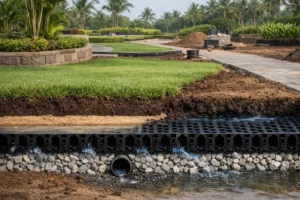
Dimple Drain Board

A dimple drain board (also sold as a drainage board or protection board) is a moulded high-density polyethylene (HDPE) sheet covered in regularly spaced studs, or dimples. Ocean Geosynthetics supplies dimple drain boards laminated with a non-woven geotextile for basement walls, retaining walls, green roofs, podiums and landscaped decks.
The dimples hold the sheet off the surface behind it and leave a continuous open space for water to run down to a drain. They also give the board its compressive strength, so it keeps its thickness under backfill or a soil-and-paving build-up and continues to carry water.
How a dimple drain board works
Each board does three jobs at once:
- Drainage: water entering from the soil side flows through the gaps between the dimples, in any direction across the sheet, and is collected by a perimeter drain pipe at the footing or by roof outlets. The board works laid horizontally or fixed vertically.
- Filtration: Ocean laminates each unit with a non-woven geotextile by thermal bonding. The fabric stops soil from entering and blocking the water channels while letting water pass freely into the drain core.
- Protection: the HDPE sheet shields the waterproofing membrane on a basement wall or roof slab from damage by backfill stones and compaction equipment.
By relieving water pressure against a below-ground wall, the board reduces the hydrostatic head the waterproofing has to resist. That is why drainage boards are normally used together with, not instead of, a waterproofing membrane.
Applications
- Foundation and basement waterproofing: drainage and protection over the membrane on the outside of basement and lift-pit walls.
- Retaining wall drainage: a continuous drain behind the wall in place of, or in addition to, a graded stone filter, connected to weep holes or a toe drain.
- Green roof and plaza deck drainage: under soil, planters and paving on roof slabs, podiums and terraces, carrying water to outlets so the growing medium does not waterlog.
- Landscaping and garden drainage: planters, courtyards and landscaped areas over structures.
- Pavement and roadway drainage: edge and sub-surface drainage where a thin drainage layer is needed.
Material properties
HDPE resists chemical deterioration, does not rot, and is not damaged by insects or rodents, so the board keeps working in wet, buried conditions. The values that matter when comparing boards are:
| Property | Typical test method | Why it matters |
|---|---|---|
| Dimple (stud) height | Measured | Sets the flow space; taller dimples carry more water. |
| Compressive strength | ASTM D1621 or EN ISO 25619-2 | Load the board takes before the dimples collapse; must exceed backfill or deck loads. |
| In-plane flow capacity | ASTM D4716 or EN ISO 12958 | Water carried per metre width at a given pressure and gradient. |
| Geotextile AOS and permittivity | ASTM D4751, ASTM D4491 | Soil retention and water entry through the filter fabric. |
Manufacturers quote compressive strength and flow by different test methods and conditions, so compare boards on the same standard. Ask us for the data sheet of the grade you are considering.
How to choose a board
- Load: deep basements, vehicle-loaded podiums and heavy green roofs need a higher compressive strength than a garden planter.
- Water volume: high groundwater, large roof catchments or long drainage paths call for taller dimples and higher flow capacity.
- Soil type: fine silty or clayey backfill needs the geotextile-laminated board so fines cannot clog the core.
Installation basics
- On walls, place the dimples against the waterproofed wall and the geotextile facing the backfill. Fix along the top edge only, above finished ground level, with a termination strip, so fixings do not pierce the membrane below ground.
- Overlap adjacent boards so the dimples interlock, and lap the geotextile flap over the joint so soil cannot enter.
- Run the board down to a perforated drain pipe at the footing, wrapped in geotextile and bedded in gravel, with an outlet to a sump or storm drain.
- On roofs and decks, lay the board over the protected waterproofing, fall it to the outlets, and cover with filter fabric and growing medium or the paving bed.
- Backfill in layers and compact carefully against the board; do not drop large stones onto it.
Related products
- Drain cells for modular roof and podium drainage
- Drainage geocomposites for landfills and large civil drains
- Waterproofing sheets for the membrane behind the board
Frequently asked questions
Which way do the dimples face?
On a basement or retaining wall, the dimples face the wall and the geotextile faces the soil. Water passes through the fabric and runs down the channels behind it to the footing drain.
Is a dimple board a waterproofing membrane?
No. It drains water away and protects the membrane, which lowers the water pressure on the wall. The waterproofing itself is a separate membrane or coating.
Why is the board laminated with geotextile?
Without a filter, soil fines wash into the channels and block them. The thermally bonded non-woven geotextile retains the soil while letting water through.
Can it be used on a green roof?
Yes. Laid over the protected roof waterproofing, it carries surplus water to the outlets so the growing medium stays drained, and it protects the membrane from mechanical damage. A separate root barrier is still needed where the waterproofing is not root resistant.
Contact us with your wall depth or roof build-up and we will recommend a board grade.


Related Case Studies