Geonet
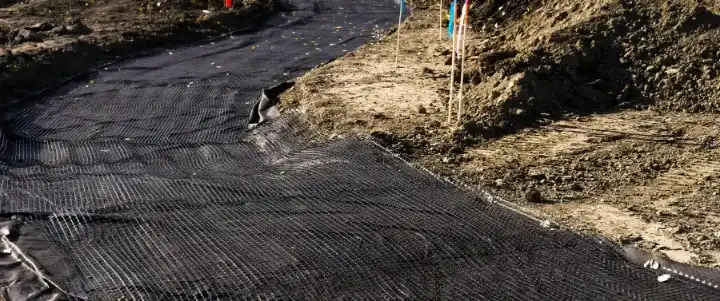
A geonet is a drainage layer made of extruded HDPE (high-density polyethylene) ribs. Ocean Geosynthetics supplies HDPE geonets for leachate collection, leak detection and gas venting in landfills, ponds and mining containment, and the same nets bonded to geotextile as drainage geocomposites. Tell us the required flow rate, normal load and application and we will propose a matching product.
Table of Contents
What is a geonet?
A geonet is made of integrally connected parallel sets of ribs overlying similar sets at a fixed angle, which forms a sheet with regular apertures. Because the two rib layers sit one above the other, the sheet has thickness (typically around 4–8 mm) and open channels run through its plane. Liquids and gases flow along those channels, sideways within the layer, rather than through it.
Most geonets are biplanar (two sets of ribs). Triplanar geonets add a third set of thicker, parallel ribs that act as defined flow channels and hold their shape better under high load. The HDPE resin density sets the stiffness: higher-density nets are more rigid and resist compression better.
The key design property is in-plane flow, reported as transmissivity or flow rate per unit width at a given normal load and hydraulic gradient. A geonet that flattens under the weight of waste or fill loses that flow, so compression behaviour matters as much as the initial value.
Geonet vs drainage geocomposite
A bare geonet is only the HDPE net. When a non-woven geotextile is heat-bonded to one or both faces, the product becomes a drainage geocomposite. The geotextile acts as a filter and stops soil or waste intruding into the channels.
- Bare geonet: used where both faces are against a geomembrane or other non-soil surface, for example the leak detection layer between the primary and secondary liners of a double-lined landfill or pond.
- Geocomposite (single-sided): geotextile on the soil side, bare net against a geomembrane.
- Geocomposite (double-sided): geotextile on both faces where soil or waste contacts the drain on both sides, such as cap drainage under cover soil.
Function
Liquid collection and drainage, gas collection and discharge, and leak detection. Geonets are used in ponds, mining and landfills.
Key properties and test methods
| Property | Test method | Why it matters |
|---|---|---|
| Transmissivity / in-plane flow rate | ASTM D4716 | Drainage capacity under a specified load and gradient; the main design value. |
| Thickness | ASTM D5199 | Channel height available for flow. |
| Resin density | ASTM D1505 / D792 | HDPE is 0.94 g/cm³ or higher; higher density gives a stiffer net. |
| Carbon black content | ASTM D4218 | UV and long-term oxidation resistance. |
| Tensile strength | ASTM D7179 | Handling and deployment on slopes. Geonets are not reinforcement. |
| Compression behaviour | ASTM D6364 | How much thickness is lost under load. |
| Ply adhesion (geocomposites) | ASTM D7005 | Bond between geotextile and net. |
Other properties that follow from the material:
- Much stiffer in compression than a thick geotextile, so the drainage path stays open under load.
- HDPE resists leachate, acids, alkalis and the chemically aggressive conditions found in landfills and mine tailings, and contact with bitumen, concrete, soil and water solutions.
- Does not rot and is not affected by biological attack, though the drainage path can still clog with biological growth or fines if it is not filtered.
Applications
- Landfill leachate collection: above the base liner and on side slopes, often as a geocomposite in place of or alongside a gravel layer.
- Leak detection: between primary and secondary geomembranes in landfills and ponds, so any leak through the top liner drains to a monitored sump.
- Landfill caps: surface water drainage above the cap geomembrane, which keeps the cover soil from saturating and sliding.
- Gas collection and venting: methane venting under landfill caps and gas relief under pond liners, where trapped gas would otherwise lift the geomembrane.
- Mining: drainage and leak detection in heap leach pads and tailings or process ponds.
- Structures (as geocomposite): drainage behind retaining walls, in tunnels, beneath sports fields and buildings, and in seeping rock slopes.
Geonets are sometimes confused with other mesh products. Slope erosion control and turf reinforcement use erosion control mats, loose boulders on slopes and rail cuttings need rockfall protection mesh, and road reinforcement uses geogrids. A drainage geonet does none of those jobs.
How to choose a geonet
- Required flow: calculate the design inflow (leachate generation, rainfall infiltration through a cap, or leak rate) and slope.
- Normal load: base layers under tall waste cells see far higher loads than caps. Ask for transmissivity measured at your design load and gradient, between the same boundary materials (geomembrane, soil, geotextile) you will use.
- Reduction factors: laboratory flow is reduced for creep, intrusion of the geotextile into the channels, and chemical and biological clogging (GRI-GC8 sets out the method). Specify on the long-term allowable value, not the index value.
- Bare net or geocomposite: use a bare net only where neither face touches soil or waste.
- Interface friction: on side slopes, the shear strength between the geonet or geocomposite and the geomembrane (ASTM D5321) controls stability and must be checked in design.
Installation basics
- Unroll down the slope, never across it, so flow runs along the roll and panels hang from the anchor trench at the crest.
- Overlap adjacent rolls and tie them with plastic cable ties at the spacing in the CQA plan. Metal ties can puncture the geomembrane and are not used.
- For geocomposites, overlap the net and heat-bond or sew the upper geotextile so soil cannot enter at the joint.
- Keep vehicles off the drainage layer and place the cover soil or drainage aggregate from the toe upwards with low-ground-pressure equipment.
Related products
- Drainage geocomposites: geonet with bonded geotextile filter.
- HDPE geomembranes: the primary and secondary liners a geonet sits between.
- Geosynthetic clay liners: used under the geomembrane in composite liners.
- Dimple drain board: for basement walls, green roofs and building drainage.
Frequently asked questions
What is a geonet made of?
Extruded high-density polyethylene (HDPE) with carbon black for UV and oxidation resistance. The ribs are formed in one piece, not welded or knitted together.
Is a geonet the same as a geocomposite?
No. A geonet is the bare HDPE net. With a geotextile bonded to one or both faces it becomes a drainage geocomposite.
What is the difference between biplanar and triplanar geonet?
A biplanar geonet has two crossing sets of ribs. A triplanar geonet has a third set of parallel ribs that form straight flow channels and keep more of their flow capacity under high loads, such as the base of deep landfill cells.
Can a geonet replace a gravel drainage layer?
It can where the design shows equivalent long-term flow after reduction factors and the regulator’s specification allows it. It saves thickness and haulage of aggregate, and is common in caps and side slopes where gravel is hard to place.
What should a geonet data sheet show?
Thickness, resin density, carbon black content, tensile strength, and transmissivity at stated loads, gradients and boundary conditions (ASTM D4716). For geocomposites, also ply adhesion and the geotextile properties.


Related Case Studies
