Ocean Non Woven Geotextiles for a Truck Terminal Project in Trichy
Project overview
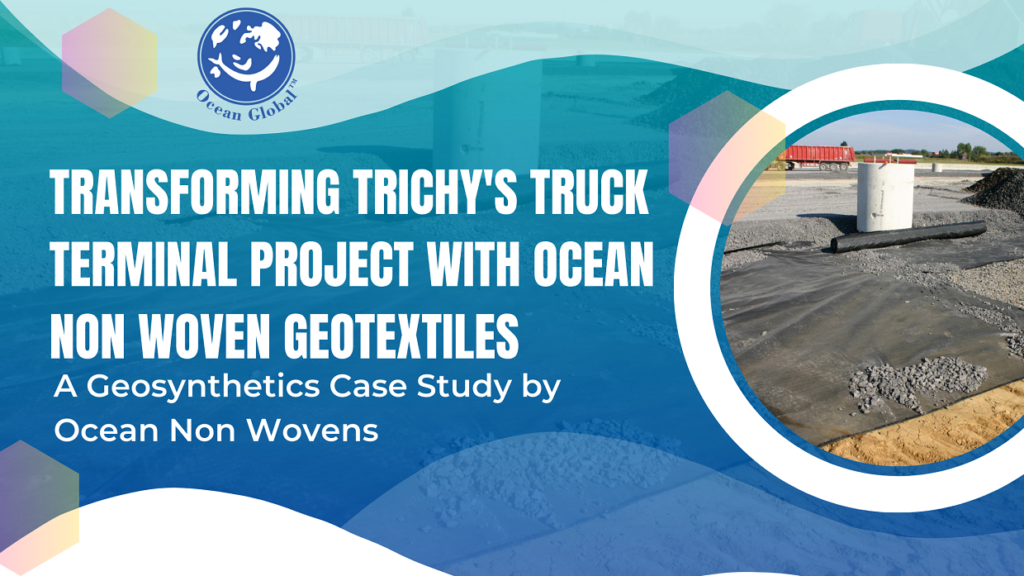
The Truck Terminal Project in Trichy (Tiruchirappalli), Tamil Nadu used 46,000 square metres of Ocean Non Woven Geotextiles as a separation layer under its parking areas and roads. The terminal was rebuilt to meet growing demand from the region’s logistics sector, with large truck parking areas, internal roads and drainage. Ocean Non Wovens worked with the contractors and engineers to supply the geotextile for these pavements.
A truck terminal carries some of the heaviest and most repetitive wheel loads of any pavement: loaded trucks turning, braking and standing in the same spots every day. If the granular base sinks into the soil beneath, the surface ruts, potholes form and water ponds.
What the geotextile does
Across the 46,000 square metres, the Ocean Non Woven Geotextiles were laid between the subgrade and the granular material. In that position the fabric does two jobs:
- Separation: it stops the aggregate being pushed down into the subgrade and stops subgrade fines pumping up into the aggregate under traffic. The base keeps its full thickness and strength, so it goes on spreading wheel loads over the subgrade as designed.
- Filtration and drainage: water can pass through the non-woven fabric, so the base can drain, while soil particles are held back.
Keeping the base clean and intact this way protects the load-bearing capacity of the pavement and extends its life. Separation geotextiles under granular layers are covered in India by IRC:SP:59, the Indian Roads Congress guidelines on geosynthetics in road pavements.
Installation basics
- Grade and compact the subgrade, removing sharp stones and roots.
- Unroll the geotextile flat, without wrinkles, overlapping adjacent rolls; softer subgrades need wider overlaps.
- Tip aggregate onto already-placed material and spread it forward, so trucks never drive directly on the fabric.
- Compact the granular layer in lifts to the specified density.
Frequently asked questions
What properties matter in a non-woven geotextile for a truck terminal?
The fabric has to survive installation under aggregate and trucks, so grab tensile strength (ASTM D4632), CBR puncture resistance (ASTM D6241) and trapezoid tear (ASTM D4533) matter most. For filtration, the apparent opening size (ASTM D4751) has to suit the subgrade soil, and permittivity (ASTM D4491) has to let water through. Ocean Non Woven Geotextiles are tested for durability, drainage and resistance to chemical and biological degradation.
How do non-woven geotextiles reduce environmental impact?
By keeping the base layer clean, a separation geotextile can reduce the aggregate thickness or the depth of soft soil that has to be excavated and replaced, which cuts quarrying, haulage and excavation. A pavement that does not rut also needs less repair over its life.
Where does the geotextile go in a truck terminal pavement?
Directly on the prepared subgrade, beneath the first granular layer (granular sub-base or WMM). It must sit between the soil and the aggregate to separate them.
Ocean Non Wovens manufactures and supplies non-woven geotextiles and other geosynthetics for roads, terminals and industrial pavements. Contact the team to discuss your project, or see more case studies.
Ocean Non Wovens Pvt. Ltd
Manufacturer, Supplier & Exporter of Geomembranes & Geosynthetics
RR-24, 2nd floor, Rohtak Rd, Mianwali Nagar, New Delhi, 110087
Tel: +91 8447226007 | Email: sales@oceangeosynthetics.com

source on Google
 How geomembranes can be used for rainwater harvesting?
 Slope and Drainage Protection Using GCCM in Jaipur, Rajasthan
 A Comprehensive Guide on What is Jute Geotextile
