How Ocean Non-Wovens Biaxial Geogrid helped ensure the success of a construction project in Bhubaneswar, Odisha

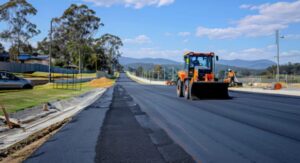
Ocean Non Wovens supplied Biaxial Geogrid for the construction of a new road in Bhubaneswar, Odisha. The soil along the alignment is prone to erosion, and without proper stabilisation there was a real risk of the road failing. The geogrid was used to stabilise the soil under the road and help prevent erosion.
The project
Bhubaneswar sits largely on lateritic ground. Laterite forms a reasonable crust when undisturbed, but once excavated and reworked its finer fractions wash out easily in heavy monsoon rain, and a soaked subgrade loses bearing capacity. A road built over that kind of ground ruts and breaks up unless its base is held together.
Ocean Non Wovens’ Biaxial Geogrid was chosen for the job. It is made of high-strength polyester fibres woven into a grid with uniform openings and similar strength in both directions.
How a biaxial geogrid works under a road
Laid at the base of the granular layer, or between subgrade and sub-base, the geogrid’s apertures interlock with the aggregate. The grid stops stones moving sideways under wheel loads (lateral restraint), so the layer behaves as a stiffer mat and spreads each load over a wider area of subgrade. The result is less rutting and less settlement, and the base aggregate is held in place rather than working loose and washing out. Because it carries tension in both the longitudinal and transverse directions, a biaxial grid suits road bases where loads come from any direction.
Indian guidance on geogrids in pavements is given in IRC:SP:59 (geosynthetics in road pavements). Geogrid tensile strength is measured to ASTM D6637 or ISO 10319 and quoted in kN/m for each direction.
The results
With the geogrid in place, the new road in Bhubaneswar is stable and resistant to erosion, and it is expected to give a long service life.
Benefits of biaxial geogrid
- Tensile reinforcement in both directions
- Load distribution over weak or erodible subgrade
- Reduced settlement and rutting
- Durability: polymer grids resist rot and soil chemicals when buried
Frequently asked questions
What is a biaxial geogrid?
A geosynthetic grid with roughly equal tensile strength in both directions, made from polymers such as polyester or polypropylene. Its open apertures interlock with soil or aggregate to reinforce it. The grid used in Bhubaneswar is made of high-strength polyester fibres woven into a grid pattern.
Where is a biaxial geogrid placed in a road?
Usually at the subgrade and sub-base interface or within the granular base. On very soft or fine-grained subgrades it is often paired with a non-woven geotextile separator so fines do not pump up into the aggregate.
Does a geogrid improve drainage?
Not directly. A geogrid is open and does not filter or carry water. Drainage comes from the granular layer and any geotextile or geocomposite used with it.
Where can I learn more about biaxial geogrid?
See the biaxial geogrid product page, more road projects in our case studies, or contact Ocean Non Wovens directly.
Ocean Non Wovens manufactures geosynthetics used to improve soil performance, prevent erosion and reinforce roads, bridge approaches and other structures.

source on Google
 Case Study: Enhancing Road Infrastructure with Ocean Geocomposite 710 GSM for NHAI in Balaghat, MP
 Landfill Project at Karnataka – Case Study